
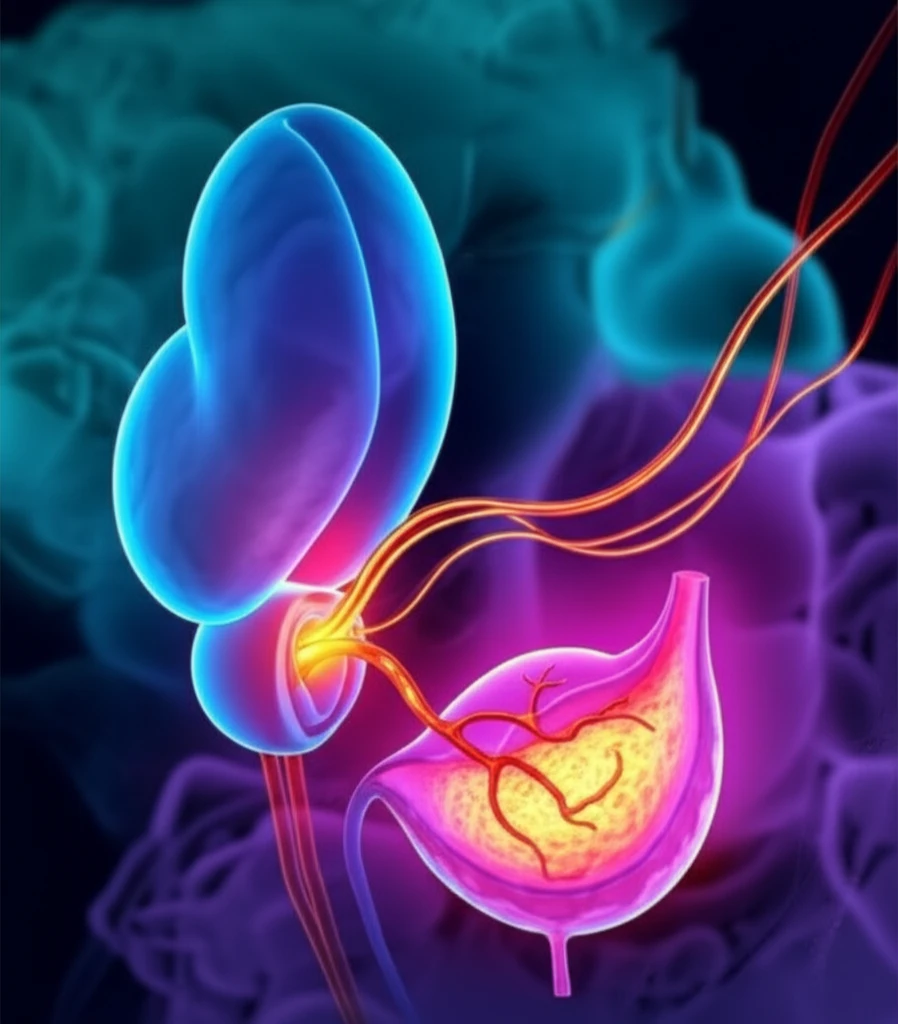
Illustration of the connection between prostate inflammation and bladder overactivity.

Decoding Bladder Overactivity: The Prostate-Bladder Connection

"Uncover the surprising link between prostate inflammation and bladder dysfunction, and what it means for your urinary health."


For men, the health of the prostate gland is often linked to urinary function. Benign prostatic hyperplasia (BPH), a common condition as men age, is known to cause lower urinary tract symptoms (LUTS). But what exactly is the connection between an inflamed prostate and an overactive bladder? Recent studies are shedding light on the intricate relationship, revealing how inflammation in the prostate can trigger a cascade of events that lead to bladder dysfunction.

Researchers have been diligently working to unravel the mysteries of this connection, aiming to find more effective treatments for the bothersome symptoms that affect millions of men worldwide. By understanding the molecular mechanisms at play, scientists hope to develop targeted therapies that can alleviate bladder overactivity and improve the quality of life for those living with BPH and related conditions.

This article delves into the groundbreaking research presented at a recent urology conference, exploring how prostatic inflammation can directly impact bladder function. We will examine the specific changes that occur in the bladder and nervous system, and discuss the potential for new treatment strategies based on these findings. Get ready to uncover the hidden links between prostate health and bladder control.

Prostate Inflammation: The Domino Effect on Your Bladder

Illustration of the connection between prostate inflammation and bladder overactivity.

A study presented at a urology conference investigated the effects of prostatic inflammation on bladder function in rats. The researchers induced prostatic inflammation using formalin injections and then monitored bladder activity using cystometry, a technique for measuring bladder pressure and volume. The results revealed a significant decrease in the intervals between bladder contractions in the rats with prostatic inflammation, indicating bladder overactivity.

But the changes didn't stop there. The researchers also examined bladder tissues and found elevated levels of prostaglandin E2 (PGE2), an inflammatory molecule. Furthermore, they observed increased protein levels of TRPV1 and EP4 receptors, which are involved in pain and inflammation signaling, as well as elevated mRNA levels of ASICs, BDNF, and NGF – all key players in nerve growth and bladder function.

  • TRPV1 and EP4 Receptors: Heightened levels contribute to increased bladder sensitivity and urgency.
  • ASICs (Acid-Sensing Ion Channels): Play a role in bladder sensation and the urge to urinate.
  • BDNF (Brain-Derived Neurotrophic Factor) and NGF (Nerve Growth Factor): Promote nerve growth and survival, potentially leading to increased bladder innervation and activity.
These findings suggest that prostatic inflammation triggers a series of molecular changes in the bladder, ultimately leading to bladder overactivity. The inflammatory molecules and nerve growth factors released in response to prostate inflammation appear to sensitize the bladder and increase its excitability, resulting in more frequent and urgent urination.

A Path Forward: Targeting Inflammation for Bladder Relief

The research highlights the crucial role of inflammation in the development of bladder overactivity associated with prostatic inflammation. These findings open the door for new treatment strategies aimed at reducing inflammation and modulating the activity of the nerve pathways involved. By targeting the specific molecules and receptors identified in this study, researchers hope to develop more effective therapies for bladder overactivity and improve the quality of life for men struggling with these bothersome symptoms.

About this Article -

This article was crafted using a human-AI hybrid and collaborative approach. AI assisted our team with initial drafting, research insights, identifying key questions, and image generation. Our human editors guided topic selection, defined the angle, structured the content, ensured factual accuracy and relevance, refined the tone, and conducted thorough editing to deliver helpful, high-quality information.See our About page for more information.

Everything You Need To Know

1

What is the connection between the prostate and bladder dysfunction?

The connection lies in the inflammation of the prostate gland. This inflammation can trigger a cascade of events, leading to bladder dysfunction. Studies show that prostatic inflammation can lead to bladder overactivity, resulting in more frequent and urgent urination. The research presented at a urology conference revealed a direct impact of prostatic inflammation on bladder function.

2

How does prostatic inflammation lead to bladder overactivity at a molecular level?

Prostatic inflammation triggers a series of molecular changes in the bladder. These include elevated levels of prostaglandin E2 (PGE2), an inflammatory molecule, increased protein levels of TRPV1 and EP4 receptors, which are involved in pain and inflammation signaling, and elevated mRNA levels of ASICs, BDNF, and NGF. These changes sensitize the bladder and increase its excitability, resulting in more frequent and urgent urination. Specifically, TRPV1 and EP4 receptors increase bladder sensitivity and urgency, ASICs play a role in bladder sensation and the urge to urinate, and BDNF and NGF promote nerve growth, potentially leading to increased bladder innervation and activity.

3

What are the implications of the study results presented at the urology conference?

The study's results open the door for new treatment strategies aimed at reducing inflammation and modulating the activity of the nerve pathways involved. By targeting the specific molecules and receptors identified in this study, such as TRPV1, EP4, ASICs, BDNF, and NGF, researchers hope to develop more effective therapies for bladder overactivity and improve the quality of life for men struggling with these bothersome symptoms. The study showed that prostatic inflammation significantly decreases the intervals between bladder contractions.

4

What role do TRPV1 and EP4 receptors play in the prostate-bladder connection?

Heightened levels of TRPV1 and EP4 receptors, observed in studies involving prostatic inflammation, contribute to increased bladder sensitivity and urgency. These receptors are involved in pain and inflammation signaling. The increase in their levels due to prostatic inflammation is a key factor in the development of bladder overactivity and the associated symptoms.

5

How was bladder activity measured in the study on prostate inflammation?

Bladder activity was monitored using cystometry, a technique for measuring bladder pressure and volume. The researchers induced prostatic inflammation using formalin injections in rats. The results revealed a significant decrease in the intervals between bladder contractions in the rats with prostatic inflammation, indicating bladder overactivity.

Newsletter Subscribe

Subscribe to get the latest articles and insights directly in your inbox.