
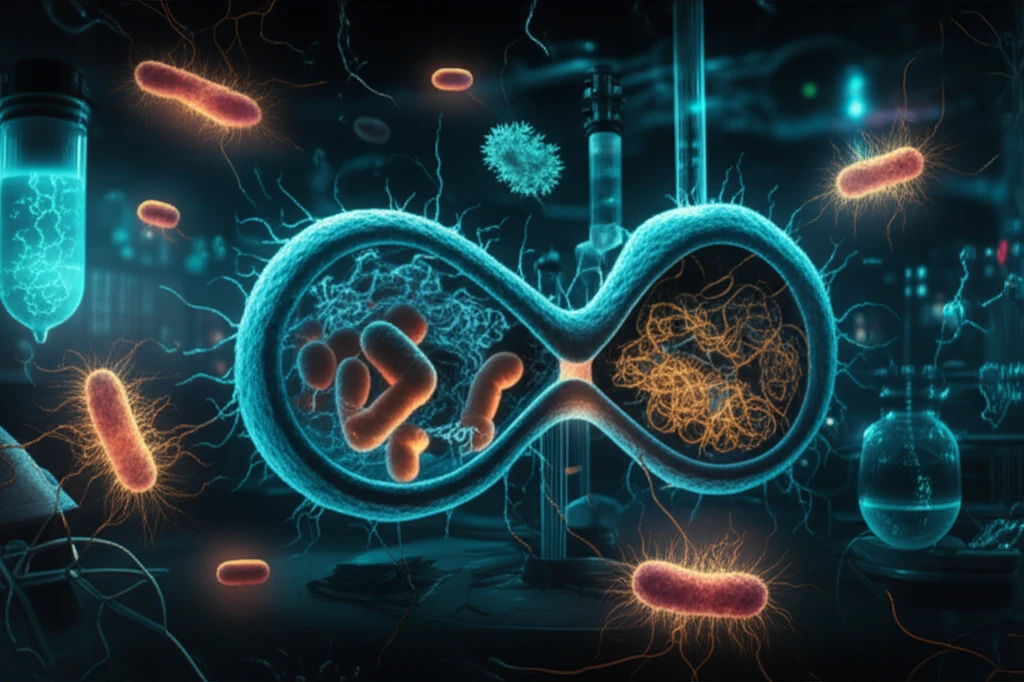
Illustration of bacteria dividing with glowing protein structures.

Decoding Bacteria's Battle Plan: How Cell Division Research Could Combat Superbugs

"Unlocking the secrets of bacterial cytokinesis to develop innovative antimicrobial strategies."


In an era where antibiotic resistance poses a significant threat to global health, the urgency to discover new therapeutic strategies is greater than ever. Pathogenic bacteria are increasingly evolving to resist existing antibiotics, leading to difficult-to-treat infections and highlighting the need for innovative approaches.

One promising avenue of research focuses on bacterial cell division, a fundamental process essential for bacterial survival. Understanding the intricate mechanisms that govern cell division in bacteria could reveal novel targets for antimicrobial development. By disrupting cell division, we can potentially halt bacterial growth and propagation, offering a powerful tool against drug-resistant strains.

This article delves into a groundbreaking study that investigates the cell division process in Corynebacterium, a genus of bacteria with significant medical and biotechnological relevance. By examining the protein-protein interactions and molecular docking of key proteins involved in cell division, this research sheds light on potential vulnerabilities that could be exploited for therapeutic intervention.

Why Bacterial Cell Division Matters: Targeting Cytokinesis

Illustration of bacteria dividing with glowing protein structures.

Bacterial cell division, also known as divisome, is orchestrated by a complex macromolecular machinery involving a series of specific and conserved proteins. This intricate process ensures the accurate replication and segregation of genetic material, leading to the formation of two identical daughter cells. Disrupting this process can prevent bacteria from multiplying.

The protein FtsZ, a tubulin homolog, plays a central role in initiating cell division. It polymerizes to form a Z-ring at the division site, serving as a scaffold for the recruitment of other essential cell division proteins. These proteins then work together to constrict the cell membrane and synthesize new cell wall material, ultimately leading to cell separation.

Other key proteins in this process include:
  • SepF: This protein interacts with FtsZ and is crucial for cell division, especially in bacteria lacking certain other division proteins.
  • FtsA and ZipA: These proteins help anchor the FtsZ ring to the cell membrane, initiating the division process.
  • Additional Divisome Components: FtsK, FtsX, FtsB, FtsI, FtsQ, and FtsW, each playing vital roles in the later stages of cell division.
The study emphasizes the interaction between SepF and FtsZ, revealing a potential therapeutic target. Molecular docking and protein-protein interaction analyses suggest that disrupting the SepF-FtsZ interaction could effectively inhibit cell division. Gene expression analysis further supports this idea, showing that these genes are often transcribed together, indicating a coordinated role in cell division.

Future Directions: From Research to Real-World Solutions

This research provides a foundation for developing novel antimicrobial agents that target bacterial cell division. By focusing on essential protein interactions like SepF-FtsZ, scientists can design drugs that specifically disrupt cytokinesis, potentially overcoming the limitations of traditional antibiotics. Further studies, including in vitro and in vivo analyses, are needed to validate these findings and translate them into effective therapeutic strategies. Addressing antibiotic resistance requires multifaceted approaches, and targeting bacterial cell division represents a promising new frontier in the fight against superbugs.

About this Article -

This article was crafted using a human-AI hybrid and collaborative approach. AI assisted our team with initial drafting, research insights, identifying key questions, and image generation. Our human editors guided topic selection, defined the angle, structured the content, ensured factual accuracy and relevance, refined the tone, and conducted thorough editing to deliver helpful, high-quality information.See our About page for more information.

Everything You Need To Know

1

What is bacterial cell division, and why is it important in the context of combating superbugs?

Bacterial cell division, also known as cytokinesis, is a fundamental process where a single bacterial cell divides into two identical daughter cells. This process is essential for bacterial survival and propagation. In the fight against superbugs, understanding and disrupting bacterial cell division offers a promising therapeutic strategy. By targeting key proteins and processes involved in cell division, researchers aim to halt bacterial growth, preventing the spread of drug-resistant infections. This approach is particularly crucial in an era where antibiotic resistance is escalating, rendering existing treatments ineffective against many pathogenic bacteria.

2

What role does FtsZ play in bacterial cell division, and how does it contribute to the overall process?

FtsZ is a crucial protein in bacterial cell division, acting as a tubulin homolog. It initiates the division process by polymerizing to form a Z-ring at the division site. This Z-ring serves as a scaffold, recruiting other essential cell division proteins. These proteins, including SepF, FtsA, and ZipA, then work together to constrict the cell membrane and synthesize new cell wall material, ultimately leading to cell separation and the creation of two daughter cells. Disrupting the formation or function of the FtsZ ring can effectively halt cell division, making it a promising target for antimicrobial interventions.

3

Besides FtsZ, what other key proteins are involved in bacterial cell division, and what are their specific roles?

Besides FtsZ, several other proteins play essential roles in bacterial cell division. SepF interacts with FtsZ and is critical for cell division, particularly in bacteria lacking certain other division proteins. FtsA and ZipA help anchor the FtsZ ring to the cell membrane, initiating the division process. Additional components like FtsK, FtsX, FtsB, FtsI, FtsQ, and FtsW each have vital roles in the later stages of cell division, contributing to the constriction of the cell membrane and the synthesis of new cell wall material. Each protein's specific function is crucial for the overall success of the division process.

4

How can research on the SepF-FtsZ interaction lead to the development of new antimicrobial agents?

The interaction between SepF and FtsZ presents a promising target for developing novel antimicrobial agents. Studies using molecular docking and protein-protein interaction analyses suggest that disrupting the SepF-FtsZ interaction could effectively inhibit cell division. By designing drugs that specifically target this interaction, scientists aim to prevent the Z-ring from forming correctly or functioning effectively, thus halting bacterial growth. Gene expression analysis supports this idea, highlighting the coordinated role of these proteins in cell division, reinforcing their potential as therapeutic targets. This approach offers a potential solution to combat antibiotic-resistant bacteria.

5

What are the next steps in translating research on bacterial cell division into real-world solutions for treating infections?

The next steps involve further studies, including in vitro and in vivo analyses, to validate the findings and translate them into effective therapeutic strategies. Researchers need to conduct more detailed experiments to confirm that disrupting the SepF-FtsZ interaction, or targeting other key proteins, can effectively inhibit bacterial cell division in various bacterial strains. This will involve designing and testing new antimicrobial agents that specifically target these interactions. Additionally, understanding the mechanisms of resistance and exploring combination therapies could further enhance the effectiveness of these new treatments, leading to real-world solutions for infections and improved patient outcomes.

Newsletter Subscribe

Subscribe to get the latest articles and insights directly in your inbox.