
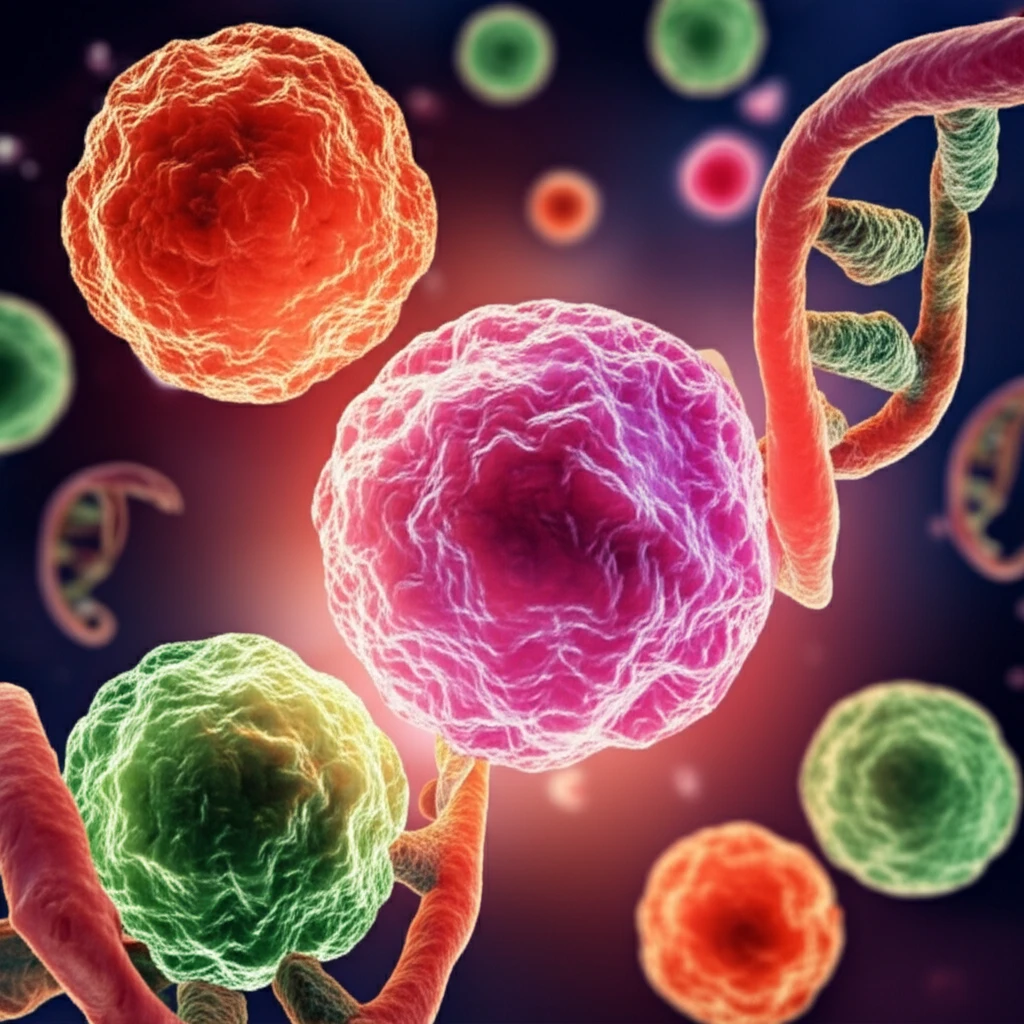
Microscopic view of leukemia cells intertwined with DNA

Decoding AML: How Advanced Genetic Testing is Changing Leukemia Care

"A comprehensive look at copy number abnormalities and loss-of-heterozygosity and how they're revolutionizing acute myeloid leukemia diagnosis and treatment."


Acute myeloid leukemia (AML) is a complex group of blood cancers affecting myeloid precursor cells. Diagnosing AML accurately and predicting its course requires a multifaceted approach, combining traditional methods with cutting-edge genetic analysis. Key to this is identifying structural genomic abnormalities which include balanced chromosomal rearrangements as well as copy number variations.

Traditionally, karyotype analysis has been the standard for detecting these abnormalities. However, it has limitations in resolution and success rate. Furthermore, examination for possible copy-neutral loss-of-heterozygosity (CN-LOH) in leukemia cells is at present not routinely performed in the clinical setting. Chromosomal microarray (CMA) analysis is a widely available assay for CNAs and CN-LOH in diagnostic laboratories, but there are currently no guidelines how to best incorporate this technology into clinical testing algorithms for neoplastic diseases including AML.

This article explores how advanced genetic testing, particularly chromosomal microarray analysis (CMA), is transforming AML diagnosis and treatment. We'll break down complex concepts like copy number abnormalities (CNAs) and copy-neutral loss-of-heterozygosity (CN-LOH), and show how they provide critical insights for personalized medicine.

What are CNAs and CN-LOH, and Why Do They Matter in AML?

Microscopic view of leukemia cells intertwined with DNA

In AML, structural genomic abnormalities play a vital role, influencing how the disease develops and responds to treatment. These include:

Copy Number Abnormalities (CNAs): These are gains or losses of DNA segments. Certain CNAs are linked to specific AML subtypes and impact prognosis.

  • Deletions: Loss of genetic material, such as the deletion of 5q or 7q, which often indicates a poorer prognosis.
  • Duplications or Amplifications: Extra copies of certain genes, like FLT3, that can drive uncontrolled cell growth.
Copy-Neutral Loss-of-Heterozygosity (CN-LOH): This occurs when a segment of DNA is inherited from only one parent, resulting in a loss of genetic diversity without a change in the number of copies of that DNA. CN-LOH can reveal duplicated mutations in genes that promote cancer.

The Future of AML Diagnostics: Personalized Treatment Through Advanced Testing

CMA is not the only tool being used in AML diagnostics. NGS-based approaches for genome-wide evaluation for CNAs and CN-LOH are also becoming feasible in the future.

As our understanding of AML genetics deepens, advanced testing methods like CMA will play an increasingly crucial role. By identifying specific CNAs and CN-LOH, doctors can better:

<ul><li>Refine risk stratification</li><li>Predict treatment response</li><li>Personalize therapy</li><li>Ultimately, improve outcomes for people living with AML</li></ul>

About this Article -

This article was crafted using a human-AI hybrid and collaborative approach. AI assisted our team with initial drafting, research insights, identifying key questions, and image generation. Our human editors guided topic selection, defined the angle, structured the content, ensured factual accuracy and relevance, refined the tone, and conducted thorough editing to deliver helpful, high-quality information.See our About page for more information.

This article is based on research published under:

DOI-LINK: 10.1016/j.cancergen.2018.07.005, Alternate LINK

Title: Assessing Copy Number Abnormalities And Copy-Neutral Loss-Of-Heterozygosity Across The Genome As Best Practice In Diagnostic Evaluation Of Acute Myeloid Leukemia: An Evidence-Based Review From The Cancer Genomics Consortium (Cgc) Myeloid Neoplasms Working Group

Subject: Cancer Research

Journal: Cancer Genetics

Publisher: Elsevier BV

Authors: Xinjie Xu, Christine Bryke, Madina Sukhanova, Emma Huxley, D.P. Dash, Amanda Dixon-Mciver, Min Fang, Patricia T. Griepp, Jennelle C. Hodge, Anwar Iqbal, Sally Jeffries, Rashmi Kanagal-Shamanna, Fabiola Quintero-Rivera, Shashi Shetty, Marilyn L. Slovak, Ashwini Yenamandra, Patrick A. Lennon, Gordana Raca

Published: 2018-12-01

Everything You Need To Know

1

What is Acute Myeloid Leukemia (AML)?

Acute myeloid leukemia (AML) is a type of blood cancer that affects myeloid precursor cells. Diagnosing AML accurately requires a comprehensive approach. It involves identifying structural genomic abnormalities, which include balanced chromosomal rearrangements and copy number variations. These abnormalities are key to understanding the disease's behavior and determining the best course of treatment.

2

What are Copy Number Abnormalities (CNAs) and Copy-Neutral Loss-of-Heterozygosity (CN-LOH)?

Copy number abnormalities (CNAs) are gains or losses of DNA segments. For instance, deletions like 5q or 7q often signal a poorer prognosis in AML. Conversely, duplications or amplifications, such as those involving the FLT3 gene, can fuel uncontrolled cell growth. Copy-neutral loss-of-heterozygosity (CN-LOH) occurs when a DNA segment is inherited from only one parent, leading to a loss of genetic diversity without altering the number of DNA copies. CN-LOH can uncover duplicated mutations in genes that promote cancer.

3

What is Chromosomal Microarray Analysis (CMA), and how is it used?

Chromosomal microarray analysis (CMA) is a widely available assay used to detect copy number abnormalities (CNAs) and copy-neutral loss-of-heterozygosity (CN-LOH) in diagnostic laboratories. It offers higher resolution and success rates compared to traditional karyotype analysis. Although CMA is an important tool, there are currently no set guidelines on how best to integrate this technology into clinical testing algorithms for conditions like acute myeloid leukemia (AML).

4

Why are Copy Number Abnormalities (CNAs) and Copy-Neutral Loss-of-Heterozygosity (CN-LOH) important?

CNAs and CN-LOH are significant in AML because they provide crucial insights into the disease's behavior and potential response to treatment. Specific CNAs are linked to particular AML subtypes and impact prognosis. Knowing these abnormalities allows for a more accurate risk assessment, enabling healthcare providers to tailor treatment plans based on the unique genetic profile of the patient’s cancer. This leads to more personalized and effective care.

5

What are the future prospects for AML diagnosis and treatment?

The future of AML diagnostics includes the use of advanced genetic testing like chromosomal microarray analysis (CMA) and next-generation sequencing (NGS). NGS-based methods are becoming more feasible for genome-wide evaluation of CNAs and CN-LOH. These advancements aim to refine AML diagnosis, risk assessment, and treatment, offering a more personalized approach to managing the disease.

Newsletter Subscribe

Subscribe to get the latest articles and insights directly in your inbox.