
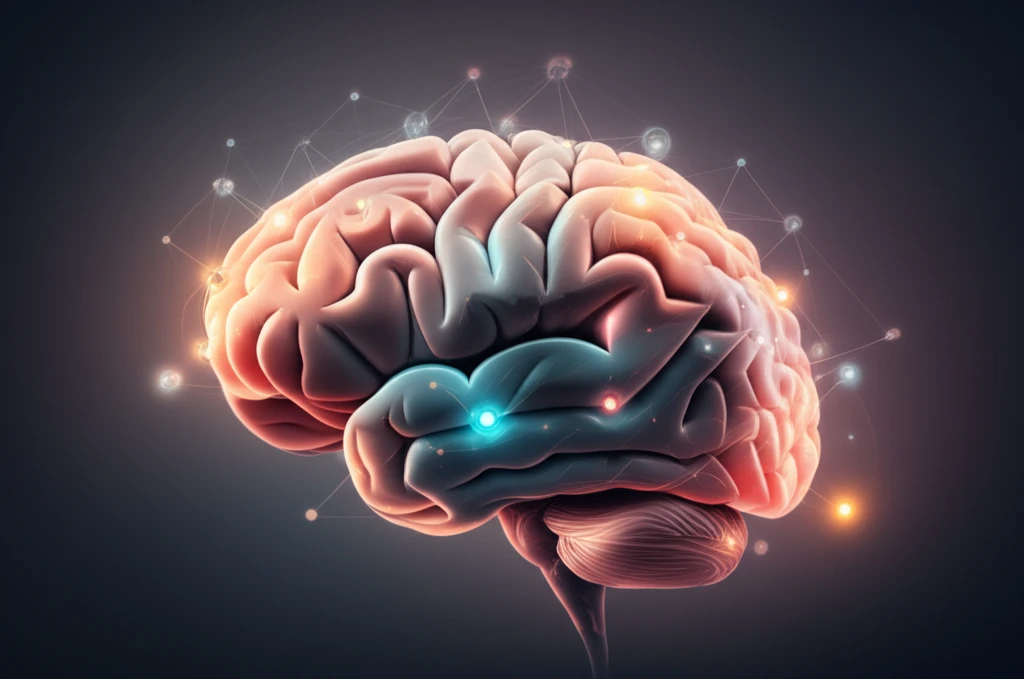
Brain with interconnected nodes, some dim, representing alexithymia

Decoding Alexithymia: How Your Brain Processes Feelings (or Doesn't)

"New research illuminates the specific brain regions linked to difficulty identifying and describing emotions, offering potential pathways for understanding and addressing this complex personality trait."


We've all experienced moments where emotions feel overwhelming and hard to articulate. But for some, this is a constant state. Alexithymia, derived from the Greek words meaning "no words for feelings," is a personality trait that makes it difficult for individuals to recognize, understand, and describe their own emotions and those of others. It's more than just being introverted or private; it's a fundamental challenge in processing the internal world of feelings.

While not a disorder itself, alexithymia is linked to a range of mental health challenges, including depression, anxiety, substance abuse, and even somatic illnesses like hypertension and diabetes. Understanding the neurological underpinnings of alexithymia is crucial for developing effective strategies to support those affected.

Recent research published in General Psychiatry sheds new light on the brain regions associated with alexithymia. By examining the regional homogeneity (ReHo) of intrinsic brain activity in individuals with varying degrees of alexithymia, the study pinpoints specific areas that may contribute to the core difficulties in emotional processing.

Unpacking the Three Dimensions of Alexithymia and Their Neural Connections

Brain with interconnected nodes, some dim, representing alexithymia

The study, led by researchers at Hangzhou Normal University, recruited university freshmen, categorizing them based on their scores on the Toronto Alexithymia Scale (TAS-20). This widely used assessment tool measures three key dimensions of alexithymia:

Participants underwent resting-state functional MRI (rs-fMRI) scans, a technique that measures brain activity while the individual is at rest. This allows researchers to examine the intrinsic connectivity and synchronization of different brain regions without the influence of specific tasks or stimuli.

  • Difficulty Identifying Feelings (DIF): The ability to recognize and distinguish between different emotions.
  • Difficulty Describing Feelings (DDF): The capacity to articulate and express emotions verbally.
  • Externally Oriented Thinking (EOT): A cognitive style focused on external events and details rather than internal thoughts and feelings.
The researchers then analyzed the ReHo, which reflects the similarity of brain activity within a given region, and correlated it with the TAS-20 scores. This approach allowed them to identify specific brain regions where activity patterns were associated with each of the three alexithymia dimensions.

Implications and Future Directions: Toward a More Emotionally Aware Future

This research provides valuable insights into the neural basis of alexithymia, highlighting the crucial roles of the insula, lingual gyrus, precentral gyrus, postcentral gyrus, and right dorsomedial prefrontal cortex (DMPFC_R) in emotional processing.

Specifically, the study found that activity in the insula was positively associated with the difficulty in identifying feelings (DIF), while activity in the lingual gyrus, precentral gyrus, and postcentral gyrus was linked to the difficulty in describing feelings (DDF). Conversely, activity in the right DMPFC was negatively correlated with externally oriented thinking (EOT).

While this study offers a significant step forward, further research is needed to fully understand the complex interplay of these brain regions and their contribution to alexithymia. Future studies with larger sample sizes and diverse populations are essential to confirm these findings and explore potential interventions to improve emotional awareness and expression in individuals with alexithymia.

About this Article -

This article was crafted using a human-AI hybrid and collaborative approach. AI assisted our team with initial drafting, research insights, identifying key questions, and image generation. Our human editors guided topic selection, defined the angle, structured the content, ensured factual accuracy and relevance, refined the tone, and conducted thorough editing to deliver helpful, high-quality information.See our About page for more information.

This article is based on research published under:

DOI-LINK: 10.1136/gpsych-2018-000003, Alternate LINK

Title: Regional Homogeneity Of Intrinsic Brain Activity Related To The Main Alexithymia Dimensions

Subject: Psychiatry and Mental health

Journal: General Psychiatry

Publisher: BMJ

Authors: Han Dai, Li Mei, Mei Minjun, Sun Xiaofei

Published: 2018-09-01

Everything You Need To Know

1

What is alexithymia?

Alexithymia is a personality trait where individuals struggle to identify, understand, and describe their own emotions and those of others. It's a fundamental difficulty in processing feelings, not just being introverted. People may have challenges recognizing what they feel and expressing those feelings to others.

2

How is alexithymia related to mental health?

While not a mental disorder in itself, alexithymia is linked to various mental health conditions such as depression, anxiety, and substance abuse, and even physical conditions like hypertension and diabetes. Addressing alexithymia could be an important piece in treating these related conditions. For example, someone with depression might find it harder to address the emotional components of their depression if they struggle to identify those emotions in the first place.

3

What is the Toronto Alexithymia Scale (TAS-20)?

The Toronto Alexithymia Scale (TAS-20) is a tool used to assess the level of alexithymia in an individual. It measures three dimensions: Difficulty Identifying Feelings (DIF), which is the ability to recognize different emotions; Difficulty Describing Feelings (DDF), which is the capacity to articulate emotions verbally; and Externally Oriented Thinking (EOT), which is a cognitive style focused on external events rather than internal feelings.

4

What is resting-state functional MRI (rs-fMRI) and how is it used in studying alexithymia?

Resting-state functional MRI (rs-fMRI) is a neuroimaging technique used to measure brain activity while a person is at rest. It allows researchers to examine the intrinsic connectivity and synchronization of different brain regions without the influence of specific tasks. In the context of alexithymia research, rs-fMRI helps identify brain regions where activity patterns correlate with difficulties in emotional processing.

5

What specific brain regions are implicated in alexithymia and what does that mean?

Research indicates several brain regions play a crucial role in emotional processing for those with alexithymia. These include the insula, lingual gyrus, precentral gyrus, postcentral gyrus, and right dorsomedial prefrontal cortex (DMPFC_R). These areas contribute to the ability to recognize, process, and respond to emotions, and understanding their function could lead to better strategies for supporting individuals with alexithymia. Future research could explore targeted interventions aimed at improving the function of these specific brain regions.

Newsletter Subscribe

Subscribe to get the latest articles and insights directly in your inbox.