
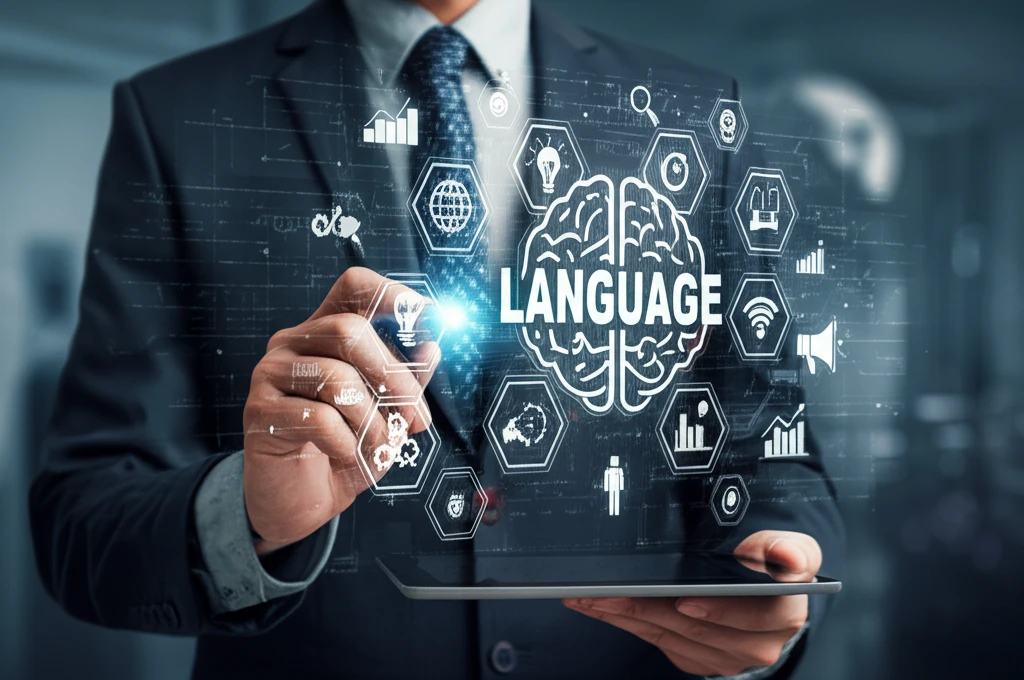
AI transforming business with advanced language models

Decoding AI: How Large Language Models Are Transforming Business

"Uncover the potential of Large Language Models (LLMs) to revolutionize business models and strategies, driving innovation and efficiency."


Large Language Models (LLMs) are heralding a new era of business innovation, bringing unprecedented capabilities to industries worldwide. These advanced AI systems, trained on vast amounts of textual data, are not just technological marvels but powerful tools capable of reshaping business models and driving strategic growth.

The potential economic impact of LLMs is staggering. According to a McKinsey & Company study from October 26, 2023, generative AI could inject between $2.6 to $4.4 trillion annually into the global economy. This impact could double if LLMs are seamlessly integrated into existing software, enhancing everything from customer interactions to software engineering.

As LLMs become more accessible and sophisticated, businesses are presented with opportunities to automate tasks, improve decision-making, and create entirely new value propositions. However, realizing these benefits requires a strategic approach to LLM implementation, focusing on alignment with business goals and a deep understanding of the transformative potential.

The LLM Revolution: Four Key Areas of Business Transformation

AI transforming business with advanced language models

Research indicates that LLMs are driving business transformation across four major archetypes, each offering unique opportunities for innovation and competitive advantage. These include creating new customer benefits, establishing new sales and communication channels, increasing business process automation, and improving the use of information resources.

Let’s explore each archetype in detail:

  • New Customer Benefits: LLMs are enabling personalized customer experiences through personal assistance, coaching, content generation, and speech interaction.
  • New Sales and Communication Channels: LLMs facilitate presales automation and customer service automation, enhancing customer engagement.
  • Increased Business Process Automation: LLMs streamline operations by automating front office processes, back office tasks, and software development.
  • Improved Use of Information Resources: LLMs enhance information access and extraction, turning vast amounts of data into actionable insights.
Understanding how LLMs impact these areas is critical for businesses looking to leverage AI for strategic advantage.

Embracing the Future with LLMs

As LLMs continue to evolve, their impact on business will only deepen. Companies that strategically embrace these technologies, focusing on alignment with business goals and a deep understanding of the transformative potential, will be best positioned to thrive in the AI-driven future. By understanding the archetypes of transformation and focusing on strategic implementation, businesses can unlock the full potential of LLMs and drive sustainable growth.

About this Article -

This article was crafted using a human-AI hybrid and collaborative approach. AI assisted our team with initial drafting, research insights, identifying key questions, and image generation. Our human editors guided topic selection, defined the angle, structured the content, ensured factual accuracy and relevance, refined the tone, and conducted thorough editing to deliver helpful, high-quality information.See our About page for more information.

This article is based on research published under:

DOI-LINK: 10.1007/978-3-031-60313-6_9,

Title: Towards A Taxonomy Of Large Language Model Based Business Model Transformations

Subject: econ.gn q-fin.ec

Authors: Jochen Wulf, Juerg Meierhofer

Published: 09-11-2023

Everything You Need To Know

1

What are Large Language Models (LLMs) and why are they considered a significant development for businesses?

Large Language Models (LLMs) are advanced AI systems trained on extensive textual data. They are considered a significant development because they can reshape business models and drive strategic growth by automating tasks, improving decision-making, and creating new value propositions. Their economic impact is potentially massive, with projections suggesting they could inject trillions of dollars into the global economy. However, it's important to note the text does not describe specific model architectures like transformers or the detailed training methodologies, which are critical for fully understanding their capabilities and limitations.

2

According to the McKinsey & Company study mentioned, what is the potential economic impact of generative AI powered by Large Language Models (LLMs)?

The McKinsey & Company study from October 26, 2023, estimates that generative AI, particularly through the use of Large Language Models (LLMs), could inject between $2.6 to $4.4 trillion annually into the global economy. This impact could double if Large Language Models (LLMs) are seamlessly integrated into existing software. The specific methodology that McKinsey used to arrive at these figures, including the sectors they examined and the assumptions they made about adoption rates, are not detailed.

3

In what four key areas are Large Language Models (LLMs) driving business transformation?

Large Language Models (LLMs) are driving business transformation in four key areas: creating new customer benefits, establishing new sales and communication channels, increasing business process automation, and improving the use of information resources. Creating new customer benefits involves personalized experiences; new channels focus on presales and customer service automation; increased automation covers front office, back office, and software development; and improved information use centers on enhanced access and extraction of data. The details surrounding the specific techniques, algorithms, or coding frameworks involved in creating each of these areas of transformation, or the potential challenges in their implementations, are omitted.

4

How do Large Language Models (LLMs) enhance customer experiences and what specific aspects of customer interaction are improved?

Large Language Models (LLMs) enhance customer experiences through personal assistance, coaching, content generation, and speech interaction. These improvements are seen as a way of enabling personalized customer experiences. The text does not specify the exact techniques used to ensure the Large Language Models (LLMs) responses are relevant, accurate, and free of bias. Nor does the text elaborate on how to address potential issues such as data privacy, security, or ethical concerns when implementing Large Language Models (LLMs) for customer interaction.

5

Beyond customer service and sales, how can Large Language Models (LLMs) be leveraged to improve internal business operations and efficiencies?

Large Language Models (LLMs) can streamline internal business operations by automating front office processes, back office tasks, and software development. This includes automating routine administrative tasks, enhancing data analysis for better decision-making, and accelerating software development cycles. However, the text does not address the challenges of retraining employees to work alongside these systems or the importance of maintaining human oversight to ensure the accuracy and ethical use of Large Language Models (LLMs) in these contexts.

Newsletter Subscribe

Subscribe to get the latest articles and insights directly in your inbox.