
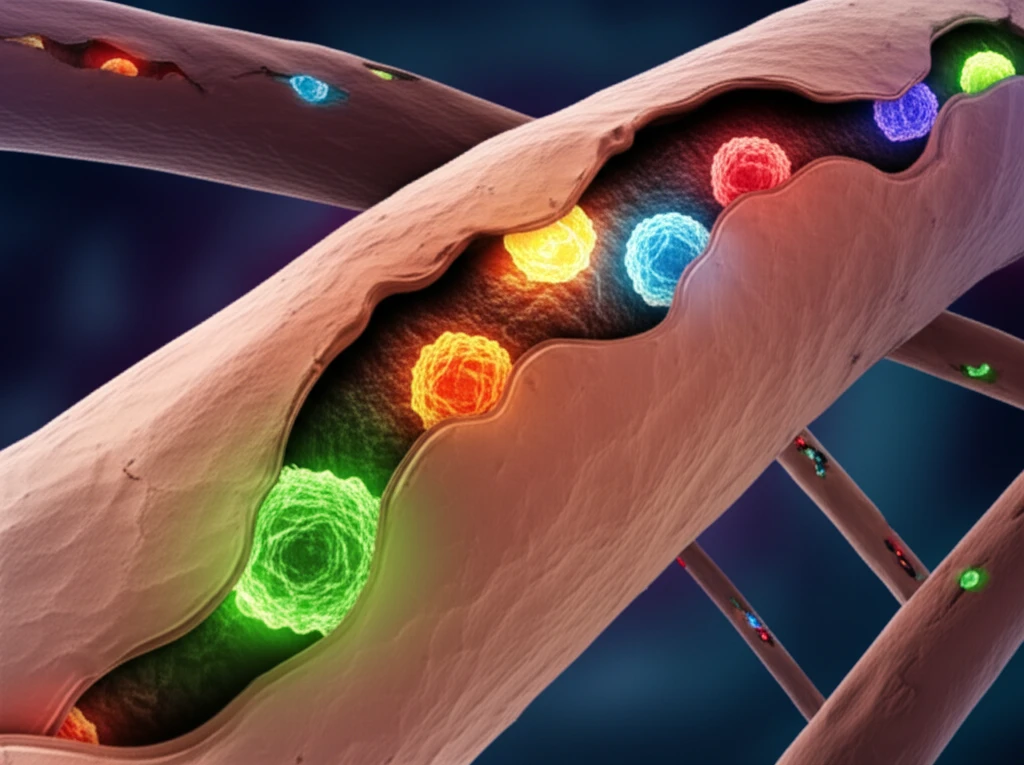
Illustration of Achilles tendon fiber regeneration.

Decoding Achilles Injuries: A New Model for Tendon Healing

"Researchers explore a rat model to better understand and treat Achilles tendon injuries, offering hope for improved recovery strategies."


Achilles tendon injuries are a widespread problem, ranging from sudden ruptures to persistent tendinitis. These injuries significantly impact healthcare costs, productivity, and individual well-being. While treatments exist, there's a constant push to refine their effectiveness and speed up recovery.

Animal models play a crucial role in understanding and improving tendon treatments. For a model to be useful, it must accurately mimic the specific injury and allow researchers to measure the outcomes they're interested in. Complete and incomplete injuries require different modeling approaches, and the primary goal is often to restore the tendon's ability to transfer loads.

This article delves into a new experimental model designed to study Achilles tendon healing in rats. By quantifying hydroxyproline levels during tendon regeneration and using the opposite paw as a control, researchers aimed to create a reliable platform for testing new therapies.

The Achilles Injury Model: A Closer Look

Illustration of Achilles tendon fiber regeneration.

The study, approved by the Ethics Committee for the Analysis of Research Projects (CAPPesq), adhered to strict ethical guidelines for animal care. Forty adult male Wistar rats, weighing 250-300g, were used. Ten rats formed the normal control group, while the remaining thirty underwent surgery.

Surgical Procedure: The rats were anesthetized, and a partial transverse section of the Achilles tendon was performed bilaterally. The right tendon was designated as the surgery right tendon (SRT), while the left served as the surgery left tendon control (SLT). The injury was created using a scalpel blade to make a precise hemisection, taking care to avoid the flexor halluces longus muscle.

  • Anesthesia and Preparation: Rats were carefully anesthetized and their legs disinfected before the procedure.
  • Surgical Incision: A longitudinal incision was made to expose the Achilles tendon and peritendon.
  • Tendon Hemisection: A transverse hemisection was performed on both tendons.
  • Closure: The skin was closed with continuous sutures.
  • Post-operative Care: Rats received analgesics and were monitored until they regained consciousness. They were housed under controlled conditions with a 12-hour light-dark cycle.
Effectiveness Assessment: To determine the effectiveness of the induced lesion, the research team measured hydroxyproline content at 7, 14, and 28 days post-surgery. These measurements were compared between the control tendons, injured tendons and normal tendons

Unlocking the Potential for Tendon Regeneration

The study revealed a significant decrease in hydroxyproline content in the injured tendons compared to the normal control tendons. This finding validates the effectiveness of the experimental injury, confirming that the model successfully mimics tendon damage.

While the healing tendon's tensile strength improves over time, it often doesn't reach the level of uninjured tissue. This rat model offers a valuable tool for studying tendon regeneration and exploring new therapeutic interventions. Further research can focus on accelerating the healing process and restoring full functionality to damaged tendons.

The experimental model has proven effective and can be used in future studies on Achilles tendon healing.

About this Article -

This article was crafted using a human-AI hybrid and collaborative approach. AI assisted our team with initial drafting, research insights, identifying key questions, and image generation. Our human editors guided topic selection, defined the angle, structured the content, ensured factual accuracy and relevance, refined the tone, and conducted thorough editing to deliver helpful, high-quality information.See our About page for more information.

This article is based on research published under:

DOI-LINK: 10.1590/s0102-86502014000700002, Alternate LINK

Title: Experimental Model Of Achilles Tendon Injury In Rats

Subject: Surgery

Journal: Acta Cirurgica Brasileira

Publisher: FapUNIFESP (SciELO)

Authors: Flavia Emi Akamatsu, Samir Omar Saleh, Walcy Rosolia Teodoro, Alexandre Queiroz Da Silva, Carlos Augusto Real Martinez, Ricardo Jordão Duarte, Mauro Figueiredo Carvalho De Andrade, Alfredo Luiz Jacomo

Published: 2014-07-01

Everything You Need To Know

1

What was the main goal of the research?

The purpose of the study was to create a reliable platform for testing new therapies aimed at accelerating recovery from injuries to the Achilles tendon. This involved developing an Achilles Injury Model using a rat model to study tendon healing.

2

Why is this research about Achilles tendon injuries important?

The study's significance lies in its potential to improve treatments for tendon injuries and speed up recovery. Achilles tendon injuries are widespread, impacting healthcare costs, productivity, and individual well-being. By understanding the healing processes through the rat model, researchers hope to refine treatments and enhance their effectiveness. The study focused on an Achilles Injury Model involving a surgical procedure performed on the Achilles tendon.

3

What exactly does the Achilles Injury Model involve?

The Achilles Injury Model involves a carefully controlled surgical procedure. First, the rats were anesthetized, and a partial transverse section of the Achilles tendon was performed bilaterally. The right tendon was the surgery right tendon (SRT), and the left was the surgery left tendon control (SLT). A precise hemisection was made using a scalpel blade to create the injury, ensuring the flexor halluces longus muscle was avoided. Post-operatively, the rats received analgesics and were monitored under controlled conditions.

4

How did the researchers determine if the Achilles Injury Model was effective?

Hydroxyproline content was measured to evaluate the induced lesion's effectiveness. Researchers quantified these levels at 7, 14, and 28 days post-surgery, comparing them between control, injured, and normal tendons. These measurements help validate the model's ability to mimic tendon damage accurately. The use of the surgery left tendon control (SLT) provided a basis for comparison with the surgery right tendon (SRT).

5

What were the key findings related to hydroxyproline and what do they mean?

The study revealed a significant decrease in hydroxyproline content in the injured tendons compared to the normal control tendons. This confirms the model's ability to replicate tendon damage effectively. This information is vital as it validates the experimental injury, confirming its suitability for testing new therapies. The model’s success opens the door for future research aimed at improving the healing of Achilles tendon injuries.

Newsletter Subscribe

Subscribe to get the latest articles and insights directly in your inbox.