
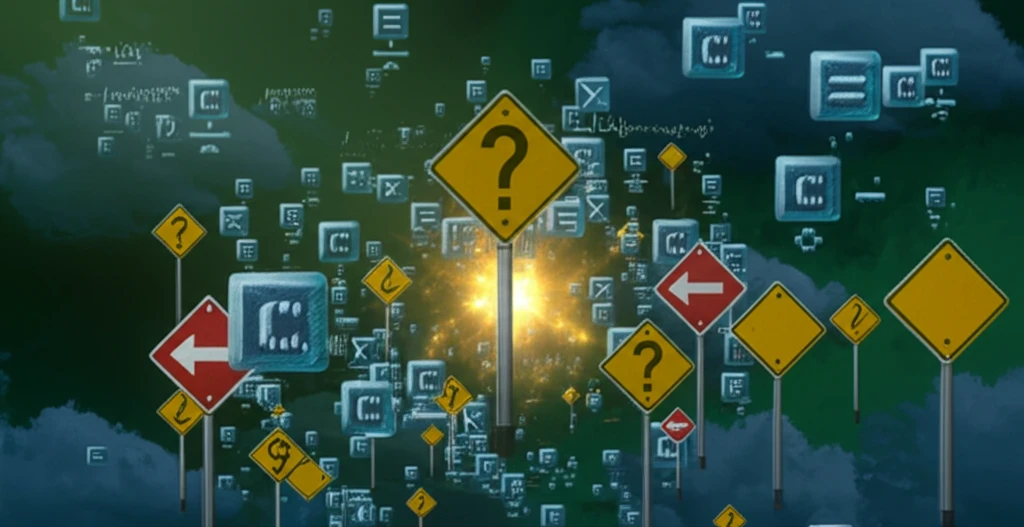
Decode Your Mind: How Signs and Symbols Shape Reality

"Unlock the power of Peirce and Wittgenstein to understand how we create meaning through signs and symbols."
From the dawn of civilization, humans have used signs – symbols, diagrams, language – to navigate and understand the world. Mathematics, a language of its own, relies heavily on these signs. These signs aren't just tools; they fundamentally shape how we perceive reality. The formulas we learn, the graphs we interpret, these aren't just representations of pre-existing truths; they actively construct our understanding.
Think about it: a simple equation can unlock the secrets of the universe, a well-placed diagram can clarify a complex system. These symbolic techniques aren't merely descriptive; they're generative, allowing us to create new knowledge and innovations. The power of mathematics, and much of our understanding, lies in our ability to manipulate and interpret these carefully constructed sign systems.
But where does meaning come from? Is it inherent in the sign itself, or is it something we create? Philosophers like Charles Sanders Peirce and Ludwig Wittgenstein grappled with this very question, offering profound insights into the nature of signs and their role in shaping our world.
Statistics Meet Semiotics: An Interpretative Field
In semiotics education, the field is frequently characterized as an interpretative, grand theory built on inductive research, designed to answer fundamental questions about how language works—illustrated through cases such as the Himba people and color perception, Aboriginal Australians and numbers, and the Piraha language studied by Dr. Daniel Everett. When statistics meet semiotics, meaning-making is rarely neutral: interpreting data with knowledge of local situations and practices reveals that locus-specific values shape distinct local social structures and policy choices. Semiotic information, statistical inference, and related concepts are increasingly treated as interlocking themes in scholarly inquiry into how meaning is measured. National statistics portals, meanwhile, supply the raw quantitative backdrop against which such interpretative frameworks operate.
Established Methods and Their Limits
Semiotics is widely defined as the interdisciplinary study of signs and sign-using behavior, though the idea of semiotics as a distinct interdisciplinary field emerged only in the late 19th and early 20th centuries. Established methods today include structural and multimodal approaches, with university courses such as 'Meaning Patterns: An Introduction to Multimodal Semiotics' offering formal instruction in its techniques. Critics note a central limitation: semiotic reasoning often proceeds through metaphor and analogy, a process that does not fit neatly into predicate calculus, and some commentators describe semiotics as including logic only as a special, degenerate case while also encompassing extra-logical, extra-computational reasoning. In applied fields such as branding, a semiotic approach is presented as moving beyond both new-age personifications of consumer desire and Marxist deconstructions of oppressive deceit.
From Greek Roots to an Interdisciplinary Field
Semiotics, sometimes called semiotic studies or semiology, is the study of signs and symbols—both individually and when grouped into sign systems—and of how meaning is constructed and understood. The field's name is rooted in the Greek word 'sēmeion,' meaning 'sign,' and it encompasses images, words, and gestures as elements that represent concepts and ideas. Its main branches are traditionally identified as syntactics, which addresses formal relations between signs, and semantics, which concerns the relation of signs to what they mean. A person who studies or practices the discipline is known as a semiotician.
Peirce's Semiotics: A World of Signs
Charles Sanders Peirce, a brilliant American philosopher, developed an intricate theory of signs known as semiotics. He proposed that a sign isn't just a simple representation of an object; it's a complex, three-part relationship between the sign itself (the representamen), the object it refers to, and the interpretation (the interpretant).
- Index: A sign directly connected to its object (e.g., smoke indicates fire).
- Icon: A sign that resembles its object (e.g., a portrait).
- Symbol: A sign whose connection to its object is arbitrary and based on convention (e.g., a national flag).
Reviewing Birth, Growth, and Semiotic Modeling
Recent reviews explicitly set out to trace the birth and growth of semiotics, synthesizing prior research to introduce the different stages of its historical development. Current research is also expanding into semiotic modeling, including the history of philosophical and psychological reflection on imagination, intuition, and creativity from thinkers such as I. Kant, G.W.F. Hegel, and P.K. Engelmeyer up to the latest semiotics of creativity and technology. Publishing venues such as SpringerLink actively feature pioneering discoveries, insightful ideas, and new methods from leading semiotics researchers, reflecting a field still generating fresh questions about how meaning is produced.
Criticisms of Structuralist Semiotics
Criticisms of structuralist semiotics have led some theorists to abandon the field altogether, while others have sought to merge it with new perspectives—though critics themselves acknowledge it is difficult to critique a shifting target that changes its form so fluidly. Reviews of the field also catalog the differing objectives and research limitations of the various schools of thought and the models involved in the study of semiotics. Even within literary criticism, where semiotic approaches treat texts as complex systems of signification, the field's utility remains contested. Proponents counter that in a world dominated by the visual over the linguistic, understanding how society constructs and interprets images is of great importance.
Social Semiotics and Comparative Frames
Semiotics is commonly described as the study of how an idea or object communicates meaning, what meaning it communicates, and which associations it brings forth—an approach with especially visible applications in marketing. Comparative frameworks distinguish social semiotics, an analytical perspective for understanding everyday objects and their meanings, from the more traditional structural semiotics. The comparative impulse extends even to cross-cultural philosophy, as seen in works such as a review of Buddhism and deconstruction toward a comparative semiotics.
Wittgenstein and the Games We Play with Meaning
Ludwig Wittgenstein took a different, but equally profound, approach to understanding meaning. He argued that meaning isn't something inherent in a sign or symbol; instead, it arises from how we use it within a particular context, what he called a "language game." Think of the rules of chess: the meaning of each piece is defined by how it can be moved and used within the game. Similarly, mathematical symbols gain their meaning from the rules and operations that govern them.
Semiotics in Professional Practice
In practice, semiotic experts apply the field's methods to concrete disputes, such as trademark cases where analyses are grounded in semiotics and the criteria stated in EUIPO guidelines and Patent Office regulations. Market researchers describe semiotic analysis as the decoding of symbols and signs with applications in social norms, advertising communication, creative design, and brand analysis. Because it examines context, semiotics is regarded as particularly valuable for brand development, brand positioning, and long-term brand management, helping enterprises deliver meaningful messages that naturally resonate with consumers. Yet awareness among the general public remains limited: in one case study of non-specialist discussions on Twitter and Instagram, only 96 of 376 tweets from non-experts used the hashtag #semiotics.
AI, Speculative Semiotics, and New Media
A recurring theme in forward-looking work is the convergence of AI and semiotics, with analysts proposing that semiotics can empower AI to understand and generate complex sign systems and to participate in creative endeavors such as literature, art, and music, potentially enabling new forms of human-machine co-creation. Similarly, future trends point to artificial intelligence and machine learning being used to analyze and generate semiotic meaning, alongside the application of semiotics in virtual and augmented reality. Another strand, speculative semiotics, is explicitly future-oriented but aims not at accurately forecasting the future; instead it uses a forward-looking, creative perspective to reflect critically on the general workings of communication and on its ideological understandings.
Semiotics in Public Discourse
One of the most-watched public treatments of the topic remains the Yale lecture on semiotics and structuralism, which has drawn roughly 469,000 views on YouTube since being posted some sixteen years ago. The lecture's enduring viewership highlights both broad public interest in how meaning systems work and the systemic challenge of situating semiotics within larger structuralist frameworks of analysis. The scale of that audience underscores that semiotics, though often framed as an academic specialty, has long been part of mainstream education and public debate.
Signs in Everyday Life
At its most human level, semiotics is the study of how meanings are constructed and understood in daily life: from emojis and traffic lights to brand logos, rituals, and political slogans, the world communicates through signs long before anyone explains them. This everyday relevance is felt even among practitioners, as many brand professionals studying semiotics realize they were inadvertently already doing parts of it without knowing it. In the current economic conditions and unpredictable employment markets, brand professionals are accordingly expanding their skill sets around semiotic thinking. On a philosophical plane, semiotic realism and work such as John Deely's on the impact of semiotics on philosophy also reframe the field's stakes for modern thought.