
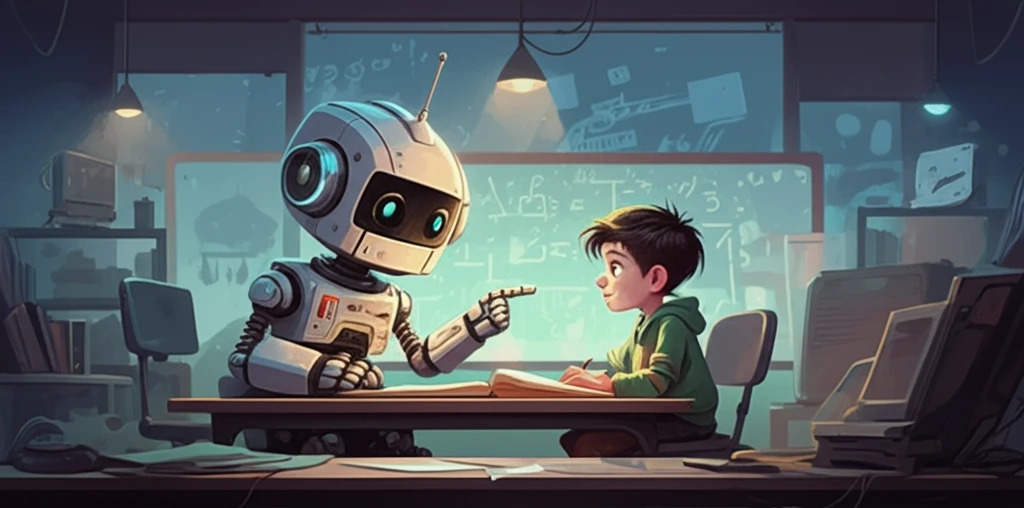
Can Robots Truly Understand and Boost Learning? The Rise of AI-Enhanced Education

"Explore how emotion and memory models in robots are revolutionizing mathematics education, offering personalized learning experiences and improved outcomes for students."
The integration of social robots in education is rapidly growing, particularly in how these robots can adapt to individual student needs. Recent studies highlight the importance of designing robots that understand and respond to user characteristics to enhance learning outcomes. Researchers are actively exploring machine learning methods to create adaptive behaviors in educational robots, with reinforcement learning algorithms gaining traction. These algorithms enable robots to learn and adjust their teaching strategies in real-time, significantly improving the effectiveness of tutoring compared to non-adaptive methods.
While many studies focus on implementing novel adaptation strategies in social robots, fewer explore their effectiveness in real-world settings within existing school curricula. Experts emphasize the necessity of conducting more in-the-field research to gain valuable insights into the future role of robots in education. Building on this need, recent work has developed emotion and memory models that enable robots to create memory accounts of children's emotional states. This advancement allows robots to tailor their behavior based on past interactions, enhancing long-term engagement and vocabulary learning.
This article delves into a pioneering study that applies an emotion and memory model to a social robot in a mathematics learning scenario. The primary aim is to assess the model's impact on children's engagement and learning in a real-life educational context. By implementing scenarios that closely resemble actual classroom activities, this research seeks to validate the effectiveness of adaptive robots in education beyond vocabulary learning. It also addresses a critical gap in understanding how robots can truly enhance learning in practical, curriculum-based settings.
Robots by the Numbers
The global consumer robot market now exceeds $12 billion, with more than 20 million robotic vacuum cleaners in use worldwide and smart speakers having sold more than 1.4 billion units. In the defense sector, the global military robot market is projected to reach $26.3 billion by 2027, with drones accounting for 80% of military robotics spending in 2023. Within education, robots are defined as specialized devices employed in the educational field to support learning. In industrial settings, by 2023 AI vision appeared in over 50% of new industrial robots, while mobile units reached 24+ hours of operation in 70% of warehouse deployments.
Learning Through Robots
One widely accepted method for developing algorithmic thinking in primary education involves working with physical digital devices such as educational robots, a problem-solving approach pupils build up interactively. Proponents of educational robotics point to the way robots engage students in what is called Computational Thinking (CT), a trend that has been reviewed from the robotic educator's perspective. The demand for innovation in teaching methods has given rise to a diverse array of robots tailored to specific educational needs. The same technologies appear across real-world domains including manufacturing, healthcare, education, gaming, logistics, space, and security, framing classroom robots as entry points into a broader field.
From Electric Eric to Mindstorms
The modern educational robot era is often dated to the 1998 launch of Lego Mindstorms, which coincided with the founding of the FIRST Lego League, a partnership between Lego and FIRST, the youth organization started by inventor Dean Kamen to boost student interest in engineering and technology. Earlier milestones in robotics history include 'Electric Eric,' a 1920s British robot. Since then, the educational robot market has expanded into interactive coding robots, drawing robots, and STEM kits designed for all ages, with historical and projected market size tracked by both value and volume across key regions.
Emotion and Memory Model for Personalized Learning
The emotion and memory model is designed to mimic how humans create and recall emotional memories. Humans store memories of both positive and negative events, categorizing them into conscious (explicit, declarative) and unconscious (implicit, procedural) memory systems. Emotional memory involves the implicit learning and storage of information about the emotional significance of events, while the memory of emotional situations refers to conscious memory. When emotional events occur, they are processed by the sensory system and transmitted to the temporal lobe or amygdala, forming either explicit or implicit memories. These memories are then retrieved when a related cue is encountered.
What the Market and Classrooms Show
Industry reports forecast educational robot revenue growth at global, regional, and country levels, analyzing the latest trends across sub-segments from 2018 to 2030. The category now spans screen-free sequencing toys, coding robots, buildable STEM kits, and lab-grade research platforms. These robots scale across age groups, so schools can select devices appropriate to each learning stage rather than one uniform product. Notable platforms in use include the humanoid NAO robot and Dobot Education, which are highlighted for their classroom benefits and applications.
Scripted Responses and the Automation Gap
A recurring criticism is that today's educational and social robots rely heavily on scripted responses that feel artificial during extended interactions, a weakness researchers have flagged even within an educational robotics market valued at $2.8 billion. Companies such as SoftBank (with Pepper) and Hanson Robotics are named as examples of systems that struggle to create truly adaptive social interactions. Meanwhile, educators note that jobs are being automated and argue that educational robotics is critical for preparing students for automation-driven job markets through hands-on, collaborative learning experiences.
Comparing the Major Platforms
Comparative analyses often stack the major platforms against one another, including Lego, EZ-Robot, FIRST Robotics, and Vex, weighing how each suits different classroom needs. Research into the educational use of home robots for children has also examined biases and shortcomings that prevent the field from being completely suitable for education. Looking ahead, 2026 trends point to AI-powered humanoid robots and STEM kits as the products reshaping consumer preferences and product forecasts.
Future Directions
This study underscores the potential of integrating emotion and memory models into educational robots to enhance children's learning and social engagement. The findings suggest that robots equipped with these models can create more personalized and effective learning experiences. Future research should focus on evaluating these models in various real-life educational scenarios to further refine their impact on learning outcomes.
Growth, With Conflicting Forecasts
Market analysts project continued growth for educational robots, though their figures differ. Market.us reports a market size projected to surpass USD 5.1 billion by 2032 at a CAGR of 16% from 2022 to 2032, with higher education dominating the market because older students require more complex input from robots. Technavio, by contrast, expects market share to increase by 580.92 thousand units from 2020 to 2025 at a CAGR of 21.32%. Because the two reports cover different periods and metrics, their growth figures are not directly comparable. Robotics experts separately note that robots can complete labor-intensive manual tasks, from intricate picking and sorting of goods to moving pallets and large payloads, creating huge efficiencies.
An Inflection Point for the Field
The educational robotics field is described as standing at an inflection point, with converging technological advances, pedagogical innovations, and policy shifts poised to reshape the landscape over the next five years. A central anticipated trend is AI-powered personalization of learning. Market forecasts for the sector vary by source: one report projects the market reaching USD 9,691.76 million by 2035 at a CAGR of 16.92%, while another predicts the market reaching USD 8.6 billion, driven in part by the availability of humanoid robots. Reports also note promising growth for early childhood education robots, supported by increasing consumer demand, technological advancements, and expanding applications.
The Dexterity Gap
A deeper systemic challenge for robotics is the astonishing capability of the human hand, which robots still struggle to match. As robotics researchers note, human sensory systems can detect minute changes and rapidly adapt to changes in tasks and environments, integrating multiple sensory inputs like vision, touch, and temperature. Robots currently lack this level of integrated sensory perception, and that shortfall constrains how effectively machines can operate in the unstructured, human-centered environments of a classroom.
Motivating Future Engineers
A pilot study explored how an introduction to robot programming influences the motivation of new engineering students. The research considered both virtual and physical robots in engineering education, including the use of augmented reality. The underlying rationale is that robots are significant in several industries and are vital in advancing critical sectors such as defense, manufacturing, medicine, and exploration.