
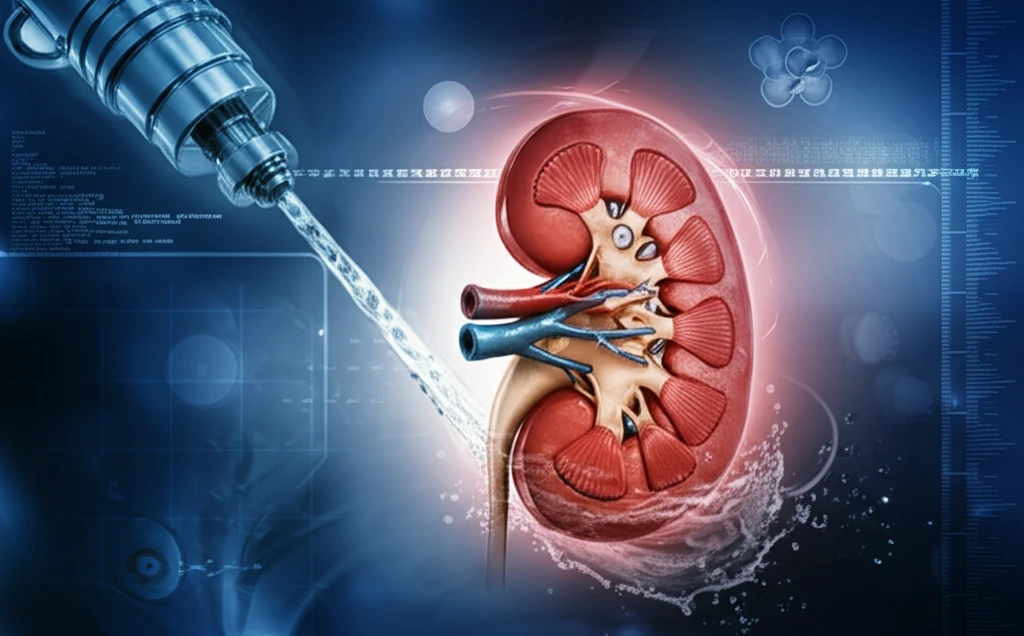
Cutting Without the Knife: How This New Water Jet Tech Could Revolutionize Kidney Surgery

"Could a novel piezo actuator-driven pulsed water jet system offer a gentler alternative to traditional kidney surgery, reducing damage and improving recovery?"
Kidney surgery, particularly partial nephrectomy (PN), has advanced significantly, becoming a cornerstone in treating localized renal cell carcinomas. The primary goal has always been to eradicate cancerous tissue while preserving as much of the healthy kidney as possible. This balancing act is crucial, as long-term kidney function directly impacts a patient's overall health and quality of life.
Traditional surgical methods, while effective, often involve clamping the renal artery to create a bloodless field. Techniques like thermal coagulation and sutured renorrhaphy are then used to control bleeding. However, these methods can inadvertently cause ischemia, leading to tissue damage and potential post-operative renal dysfunction. Recognizing these limitations, researchers have been exploring gentler, more precise techniques.
Enter the piezo actuator-driven pulsed water jet system—a novel technology that may revolutionize how kidney surgeries are performed. This system uses a fine, pulsating jet of water to dissect tissue, theoretically minimizing trauma to the surrounding healthy kidney. Early studies suggest this approach could significantly reduce post-operative complications and improve patient recovery. Let's explore how this technology works and what the future holds for kidney surgery.
What Makes This Water Jet System Different?
The piezo actuator-driven pulsed water jet system isn't just another water jet. It's a sophisticated device designed to overcome the limitations of conventional surgical methods. Traditional water jets deliver a continuous stream of water, which can sometimes lead to excessive tissue damage and make precise dissection challenging. The new system, however, uses a pulsed jet, delivering intermittent bursts of water. This allows for more controlled and precise tissue removal, minimizing collateral damage to the surrounding healthy tissue.
- Precision Cutting: The pulsed jet allows surgeons to dissect tissue with greater accuracy, preserving fine blood vessels and minimizing bleeding.
- Reduced Thermal Injury: Unlike thermal coagulation, which uses heat to stop bleeding, the water jet system avoids thermal damage to the surrounding tissue.
- Minimized Ischemia: By reducing the need for extensive clamping and coagulation, the system helps maintain blood flow to the kidney, reducing the risk of ischemia.
- Improved Recovery: Early studies suggest that the gentler approach leads to faster recovery times and reduced post-operative complications.
The Future of Kidney Surgery
The development of the piezo actuator-driven pulsed water jet system represents a significant advancement in surgical technology. While more research is needed to fully understand its long-term benefits, early results suggest that it holds promise as a gentler, more precise alternative to traditional kidney surgery. As the technology evolves and becomes more widely available, it could transform the way partial nephrectomies are performed, leading to improved outcomes and a better quality of life for patients.