
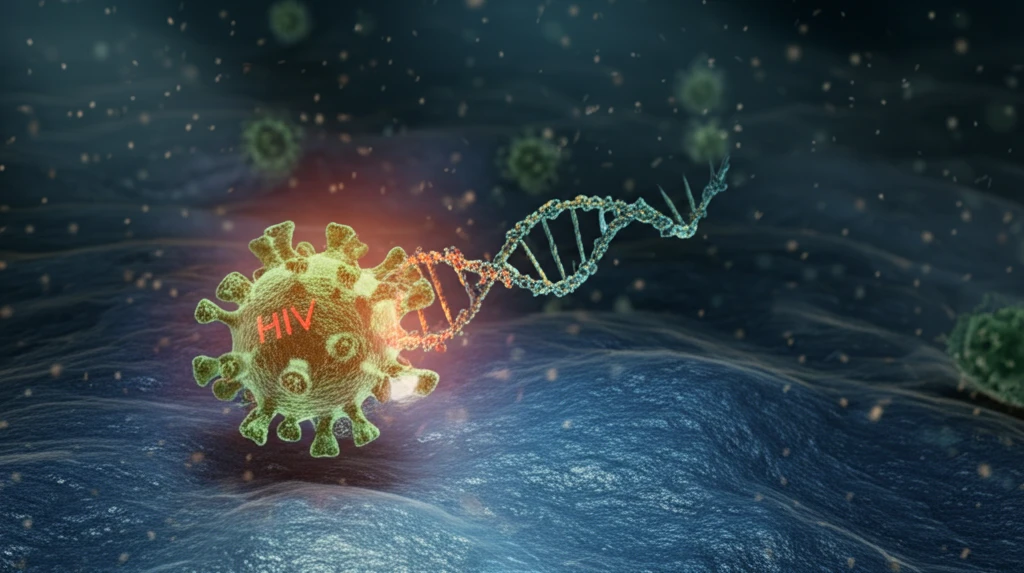
CRISPR's Next Frontier: Engineering Immunity for the Future

"How a novel cellular platform is optimizing CRISPR/Cas9 technology for AIDS gene therapy, bringing hope and new strategies to combat HIV."
In the ongoing battle against HIV and AIDS, scientists are constantly seeking new and innovative therapeutic strategies. Despite the advancements in antiretroviral therapies, AIDS remains a significant global health challenge. The rise of drug-resistant HIV strains underscores the urgent need for more effective, long-term solutions.
One promising avenue of research involves gene therapy, which aims to modify a patient's own cells to combat the virus. Immortalized cell lines, particularly those representing the major targets of HIV in humans—macrophages and CD4+ T lymphocytes—are invaluable for this research. These cell lines allow scientists to study HIV infection and test new therapeutic approaches in a controlled laboratory setting.
Recently, researchers have focused on using CRISPR/Cas9 technology to engineer HIV-resistant cells. This gene-editing tool allows for precise modifications to a cell's DNA, offering the potential to disrupt viral entry or replication. By optimizing CRISPR/Cas9 technology within a novel cellular platform, scientists are paving the way for more effective and targeted gene therapies for AIDS.
Engineering HIV Resistance: How CRISPR/Cas9 Targets CCR5
A critical aspect of HIV infection involves the virus's ability to bind to specific receptors on the surface of immune cells. The co-receptors CCR5 and CXCR4 are essential for HIV to enter CD4+ T cells. Disrupting these co-receptors can prevent the virus from infecting cells, providing a potential therapeutic strategy. Many T cell lines do not express adequate levels of CCR5, limiting their utility for HIV research.
- Selecting the Right Cell Line: Jurkat T cells were chosen for their high expression levels of CD4 and CXCR4 genes.
- CRISPR/Cas9 Knock-In: The ubiquitous CAG promoter was inserted into the CCR5 gene promoter to enhance CCR5 expression.
- Verification of Recombination: PCR and Southern blotting were used to confirm homologous recombination events and rule out random integration.
- Creation of Jurkat-KI-R5: The resulting cell line, Jurkat-KI-R5, stably expresses high levels of CCR5.
Future Directions: Eradicating HIV with Precision Gene Editing
The development of Jurkat-KI-R5 cells opens up new avenues for gene therapy strategies aimed at disrupting CCR5. By using CRISPR/Cas9 technology to target the CCR5 gene in these cells, researchers can generate HIV-resistant CD4+ T cells. These modified cells can then be used to study the efficacy of different gene-editing approaches and optimize protocols for clinical applications.