
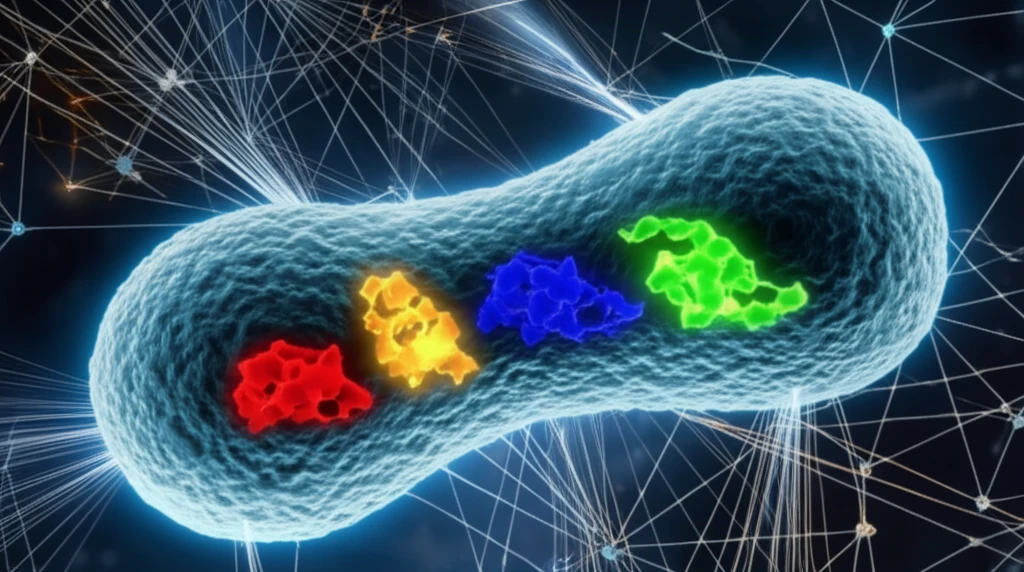
Illustration of bacterial cell division with SepF and FtsZ proteins highlighted.

Cracking the Code of Bacterial Division: How Understanding Cell Division Can Lead to New Antibiotics

"A new study reveals how cell division in Corynebacterium works, offering hope for fighting antibiotic-resistant infections."


In an era where antibiotic resistance is rapidly increasing, the need for new therapeutic strategies is more critical than ever. Pathogenic bacteria are evolving to resist existing antibiotics, causing a range of serious diseases that are increasingly difficult to treat. This challenge has spurred researchers to explore innovative approaches, focusing on the fundamental processes that allow bacteria to thrive and spread.

One promising area of research is bacterial cell division, a complex process essential for bacterial survival and propagation. Understanding the intricacies of cell division can reveal vulnerabilities that can be targeted with new drugs. A recent study delves into the cell division mechanisms of the Corynebacterium genus, a group of bacteria known for both its medical and biotechnological importance.

Corynebacterium includes species that cause diseases like diphtheria and pseudotuberculosis, making it a key target for new antibacterial strategies. This research focuses on the proteins involved in cell division, particularly SepF and FtsZ, and their interactions. By examining how these proteins function and interact, scientists hope to identify novel targets for therapeutic intervention.

Why Understanding Bacterial Cell Division Matters

Illustration of bacterial cell division with SepF and FtsZ proteins highlighted.

Bacterial cell division, also known as divisome, in Corynebacterium involves a complex machinery of conserved proteins. This process is essential for bacteria to multiply and cause infections. The divisome assembly requires the cooperative recruitment of cell division proteins, initiated by the highly conserved tubulin homolog FtsZ. This process occurs in two main steps:

The early divisome components polymerize FtsZ into single-stranded protofilaments.

  • Late divisome components facilitate lateral interaction between protofilaments, forming stable bundles.
  • FtsZ interacts dynamically with many cytosolic molecules and must be precisely timed and placed for cell division.
Understanding these steps is crucial for identifying targets that can disrupt bacterial cell division. By focusing on these vulnerabilities, researchers aim to develop drugs that can effectively stop bacterial infections.

Looking Ahead: Novel Therapeutic Targets

This research highlights the potential of targeting the interaction between FtsZ and SepF as a new therapeutic strategy. The study also identified new protein candidates that could be further explored as drug targets to control bacterial infections. By combining in silico and in vitro analyses, scientists are gaining a more complete understanding of cell division in bacteria, paving the way for the development of new and effective antibiotics.

About this Article -

This article was crafted using a human-AI hybrid and collaborative approach. AI assisted our team with initial drafting, research insights, identifying key questions, and image generation. Our human editors guided topic selection, defined the angle, structured the content, ensured factual accuracy and relevance, refined the tone, and conducted thorough editing to deliver helpful, high-quality information.See our About page for more information.

Everything You Need To Know

1

Why is understanding bacterial cell division in Corynebacterium important for combating antibiotic resistance?

Understanding bacterial cell division, specifically the divisome process in Corynebacterium, is crucial because it reveals vulnerabilities that can be targeted with new drugs. As pathogenic bacteria evolve to resist existing antibiotics, understanding the intricacies of how bacteria like Corynebacterium multiply offers opportunities to disrupt their cell division and propagation, ultimately combating antibiotic-resistant infections. This approach is especially important as Corynebacterium includes species that cause diseases like diphtheria and pseudotuberculosis.

2

What are FtsZ and SepF, and why are they significant in the context of Corynebacterium cell division?

FtsZ and SepF are key proteins involved in cell division in Corynebacterium. FtsZ, a tubulin homolog, initiates divisome assembly by polymerizing into single-stranded protofilaments. SepF facilitates the lateral interaction between these protofilaments, forming stable bundles. Their interaction is significant because targeting this interaction represents a potential therapeutic strategy to disrupt cell division and control bacterial infections. Disrupting the function or interaction of these proteins can effectively halt bacterial infections. Other proteins are also under investigation to control bacterial infections.

3

How does the divisome work in Corynebacterium, and what are the main steps involved?

The divisome in Corynebacterium involves a complex machinery of conserved proteins essential for bacterial multiplication. The process occurs in two main steps: first, early divisome components polymerize FtsZ into single-stranded protofilaments. Second, late divisome components facilitate lateral interaction between protofilaments, forming stable bundles. FtsZ interacts dynamically with many cytosolic molecules and must be precisely timed and placed for successful cell division. Disrupting either of these steps can halt bacterial infections.

4

What are some potential novel therapeutic targets identified in the research on Corynebacterium cell division, and how might they lead to new antibiotics?

The interaction between FtsZ and SepF has been identified as a potential therapeutic target. Additionally, the research suggests that other protein candidates involved in the divisome process could be further explored as drug targets to control bacterial infections. By combining in silico and in vitro analyses, scientists aim to gain a more complete understanding of cell division in bacteria, paving the way for the development of new and effective antibiotics. If the interaction between FtsZ and SepF can be stopped in early divisome, cells division will stop and the infection can be halted.

5

What does this study on Corynebacterium cell division tell us about future strategies for fighting antibiotic resistance, and what are the broader implications?

This study emphasizes the potential of targeting bacterial cell division as a viable strategy for fighting antibiotic resistance. By focusing on the specific mechanisms and proteins involved in cell division in Corynebacterium, such as FtsZ and SepF, researchers can identify novel therapeutic targets for new antibiotics. The broader implications include the possibility of developing targeted therapies that specifically disrupt bacterial cell division, minimizing harm to the host and potentially overcoming the growing challenge of antibiotic resistance. The identification of new protein candidates through in silico and in vitro analyses further expands the possibilities for innovative drug development. This approach offers a promising avenue for controlling bacterial infections in an era where traditional antibiotics are becoming less effective.

Newsletter Subscribe

Subscribe to get the latest articles and insights directly in your inbox.