
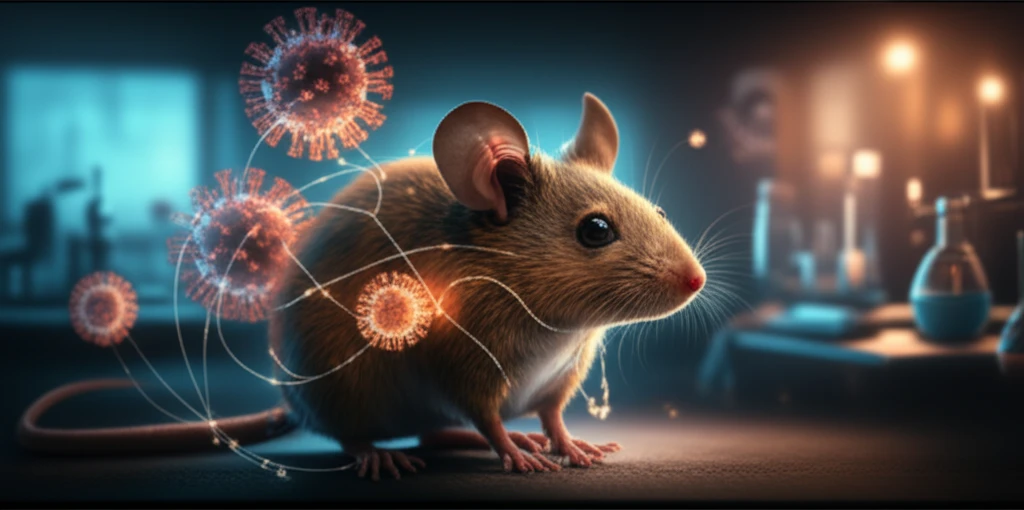
Surreal illustration of a mouse model intertwined with RSV viruses, symbolizing medical research and potential breakthroughs.

Cracking the Code: How a New Mouse Model Could Revolutionize RSV Research

"Scientists develop a lethal mouse model for human respiratory syncytial virus (HRSV), paving the way for better vaccines and antiviral treatments."


Human respiratory syncytial virus (HRSV) is a major global health threat, particularly for young children and the elderly. This common virus leads to millions of infections and hospitalizations each year, with a significant number of deaths. Despite decades of research, there's still no widely available, effective vaccine or targeted antiviral therapy for HRSV.

One of the biggest challenges in developing these solutions has been the lack of a suitable animal model that accurately replicates the severe effects of HRSV in humans. While researchers have used various animals, including primates and traditional mice, none have fully captured the lethal nature of the virus, especially in vulnerable populations.

Now, a team of scientists has achieved a significant breakthrough: they've created a lethal mouse model for HRSV by adapting a clinical isolate of the virus through serial passages in aged mice. This new model, described in a recent publication in "Antiviral Research", closely mimics the severe lung pathology and inflammatory responses seen in human HRSV infections, offering a promising tool for future research.

Why Is This Mouse Model a Game-Changer for RSV Research?

Surreal illustration of a mouse model intertwined with RSV viruses, symbolizing medical research and potential breakthroughs.

The traditional BALB/c mouse model, commonly used in HRSV research, is semi-permissive, meaning that while the virus can infect the mice and cause illness, it's generally not fatal. This limits the ability of researchers to study severe disease outcomes and test potential therapies for those most at risk.

The newly developed mouse model overcomes this limitation by using a mouse-adapted strain of HRSV called GZ08-18. This virus, derived from a clinical isolate (GZ08-0), was serially passaged through aged BALB/c mice, resulting in a virus that is far more virulent and causes lethal infections. Here’s a detailed summary:

  • Lethality: Unlike the parental virus, GZ08-18 consistently causes death in infected mice, mirroring the severe outcomes seen in vulnerable human populations.
  • Higher Viral Replication: GZ08-18 replicates to a significantly higher titer in the lungs of infected mice compared to the parental virus, indicating its enhanced ability to infect and spread within the host.
  • Exaggerated Lung Pathology: The mouse-adapted virus induces more severe lung damage and inflammation, closely resembling the pathology observed in severe human HRSV infections.
  • Increased Inflammatory Response: GZ08-18 infection leads to a heightened production of pro-inflammatory cytokines and chemokines, contributing to the severity of the disease.
Researchers further demonstrated the model's utility by using it to evaluate the effectiveness of ribavirin, an antiviral drug. They found that ribavirin treatment completely prevented death in mice infected with GZ08-18, confirming the model's ability to assess antiviral interventions.

What Does This Mean for the Future of RSV Treatments?

This new lethal mouse model represents a significant step forward in HRSV research. It offers a more accurate and reliable platform for evaluating potential vaccines, antiviral therapies, and immunomodulatory strategies. By providing a better understanding of severe HRSV pathogenesis, this model could accelerate the development of life-saving interventions for infants, the elderly, and immunocompromised individuals.

About this Article -

This article was crafted using a human-AI hybrid and collaborative approach. AI assisted our team with initial drafting, research insights, identifying key questions, and image generation. Our human editors guided topic selection, defined the angle, structured the content, ensured factual accuracy and relevance, refined the tone, and conducted thorough editing to deliver helpful, high-quality information.See our About page for more information.

This article is based on research published under:

DOI-LINK: 10.1016/j.antiviral.2018.11.015, Alternate LINK

Title: Establishment Of A Lethal Aged Mouse Model Of Human Respiratory Syncytial Virus Infection

Subject: Virology

Journal: Antiviral Research

Publisher: Elsevier BV

Authors: Ke Zhang, Cun Li, Yu-Si Luo, Lei Wen, Shuofeng Yuan, Dong Wang, Bosco Ho-Yin Wong, Xiaoyu Zhao, Man Chun Chiu, Zi-Wei Ye, Zehua Sun, Hanjun Zhao, Xiaomin Zhang, Meng Hu, Dong Yang, Huiping Shuai, Yixin Wang, Jie He, Michael E. Bose, Kelly J. Henrickson, Jian-Dong Huang, Bojian Zheng, Hin Chu, Jie Zhou

Published: 2019-01-01

Everything You Need To Know

1

What is Human Respiratory Syncytial Virus (HRSV) and why is it a major health concern?

HRSV is a common virus that causes respiratory infections, particularly in young children and the elderly. It leads to millions of infections and hospitalizations globally each year. Despite extensive research, there's no widely available effective vaccine or targeted antiviral therapy. The virus can cause severe lung infections, and is a major cause of death among vulnerable populations, making it a significant global health threat.

2

How does the newly developed mouse model improve upon previous models for HRSV research?

The new model utilizes a mouse-adapted strain of HRSV, specifically GZ08-18, which was derived from a clinical isolate (GZ08-0). This strain was developed through serial passages in aged BALB/c mice. Unlike the commonly used BALB/c model, which is semi-permissive, GZ08-18 consistently causes lethal infections in mice. This enhanced lethality, higher viral replication, exaggerated lung pathology, and increased inflammatory responses closely mimic severe human HRSV infections, making it a more effective tool for studying the disease and testing treatments.

3

What are the key differences between the parental virus and the mouse-adapted virus GZ08-18?

The mouse-adapted virus, GZ08-18, exhibits several key differences from the parental virus. Firstly, GZ08-18 is lethal in infected mice, unlike the parental virus. Secondly, GZ08-18 replicates to a significantly higher titer in the lungs of infected mice. Thirdly, it induces more severe lung damage and inflammation. Finally, GZ08-18 leads to a heightened production of pro-inflammatory cytokines and chemokines, contributing to the severity of the disease. These differences allow researchers to study the severe outcomes of HRSV infections more accurately.

4

How has the new mouse model been used to validate potential treatments for HRSV?

Researchers used the new mouse model to evaluate the effectiveness of ribavirin, an antiviral drug. They found that ribavirin treatment completely prevented death in mice infected with GZ08-18. This confirms the model's ability to assess antiviral interventions and provides a platform for testing other potential vaccines and therapies. The ability to observe such clear therapeutic effects validates the model's utility in assessing treatment efficacy.

5

What impact will this new lethal mouse model have on the future of RSV treatments?

The new lethal mouse model represents a significant advancement in HRSV research. It provides a more accurate and reliable platform for evaluating potential vaccines, antiviral therapies, and immunomodulatory strategies. By offering a better understanding of severe HRSV pathogenesis, this model could accelerate the development of life-saving interventions. It is particularly relevant for infants, the elderly, and immunocompromised individuals who are at high risk of severe complications from HRSV infection.

Newsletter Subscribe

Subscribe to get the latest articles and insights directly in your inbox.