
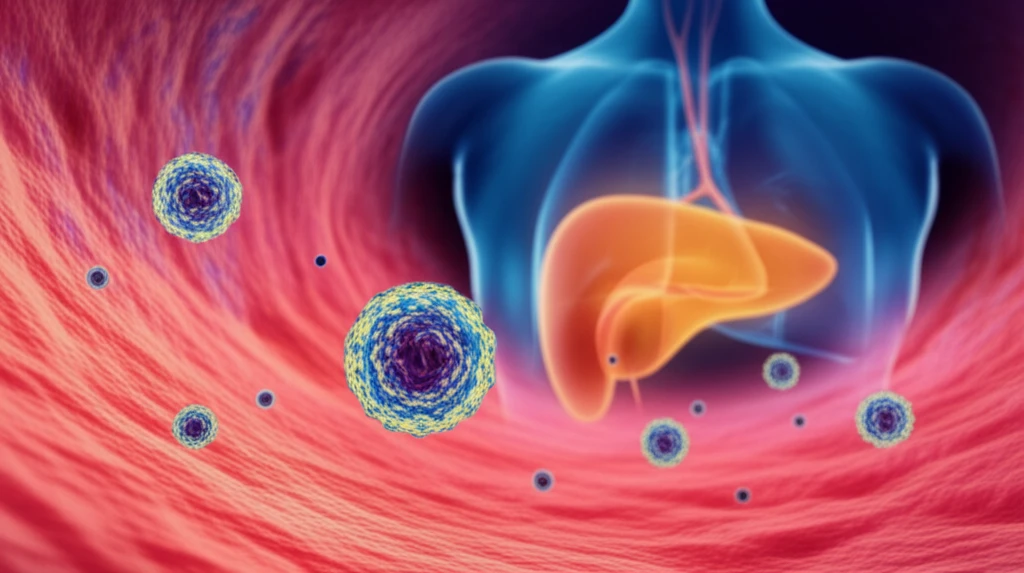
Exosomes floating in a blood stream in front of a pancreas

Cracking the Code: Can Exosome Analysis Revolutionize Pancreatic Cancer Detection?

"New research explores how surface-enhanced Raman spectroscopy (SERS) and advanced data analysis could lead to earlier, more accurate diagnoses."


Pancreatic cancer is one of the deadliest forms of cancer, often diagnosed at advanced stages when treatment options are limited. The lack of early detection methods is a critical challenge, driving researchers to explore innovative approaches for timely diagnosis. One promising avenue involves the study of exosomes, tiny vesicles released by cells that contain a wealth of information about their origin.

Exosomes have emerged as potential biomarkers for various diseases, including cancer. These vesicles carry proteins, RNA, and other molecules that reflect the state of the parent cell, offering a non-invasive way to probe the cellular environment. However, analyzing exosomes and extracting meaningful diagnostic information has been a complex undertaking.

A recent study published in Nanomedicine: Nanotechnology, Biology, and Medicine explores a novel method for characterizing exosomes using surface-enhanced Raman spectroscopy (SERS) coupled with principal component differential function analysis (PC-DFA). This approach aims to identify unique spectral signatures of exosomes derived from pancreatic cancer cells, potentially paving the way for earlier and more accurate detection of this devastating disease.

SERS and PC-DFA: A Powerful Combination for Exosome Analysis

Exosomes floating in a blood stream in front of a pancreas

The study's core innovation lies in the application of SERS to analyze exosomes. Raman spectroscopy is a technique that measures the vibrational modes of molecules, providing a unique fingerprint of their composition. By enhancing the Raman signal using metallic nanoparticles, SERS allows for highly sensitive detection of exosomal components.

Researchers combined SERS with PC-DFA, a sophisticated data analysis method, to identify distinct patterns in the Raman spectra of exosomes. This approach involves the following steps:

  • Exosome Isolation: Exosomes were isolated from cell culture supernatants of pancreatic cancer cell lines (CD18/HPAF and MiaPaCa) and a normal pancreatic epithelial cell line (HPDE).
  • SERS Measurement: Exosomes were mixed with gold nanoparticles and deposited on a gold substrate. Raman spectra were then acquired using a Raman microscope.
  • PC-DFA Analysis: Principal component analysis (PCA) was used to reduce the dimensionality of the SERS data, followed by differential function analysis (DFA) to classify exosomes based on their spectral signatures.
The PC-DFA algorithm was trained using exosomes derived from cell lines and then tested on serum samples from healthy individuals and patients with early-stage pancreatic cancer. The results demonstrated that this approach could differentiate between cancerous and non-cancerous exosomes with significant accuracy.

Implications and Future Directions

This study provides compelling evidence that SERS combined with PC-DFA can be a powerful tool for exosome analysis and early detection of pancreatic cancer. The ability to differentiate between cancerous and non-cancerous exosomes with high accuracy opens new possibilities for non-invasive diagnostics. While further research is needed to validate these findings in larger clinical trials, this approach holds great promise for improving the prognosis of pancreatic cancer patients.

About this Article -

This article was crafted using a human-AI hybrid and collaborative approach. AI assisted our team with initial drafting, research insights, identifying key questions, and image generation. Our human editors guided topic selection, defined the angle, structured the content, ensured factual accuracy and relevance, refined the tone, and conducted thorough editing to deliver helpful, high-quality information.See our About page for more information.

Everything You Need To Know

1

What are exosomes and why are they important for detecting diseases?

Exosomes are tiny vesicles released by cells that contain a variety of molecules, including proteins and RNA, which reflect the state of the parent cell. They're significant because they offer a non-invasive way to probe the cellular environment and can serve as biomarkers for diseases like pancreatic cancer. The implication of using exosomes in diagnostics is the potential for earlier and more accurate detection of diseases, allowing for timely intervention and improved treatment outcomes.

2

What is Surface-Enhanced Raman Spectroscopy (SERS) and how is it used to analyze exosomes?

Surface-Enhanced Raman Spectroscopy (SERS) is a technique that enhances Raman spectroscopy using metallic nanoparticles. Raman spectroscopy measures the vibrational modes of molecules, providing a unique fingerprint of their composition. SERS is significant because it allows for highly sensitive detection of exosomal components, making it possible to analyze the molecular composition of exosomes with greater precision. The implications of SERS in exosome analysis are improved detection sensitivity and the ability to identify subtle changes in exosomal composition that may indicate the presence of disease.

3

What is Principal Component Differential Function Analysis (PC-DFA) and how does it help in identifying cancerous exosomes?

Principal Component Differential Function Analysis (PC-DFA) is a sophisticated data analysis method used to identify distinct patterns in the Raman spectra of exosomes. It involves using principal component analysis (PCA) to reduce the dimensionality of the SERS data, followed by differential function analysis (DFA) to classify exosomes based on their spectral signatures. PC-DFA is significant because it allows researchers to differentiate between cancerous and non-cancerous exosomes with high accuracy. The implication of using PC-DFA in exosome analysis is the potential for non-invasive diagnostics that can detect diseases like pancreatic cancer at an early stage.

4

Why was it important to isolate exosomes from different pancreatic cell lines in the study?

The study isolated exosomes from pancreatic cancer cell lines (CD18/HPAF and MiaPaCa) and a normal pancreatic epithelial cell line (HPDE). This process is crucial because it allows researchers to obtain a pure sample of exosomes from specific cell types. By analyzing exosomes from both cancerous and normal cells, scientists can identify unique spectral signatures that distinguish between the two. Without this isolation step, it would be difficult to accurately characterize the molecular composition of exosomes and identify potential biomarkers for disease.

5

What role do gold nanoparticles play in the SERS analysis of exosomes?

Gold nanoparticles are used in SERS to enhance the Raman signal of exosomal components. When exosomes are mixed with gold nanoparticles and deposited on a gold substrate, the nanoparticles create a strong electromagnetic field that amplifies the Raman signal. This enhancement is significant because it allows for highly sensitive detection of exosomal components, even at low concentrations. The implications of using gold nanoparticles in SERS are improved detection sensitivity and the ability to analyze exosomes with greater precision.

Newsletter Subscribe

Subscribe to get the latest articles and insights directly in your inbox.