
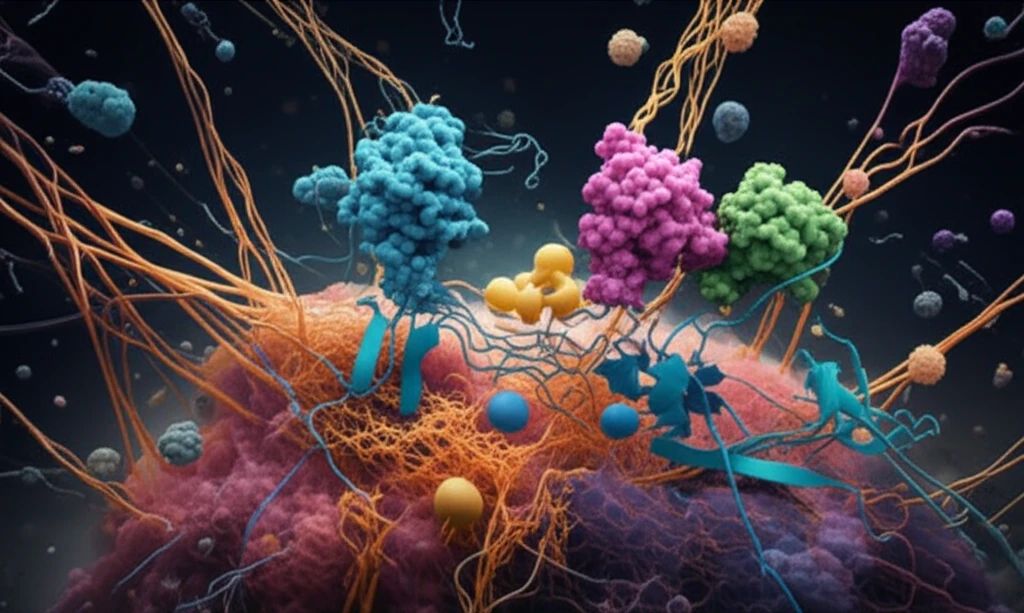
Cracking the Cell Code: How Kindlin-2 and ILK Team Up for Cellular Movement

"Discover how scientists are unraveling the mysteries of cell adhesion and spreading, offering new insights into tissue development and disease."
Our bodies are made up of trillions of cells, each with the ability to sense and interact with its environment. This interaction is crucial for everything from tissue development to wound healing. Integrins, receptors on the cell surface, play a vital role in this process by adhering to the surrounding environment. But integrins don't work alone; they team up with other proteins inside the cell, like kindlin, to get the job done.
For years, scientists have known that kindlin is essential for integrin-related functions, but the specifics of how it operates have remained unclear. A recent study published in the Journal of Cell Science sheds light on this mystery, focusing on the interaction between kindlin-2 and integrin-linked kinase (ILK).
This article will explore the groundbreaking research of Yasmin Kadry and her team, diving into how kindlin-2 and ILK cooperate to regulate cell adhesion and spreading. We'll break down the complex science into easy-to-understand terms and discuss the potential implications of this discovery for future research and medical treatments.
The Kindlin-2 and ILK Connection: A Cellular Partnership
The research team focused on understanding the interaction between kindlin-2 and ILK, suspecting that this partnership is crucial for cell function. To investigate, they first sought to pinpoint the exact binding site of kindlin-2 on ILK. By examining conserved regions on ILK – areas that remain similar across different species – they were able to identify the specific location where kindlin-2 attaches.
- Impaired Localization: The mutant ILK proteins failed to properly localize to focal adhesions, which are essential for cell adhesion and movement.
- Reduced Cell Spreading: Cells with the mutant ILK exhibited a decreased ability to spread, indicating a critical role for the kindlin-2 and ILK interaction in this process.
Why This Matters: Implications and Future Directions
This research provides valuable insights into the complex mechanisms that govern cell adhesion and spreading. By identifying the specific binding site between kindlin-2 and ILK and demonstrating the importance of this interaction, scientists have gained a deeper understanding of how cells interact with their environment.
Understanding cell adhesion and spreading is crucial for understanding a variety of biological processes, including tissue development, wound healing, and immune responses. Furthermore, disruptions in these processes can contribute to various diseases, such as cancer and fibrosis. By unraveling the intricacies of cell adhesion, this research could pave the way for new therapeutic strategies to target these diseases.
Looking ahead, future research could explore how this interaction is regulated and how it contributes to different cellular processes. Further investigation into the roles of kindlin-2 and ILK could reveal even more potential therapeutic targets for a wide range of diseases. As Yasmin Kadry aptly put it, seeing the effect on localization in live cells was both thrilling and rewarding, and this excitement is sure to fuel further discoveries in the field.