
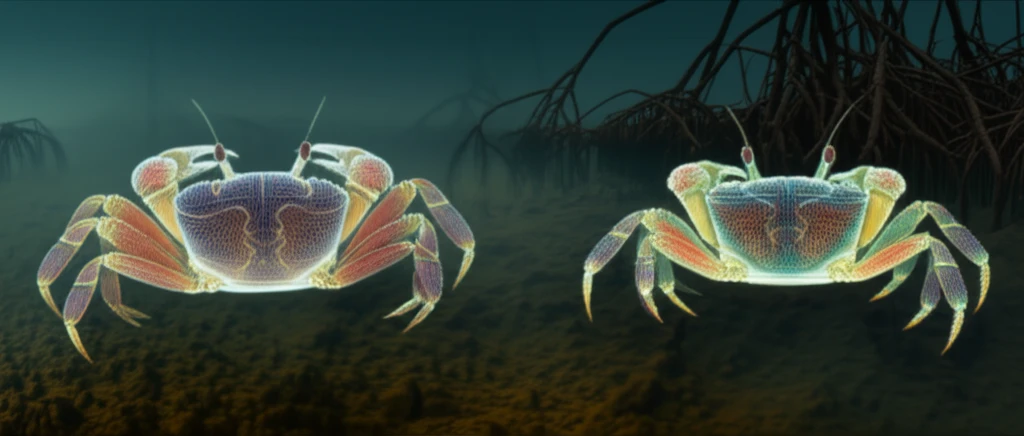
Crabs Under Stress: How Salinity Changes Impact Estuarine Life

"Uncover the surprising ways estuarine crabs adapt to drastic salinity shifts – and what it means for their survival."
Estuaries are dynamic environments where freshwater meets saltwater, leading to dramatic and frequent salinity fluctuations. These changes pose significant challenges for the organisms that call these habitats home, requiring them to adapt at biochemical, physiological, and behavioral levels to maintain their internal balance.
Crustaceans, such as crabs, are particularly vulnerable to salinity changes. While some can regulate their internal salt concentration regardless of the external environment (hyper-regulators), others conform to the salinity of their surroundings. Understanding how these creatures adapt is crucial for predicting their survival in the face of increasing environmental stressors.
This article delves into a study examining the histochemical fiber type composition in the claw closer muscles of two estuarine crab species, Cyrtograpsus angulatus and Neohelice granulata, under reduced salinity conditions. By analyzing muscle fiber types, researchers gained insights into the crabs' adaptation mechanisms and their ability to cope with the energetic demands of osmoregulation.
Decoding Crab Muscle: Fiber Types and Salinity Stress
The study focused on the claw closer muscles, essential for feeding, defense, and social interactions. Researchers acclimated the crabs to a low salinity environment (10 psu) and then analyzed the muscle tissue using various histochemical techniques, including myosin-adenosine triphosphatase (m-ATPase) to identify different fiber types, succinic dehydrogenase (SDH) to assess oxidative capacity, and Periodic Acid Schiff (PAS) and Sudan Black B to evaluate glycogen and lipid content, respectively.
- Fiber Type I: Large fibers with weak reactions, indicating lower glycolytic and oxidative capacity.
- Fiber Type IV: Small fibers with strong reactions, suggesting rapid contraction and high metabolic activity.
- Fiber Types II & III: Intermediate characteristics, offering a balance between speed and endurance.
Adapting to Change: Implications for Crab Survival
The differential responses observed in the claw closer muscles of Neohelice granulata and Cyrtograpsus angulatus highlight the complexity of adaptation to salinity stress. These findings suggest that each species employs unique mechanisms to cope with the energetic demands of osmoregulation and maintain essential functions in a fluctuating environment.
While the study did not find significant changes in lipid concentration in the claw closer muscles, it did observe variations in glycogen reserves, suggesting different energy utilization strategies between the two species. Further research is needed to fully elucidate the biochemical pathways involved in salinity adaptation and to assess the long-term consequences of these changes on crab populations.
Understanding how estuarine crabs respond to salinity fluctuations is crucial for predicting their resilience in the face of ongoing environmental changes, including climate change and habitat degradation. By studying their physiological adaptations, we can gain valuable insights into the broader ecological impacts of environmental stressors on estuarine ecosystems.