
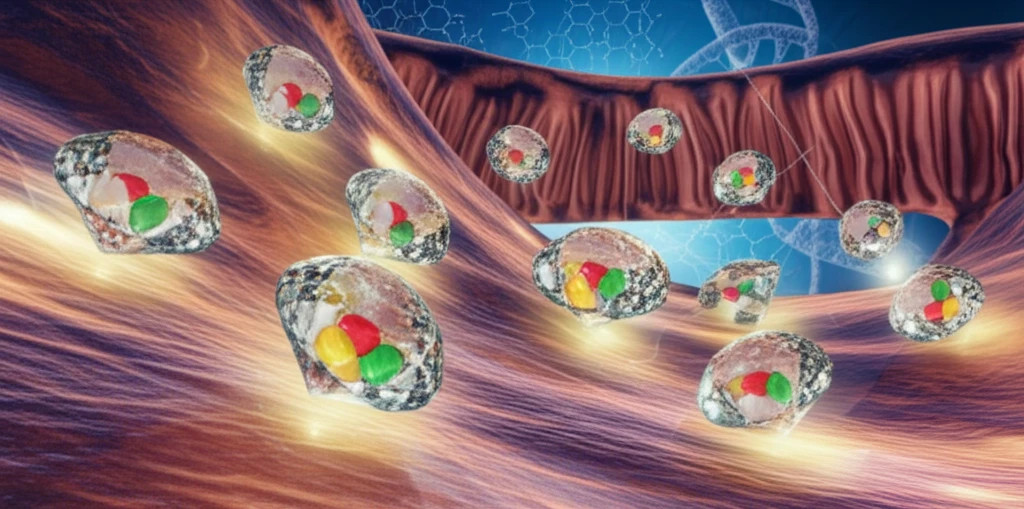
Could Nanodiamonds Be the Key to Better Vitamin Absorption? The Future of Oral Supplements

"Scientists are exploring how nanodiamonds, combined with Vitamin E TPGS, can revolutionize drug and nutrient delivery, potentially making supplements more effective."
In the ever-evolving world of nutritional science, the quest for maximizing the effectiveness of supplements is ongoing. Many nutrients, despite their potential benefits, suffer from poor absorption rates in the body, limiting their impact on health. Traditional oral supplements often fall short due to factors like poor solubility and instability in the gastrointestinal tract.
Recent research has turned towards nanotechnology to tackle these challenges, with nanodiamonds emerging as a promising tool. These tiny carbon structures, known for their biocompatibility and unique surface properties, are being explored as carriers to improve the delivery of vitamins and other nutrients.
A compelling study published in the International Journal of Pharmaceutics investigates the interactions between curcumin-loaded Vitamin E TPGS-coated nanodiamonds and Caco-2 cell monolayers, mimicking the intestinal barrier. This research aims to unlock new possibilities for enhancing nutrient absorption and bioavailability, potentially transforming how we approach supplementation.
An Emerging Supplement Strategy
Nanodiamonds are being investigated as a possible way to improve oral nutrient delivery, but their impact on vitamin absorption remains an emerging research question. The potential appeal lies in addressing common problems such as poor absorption, instability, and degradation during digestion. Evidence is not yet sufficient to establish nanodiamond-based supplements as a proven replacement for conventional formulations.
Why Conventional Delivery Falls Short
Conventional vitamin supplementation can struggle with heat, light, moisture, poor absorption, and rapid degradation during digestion. Nanodiamonds have attracted interest because they offer a large surface area, easy bioconjugation, and high biocompatibility, while typically measuring about 2–8 nm and being produced through detonation reactions. A study of curcumin-loaded, Vitamin E TPGS-coated nanodiamonds examined interactions with Caco-2 cell monolayers, an intestinal-barrier model, to explore whether this approach could improve nutrient absorption and bioavailability.
From Nanomaterial to Delivery Candidate
Nanodiamonds have gradually moved from being studied as unusual carbon nanomaterials toward consideration in nanomedicine and drug delivery. This development reflects growing interest in materials that can be engineered at very small scales and adapted for biological applications. Their possible role in oral vitamin delivery remains a newer extension of that broader research trajectory.
How Nanodiamonds Enhance Vitamin Absorption: The Science Explained
Nanodiamonds (NDs) are a novel class of carbon nanoparticles gaining traction in drug and nutrient delivery. Their appeal lies in several key characteristics: biocompatibility, a chemically inert core, and versatile surface properties that allow them to be easily modified with various molecules.
- Enhanced Absorption: Nanodiamonds significantly improve the intestinal permeability of curcumin, a compound known for its antioxidant and anti-inflammatory properties but limited by poor absorption.
- Cellular Uptake: Vitamin E TPGS-coated nanodiamonds are efficiently taken up by Caco-2 cells, a model for intestinal cells, indicating improved cellular absorption.
- Biocompatibility: The nanodiamonds exhibited low toxicity, suggesting they are safe for oral delivery.
- Targeted Delivery: The delivery mechanism involves energy-dependent endocytosis, where cells actively engulf the nanodiamonds.
A Broadening Research Field
Recent reviews place nanodiamonds within a wider wave of research on carbon-based nanomaterials, including carbon nano-onions, fullerenes, and graphite. A 2024 review covers nanodiamond synthesis methods, properties, and biomedical uses, while nutrition research examines nanoparticles as tools for improving the bioavailability and efficiency of bioactive compounds. The proposed nutritional advantage of nanoparticles is associated with properties such as exceptional solubility and a high surface-to-volume ratio.
Unresolved Safety Questions
The promise of nanodiamonds is accompanied by unresolved safety questions. Reviews identify uncertainty about whether nanodiamonds can invade and accumulate in cells and about how they are extracted from organisms. Clinical translation therefore still requires clearer evidence on biotoxicity, cellular effects, biodistribution, and the limitations of using nanodiamonds in medical applications.
A Potential but Unsettled Alternative
Nanodiamond delivery differs from standard oral supplementation by attempting to use a nanoscale carrier rather than relying solely on the vitamin formulation itself. In principle, a carrier-based strategy could address instability, solubility, or digestive losses, but the available material does not establish that nanodiamonds outperform established delivery methods. Any comparison should therefore weigh possible absorption benefits against unresolved safety and clearance questions.
The Future of Supplements: What Nanodiamonds Could Mean for You
While still in the early stages of research, nanodiamonds hold tremendous potential for transforming the supplement industry. By improving the absorption and bioavailability of nutrients, these tiny carriers could lead to more effective and targeted health interventions. As research progresses, we may see nanodiamonds playing a key role in personalized nutrition, ensuring that individuals receive the maximum benefit from their supplements.
Promising Chemistry, Incomplete Answers
Nanodiamonds offer a technically interesting platform for oral delivery because their surfaces can be modified with polymers or surfactants. However, the cited research reports that it is difficult to draw a definite conclusion about whether non-covalent or covalent attachment is more effective. The most responsible interpretation is that nanodiamond-based delivery is promising but still requires comparative evidence on oral delivery efficiency and safety.
The Next Evidence Threshold
Future work will need to determine whether nanodiamonds can consistently improve vitamin absorption in realistic oral formulations. Research priorities include comparing surface-coating strategies, testing performance beyond laboratory models, and clarifying how the particles behave in the body. Until those questions are answered, nanodiamonds are better viewed as an experimental platform than as a ready-to-use supplement technology.
Vitamin Delivery as a Public-Health Challenge
Vitamin deficiencies involving vitamins D, A, E, K, B12, and folate remain a significant public-health concern despite widespread supplementation efforts. Traditional oral formulations can have low bioavailability because of poor water solubility, instability in the digestive tract, and substantial first-pass metabolism. Nanocarrier-based systems are being explored alongside broader nanotechnology approaches to address poor solubility, instability, rapid degradation, and inefficient absorption.
What Measurement Can Tell Us
Research on detonation nanodiamonds has experimentally examined how absorption compares with scattering in their light spectra. The study used UV-visible spectrophotometry with an integrating sphere and compared those measurements with conventional absorbance spectra. This finding informs how nanodiamonds are characterized, but by itself it does not demonstrate improved vitamin absorption or a health benefit in people.