
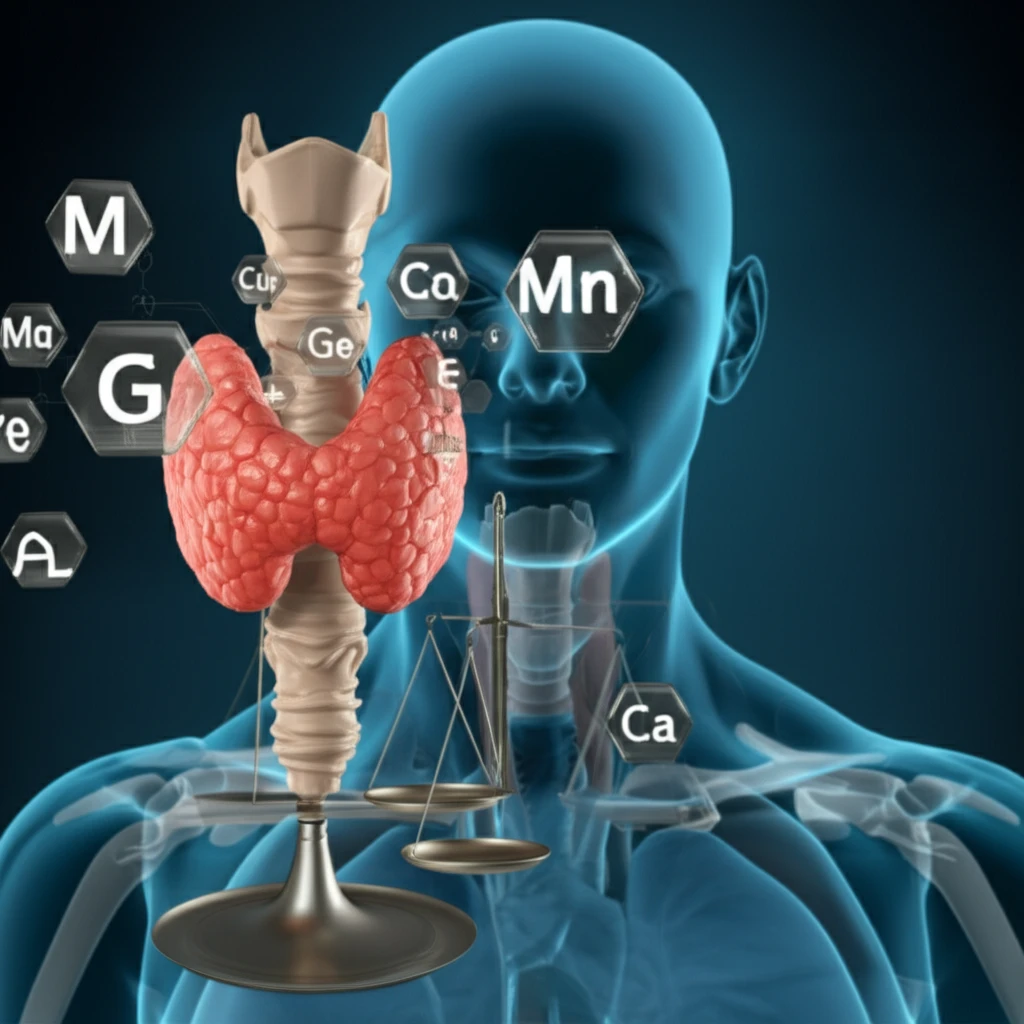
Surreal illustration of thyroid gland intertwined with manganese symbols, representing the balance between health and toxicity.

Could Manganese Be Silently Sabotaging Your Thyroid?

"Groundbreaking research reveals how a common metal may disrupt thyroid function and what you can do about it."


Manganese, an essential metal for various bodily functions, walks a precarious line between necessity and neurotoxicity. When levels surge, particularly in the brain's basal ganglia, it can trigger a cascade of neurological issues. While excessive exposure is a well-known culprit, impaired excretion due to liver dysfunction can also lead to manganese buildup, even without elevated environmental levels. Recent studies have uncovered two genetic disorders, stemming from mutations in the SLC30A10 and SLC39A14 genes, which disrupt manganese metabolism and lead to neurotoxicity.

Adding a surprising twist to the story, scientists have discovered that a deficiency in the SLC30A10 transporter not only leads to manganese overload but also to severe hypothyroidism. This unexpected finding suggests that thyroid health might be an underappreciated aspect of manganese toxicity, prompting a deeper dive into the connection between the metal and our thyroid.

This article explores groundbreaking research into how manganese disrupts thyroid function, potentially leading to hypothyroidism. We'll dissect the roles of key manganese transporters, SLC30A10 and SLC39A14, and reveal how imbalances in these systems can throw your thyroid health off track. By understanding this intricate relationship, you can take proactive steps to protect your thyroid and overall well-being.

The Manganese-Thyroid Connection: How Transporters Play a Key Role

Surreal illustration of thyroid gland intertwined with manganese symbols, representing the balance between health and toxicity.

The study sheds light on how two key transporters, SLC30A10 and SLC39A14, work together to maintain manganese balance in the body, particularly in the liver and thyroid. SLC30A10 acts as a manganese 'efflux' transporter, responsible for removing excess manganese from cells, while SLC39A14 functions as an 'influx' transporter, bringing manganese into cells. These transporters are like gatekeepers, carefully controlling the flow of manganese in and out of cells to prevent dangerous buildup.

To unravel the complexities of manganese metabolism and its impact on the thyroid, researchers conducted a series of experiments on mice. They created different groups of mice: those lacking only SLC30A10, those lacking only SLC39A14, and those lacking both transporters. By comparing the manganese levels in various tissues and assessing thyroid function in each group, they gained valuable insights into the roles of these transporters.

Here's what they discovered:
  • SLC30A10 Deficiency: Mice lacking SLC30A10, the manganese exporter, experienced elevated manganese levels in the liver, blood, brain, and thyroid, leading to hypothyroidism.
  • SLC39A14 Deficiency: Mice lacking SLC39A14, the manganese importer, showed higher manganese levels in the blood and brain but not in the liver. Interestingly, these mice did NOT develop hypothyroidism.
  • Double Knockout (lacking both): Mice lacking both transporters had even higher manganese levels in the blood and brain than either single knockout group. Like the SLC39A14 deficient mice, they did not develop hypothyroidism.
These findings suggest that while both transporters are crucial for overall manganese balance, the specific accumulation of manganese in the thyroid, driven by SLC30A10 deficiency, is what triggers thyroid dysfunction. The research also revealed that SLC39A14 and SLC30A10 are strategically positioned in liver cells to regulate manganese excretion, with SLC39A14 facilitating manganese entry into liver cells and SLC30A10 mediating its removal into bile for elimination from the body.

Protecting Your Thyroid: Key Takeaways and Future Directions

This research provides compelling evidence that manganese accumulation in the thyroid can directly impair thyroid hormone production, leading to hypothyroidism. The good news is that understanding this link empowers you to take proactive steps to protect your thyroid health.

Here are some key takeaways from the study: <ul> <li>Manganese is essential, but balance is key.</li> <li>Thyroid health is an underappreciated aspect of manganese toxicity.</li> <li>SLC30A10 and SLC39A14 transporters play a crucial role in manganese metabolism.</li> </ul>

Future research will focus on pinpointing the exact steps in thyroid hormone synthesis that are disrupted by manganese and exploring the potential of targeted therapies to restore thyroid function in individuals with manganese imbalances. Until then, maintaining a balanced diet, minimizing exposure to excessive manganese, and consulting with a healthcare professional about your individual risk factors are crucial steps in safeguarding your thyroid.

About this Article -

This article was crafted using a human-AI hybrid and collaborative approach. AI assisted our team with initial drafting, research insights, identifying key questions, and image generation. Our human editors guided topic selection, defined the angle, structured the content, ensured factual accuracy and relevance, refined the tone, and conducted thorough editing to deliver helpful, high-quality information.See our About page for more information.

Everything You Need To Know

1

What is the main connection between manganese and thyroid health?

Manganese is a metal essential for various bodily functions, but it can become problematic. Its accumulation, particularly in the thyroid, can disrupt thyroid hormone production. This can lead to hypothyroidism. The SLC30A10 and SLC39A14 transporters play key roles in managing manganese levels, with the SLC30A10 being particularly crucial for preventing thyroid dysfunction.

2

What roles do the SLC30A10 and SLC39A14 transporters play in manganese balance?

The SLC30A10 and SLC39A14 transporters are key in maintaining the right balance of manganese in the body. SLC30A10 removes excess manganese from cells, while SLC39A14 brings manganese into cells. The research showed that a deficiency in SLC30A10, which leads to manganese buildup in the thyroid, causes hypothyroidism. This highlights the importance of these transporters in protecting thyroid health.

3

What is hypothyroidism, and how does it relate to the findings about manganese?

Hypothyroidism, resulting from manganese accumulation in the thyroid, is a condition where the thyroid gland does not produce enough thyroid hormones. This can lead to various symptoms, including fatigue, weight gain, and cognitive issues. The research suggests that by understanding the role of manganese and its transporters, individuals can take steps to protect their thyroid health and potentially prevent hypothyroidism.

4

How were the roles of SLC30A10 and SLC39A14 investigated in the study?

The experiments involved studying mice with deficiencies in the SLC30A10 and SLC39A14 transporters. Mice lacking the SLC30A10 transporter developed hypothyroidism due to manganese accumulation in the thyroid. Mice lacking SLC39A14 did not show hypothyroidism. This highlights that SLC30A10's role is vital to prevent thyroid dysfunction. This research method helped scientists understand how these transporters affect manganese balance.

5

Why is it important to understand the relationship between manganese and the thyroid?

Understanding the connection between manganese, the SLC30A10 and SLC39A14 transporters, and thyroid health is significant because it provides a target for proactive health measures. By understanding that manganese accumulation can lead to hypothyroidism, individuals can make informed choices to protect their thyroid, such as being mindful of manganese exposure or supporting liver function. While specific steps are not explicitly detailed, the research underscores the importance of further exploring this relationship.

Newsletter Subscribe

Subscribe to get the latest articles and insights directly in your inbox.