
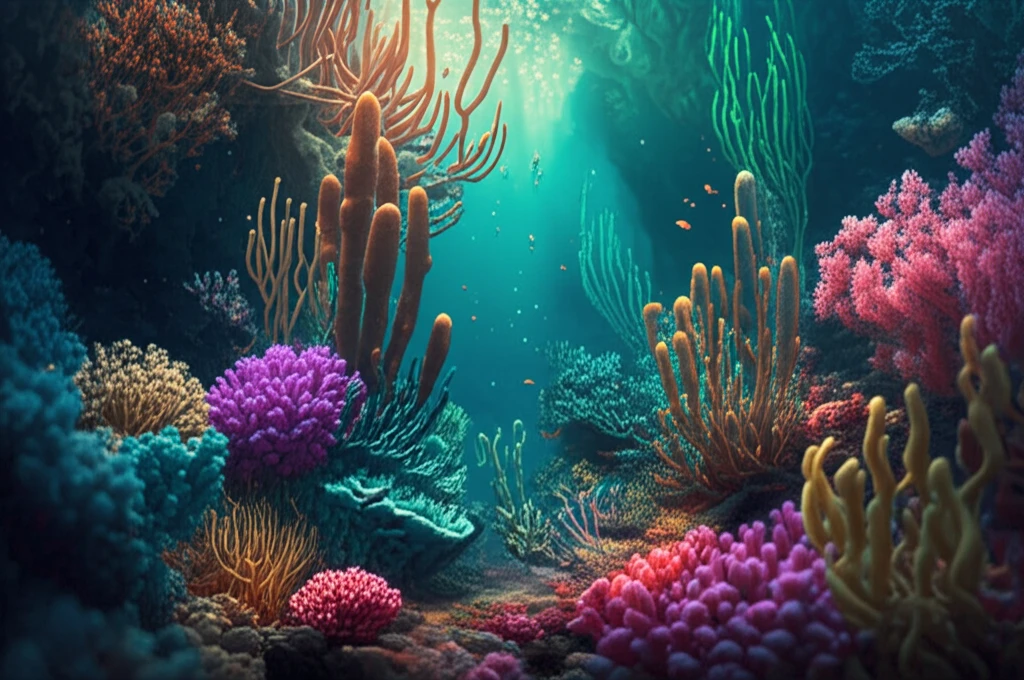
Coral Comeback? How Reefs Are Adapting to Climate Change

"Discover the surprising resilience of coral reefs and the sea sponges that may hold the key to surviving future El Niño events."
Coral reefs around the world are facing unprecedented challenges from human impacts and global climate change. Rising ocean temperatures, ocean acidification, and the increasing frequency of extreme weather events like El Niño are threatening the health and survival of these vital marine ecosystems. However, some organisms inhabiting marginal habitats may be adapting to higher levels of physiological stress. This raises the possibility that insights can be gleaned into how coral might be saved.
A recent study focused on emergent intertidal coral reefs in Bahia, Brazil, examined the long-term impacts of the 1997-98 El Niño event on reef fauna. These reefs, which experience significant daily fluctuations in temperature and solar radiation, offer a unique opportunity to study the resilience of coral species and reef communities under extreme conditions. The 17-year biodiversity survey (1995-2011) assessed the impact of the major El Niño event on the reef fauna and tracked subsequent recovery, revealing surprising insights into the adaptability of certain species.
Intertidal reefs may be more resilient to climatic events and provide important insights into the adaptation of reef fauna to future ocean warming.
A Rich Ecosystem Under Rapid Decline
Coral reefs are underwater ecosystems formed from colonies of coral polyps held together by calcium carbonate, with most reefs built from stony corals whose polyps cluster in groups. These structures host immense biodiversity, supporting more than 25% of all known marine species according to one statistical roundup. Yet the outlook is grim: reports project that reefs could lose about 75% of their area by 2100 under higher emissions, even as roughly 30% of the world's reefs are already considered degraded and intensifying climate-driven heatwaves continue to trigger bleaching. Sources consistently characterize reefs as extraordinarily rich yet critically threatened ecosystems facing rapid decline despite existing protections.
Surveying Reefs Through Indicator Species
A widely used field approach is the Reef Check protocol, an eco-holistic method that relies on indicator species and records three components of the reef—fish, invertebrates, and substrate—with only minor modifications for particular sites. Similar survey programs collect data on the species diversity, abundance, and size of fish communities while also characterizing the reef's makeup, including corals and algae. The importance of such monitoring rests partly on what healthy reefs provide: more than half of all U.S. fisheries species depend on coral reefs for a portion of their life cycles, supporting commercial and recreational fishing. Observers note that reefs are among the most complex and biologically diverse ecosystems, which is precisely why standardized, comprehensive survey methods matter.
Ancient Structures, Centuries of Observation
Most established coral reefs are between 5,000 and 10,000 years old, and although they are the largest structures of biological origin on the planet, they are extremely delicate, forming only under specific conditions. The animals primarily responsible for building reefs are coral polyps, which can take many forms—from large reef-building colonies and graceful flowing fans to small solitary organisms—and thousands of coral species have been discovered. European interest in reefs dates back to the age of exploration, when they were feared as dangerous hazards to voyaging amid speculation about a Great South Land. This mix of ancient natural history and centuries of scientific curiosity frames how researchers study reefs today.
Differential Responses: Resilience and Decline
The study revealed a mixed picture of resilience and decline among different reef organisms. Two dominant coral species, Favia gravida and Siderastrea stellata, showed remarkable tolerance to the El Niño-associated stress. Their densities remained relatively stable throughout the survey period, suggesting a high degree of adaptation to fluctuating environmental conditions. However, other taxa experienced significant declines.
- Coral Resilience: Two coral species showed high tolerance to El Niño stress.
- Decline in Other Taxa: Molluscs, bryozoans, and ascidians suffered significant losses.
- Echinoderm Recovery: Echinoderms recovered diversity after an initial reduction.
- Sponge Success: Sponges were not impacted and increased in density.
Signs of Resilience and New Research Leads
As coral reefs decline at unprecedented rates, recent research indicates that some coral species may be more resilient to warming temperatures than others, offering a potential bright spot in otherwise sobering findings. Studies describe coral reefs as among the most productive ecosystems on Earth, with the defining relationship being the symbiosis between corals and algae of the genus Symbiodinium. Reports also emphasize that reefs nurture an estimated quarter of ocean species at some point in their life cycles, support fish that provide protein for millions of people, and protect coastlines from storms. Together these findings point researchers toward which reefs are hanging on and why.
Legislative Failures and Conflicting Assessments
Some analyses argue that legislation has been ineffective at preserving coral reefs, with climate change described as the dominant driver of decline within a 'perfect storm' of human-caused threats. One fact sheet reports that 75% of the world's coral reefs are at risk and 10% are already damaged beyond repair, though it also cites success stories in slowing or reversing degradation. By contrast, critics of mainstream coverage contend the situation is overstated—physicist Peter Ridd has argued the Great Barrier Reef was still doing fine despite six supposedly cataclysmic bleaching events in the last decade, saying 'there should be no coral at all if those reports were true.' Even as these assessments conflict, the Great Barrier Reef remains home to more than 400 coral species, 1,500 fish species, 4,000 mollusc species, and six of the world's seven sea turtle species, underscoring the stakes of the debate.
Rainforests of the Sea Under Pressure
Coral reefs are commonly compared to tropical rainforests because of their exceptionally high biodiversity, with both ecosystems supporting vast numbers of species despite covering relatively small areas of the Earth. That biodiversity is under measurable strain: intensive studies report that 62% of reef fish species decreased in abundance within a short three-year period, while bleaching, storms, and outbreaks of destructive species such as crown-of-thorns starfish have reduced coral cover by 10% or more. Comparative risk analyses, including work by The Nature Conservancy and UNAM, examine how impacts on coral cover differ across realms, showing that threats are not distributed evenly worldwide. Analyses also emphasize that restoration efforts are essential and often more cost-effective than artificial alternatives.
Hope for the Future
The study's findings underscore the complex and varied responses of reef organisms to climate-related stressors. While the overall composition of the reef community has shifted, the resilience of certain coral and sponge species offers a glimmer of hope. These species may represent valuable models for understanding temperature adaptation in reef organisms and could inform conservation efforts aimed at enhancing reef resilience in the face of ongoing climate change. Further research into the physiological mechanisms underlying their tolerance could provide crucial insights for protecting these vital ecosystems.
Experts Converge, Knowledge Gaps Remain
In July 2026, coral reef scientists, conservationists, policymakers, and community leaders from more than 90 countries met at the International Coral Reefs Symposium in Auckland, Aotearoa New Zealand, to press forward with climate looming over the proceedings. Expert opinion has also been formally assessed to identify current knowledge gaps in determining future changes to reefs, including a focused study of Arabian/Persian Gulf coral reefs. Practical guidance continues to be developed, including ecological engineering guides devoted to restoring coral reefs and their associated ecosystems—seagrasses and mangroves—that build on earlier IFRECOR publications on reef restoration. Together these efforts show a field consolidating its methods and priorities even as the climate challenge intensifies.
Reading the Past to Plan for the Future
Coral reefs cover just 0.1% of the ocean floor yet provide habitat for approximately 25% of all marine species, making their future outlook a matter of outsized consequence, as one crisis report notes. Researchers are increasingly turning to palaeoclimatology—studying coral skeletons to uncover past climate and environmental changes, for example in the Caribbean—to inform predictions for reefs' future. Institutions such as the World Resources Institute frame the challenge around decoding reefs' status, the risks they face, and strategies for ensuring their future. Restoration technologies and status assessments, including regionally focused outlooks for places like Florida, round out the emerging frontier.
A Systemic Crisis Requires Systemic Response
The systemic nature of the coral reef crisis is captured by UNEP Executive Director Achim Steiner, who states that coral reefs are 'extraordinary and critically important ecosystems, but they are severely impacted by rising ocean temperatures and acidity.' Because the drivers—warming waters and ocean acidification—are global in origin, responses cannot be confined to individual reefs or nations. UNEP frames the situation as an urgent need for sustainable management of coral reefs, treating them as ecosystems whose decline reflects broader environmental pressures. This positions reef conservation within the larger climate and sustainability agenda rather than as an isolated marine issue.
Stressed Reefs, Natural Refuges, and Limited Refuge
Coral reefs face an unprecedented combination of stressors, with climate change the most severe threat as rising ocean temperatures trigger bleaching events of increasing frequency and severity. However, research suggests some reefs have a 'secret weapon': naturally cooled sites that survive marine heatwaves—though researchers caution such refuges don't necessarily have permanence, and a reef that rides out one heatwave might not survive the next as climate conditions change. Human impacts on reefs vary with depth along the reef profile and the environmental descriptor adopted, meaning local pressures compound global ones unevenly. Reef-building corals also have hard habitat requirements, needing shallow, clear water that allows light penetration for the photosynthesis on which their symbiotic relationship with algae depends.