
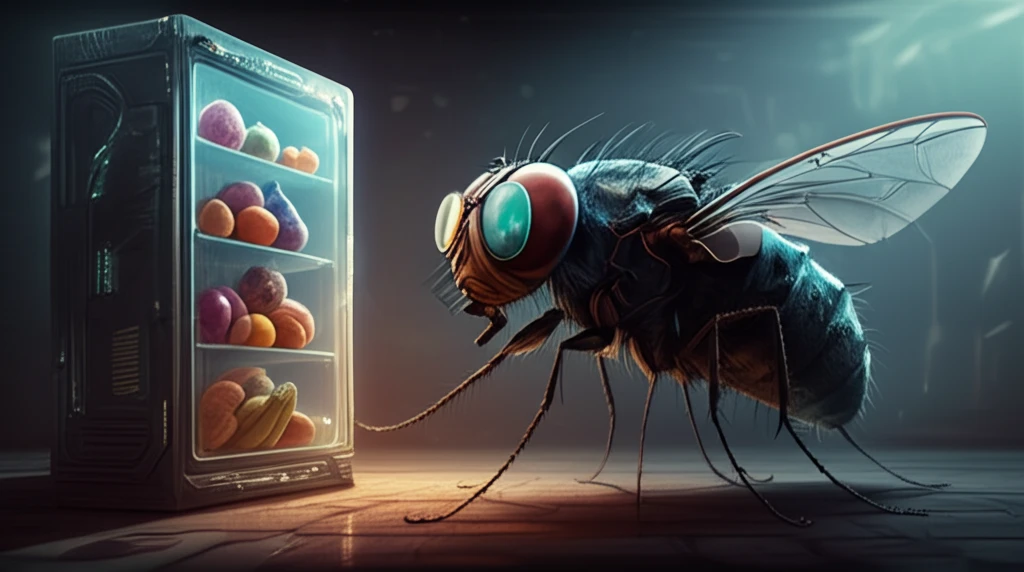
Fruit fly optimizing a futuristic refrigerator

Cooling Reinvented: How Fruit Fly Optimization is Revolutionizing Refrigeration

"Eco-friendly Refrigeration: Discover how bio-inspired algorithms are making thermoacoustic refrigerators more efficient and sustainable."


Refrigeration is an indispensable aspect of modern life, essential for preserving food, medicines, and maintaining comfortable environments. However, traditional refrigeration systems often rely on harmful refrigerants and consume significant amounts of energy. As the world increasingly focuses on sustainability, there is a growing need for eco-friendly and energy-efficient cooling technologies. This is where thermoacoustic refrigeration comes into play, offering a promising alternative.

Thermoacoustic refrigeration uses sound waves to produce cooling, eliminating the need for chemical refrigerants. The technology is based on the principle that when a sound wave travels through a gas, it causes the gas to compress and expand, creating temperature differences. These temperature differences can then be used to cool an object or space. Despite its potential, thermoacoustic refrigeration has faced challenges in achieving efficiencies comparable to conventional systems.

Now, researchers are turning to nature-inspired optimization techniques to enhance the performance of thermoacoustic refrigerators. One such method is the Fruit Fly Optimization Algorithm (FOA), a computational technique that mimics the foraging behavior of fruit flies to find optimal solutions. This article explores how FOA is being used to fine-tune the design and operation of thermoacoustic refrigerators, paving the way for more efficient and sustainable cooling solutions.

What is Fruit Fly Optimization and Why is it a Game Changer for Refrigeration?

Fruit fly optimizing a futuristic refrigerator

The Fruit Fly Optimization Algorithm (FOA) is a nature-inspired algorithm that mimics the food-finding behavior of fruit flies. Fruit flies, known for their excellent sense of smell, can detect food sources from great distances. FOA leverages this capability by simulating a population of fruit flies searching for the best solution in a given problem space. Each fruit fly represents a potential solution, and the algorithm iteratively refines these solutions based on their 'smell' (fitness) value.

In the context of thermoacoustic refrigeration, FOA is used to optimize various design parameters such as stack length, stack center position, blockage ratio, and drive ratio. These parameters significantly impact the refrigerator's performance, and finding the optimal combination can be challenging. FOA provides an efficient way to explore the design space and identify the parameter values that maximize the refrigerator's coefficient of performance (COP) and cooling power.

Here are the Benefits of FOA:
  • Efficiency: FOA can quickly converge to optimal solutions, reducing the computational time and resources required for design optimization.
  • Flexibility: FOA can handle complex, multi-dimensional problems, making it suitable for optimizing various aspects of thermoacoustic refrigerator design.
  • Robustness: FOA is less sensitive to the initial starting point, ensuring that it can find good solutions even with limited prior knowledge.
  • Eco-Friendliness: By optimizing the design of thermoacoustic refrigerators, FOA contributes to the development of more energy-efficient and sustainable cooling technologies.
A research study published in the International Journal of Refrigeration demonstrated the effectiveness of FOA in optimizing a stack unit of a standing wave thermoacoustic refrigerator. The researchers found that FOA not only improved the refrigerator's COP but also enhanced its cooling power. Compared to traditional optimization methods, FOA showed better results, indicating its potential as a powerful tool for designing high-performance thermoacoustic refrigerators.

The Future of Cooling: What's Next for FOA and Thermoacoustic Refrigeration?

The successful application of FOA in optimizing thermoacoustic refrigerators opens up exciting possibilities for the future of cooling technology. As research continues, FOA can be further refined and integrated with other optimization techniques to achieve even greater levels of efficiency and performance. Additionally, FOA can be used to optimize other components of thermoacoustic systems, such as heat exchangers and resonators, leading to holistic improvements in system design.

About this Article -

This article was crafted using a human-AI hybrid and collaborative approach. AI assisted our team with initial drafting, research insights, identifying key questions, and image generation. Our human editors guided topic selection, defined the angle, structured the content, ensured factual accuracy and relevance, refined the tone, and conducted thorough editing to deliver helpful, high-quality information.See our About page for more information.

This article is based on research published under:

DOI-LINK: 10.1016/j.ijrefrig.2018.09.031, Alternate LINK

Title: Single-Objective Optimization For Stack Unit Of Standing Wave Thermoacoustic Refrigerator Through Fruit Fly Optimization Algorithm

Subject: Mechanical Engineering

Journal: International Journal of Refrigeration

Publisher: Elsevier BV

Authors: Anas A. Rahman, Xiaoqing Zhang

Published: 2019-02-01

Everything You Need To Know

1

What are the primary benefits of using thermoacoustic refrigeration compared to traditional systems?

Thermoacoustic refrigeration offers several key advantages over traditional refrigeration. It eliminates the need for chemical refrigerants, which are often harmful to the environment. Instead, it uses sound waves to produce cooling, making it a more eco-friendly option. While this method has faced challenges in efficiency, ongoing research and optimization techniques like Fruit Fly Optimization (FOA) are helping to improve its performance, bringing it closer to the efficiency levels of conventional systems. The ability to operate without harmful refrigerants is a significant step towards more sustainable cooling solutions. Further development of thermoacoustic refrigeration promises a greener approach to preserving food and maintaining comfortable environments, aligning with global sustainability goals.

2

How does the Fruit Fly Optimization Algorithm (FOA) work to improve thermoacoustic refrigerator design?

The Fruit Fly Optimization Algorithm (FOA) mimics the food-finding behavior of fruit flies to optimize the design of thermoacoustic refrigerators. Fruit flies are known for their keen sense of smell, which allows them to detect food sources from great distances. FOA simulates a population of fruit flies, each representing a potential solution to the design problem. The algorithm iteratively refines these solutions based on their 'smell' (fitness) value, searching for the parameter values that maximize the refrigerator's coefficient of performance (COP) and cooling power. For instance, FOA can adjust parameters such as stack length, stack center position, blockage ratio, and drive ratio to enhance the refrigerator's overall efficiency and performance. The algorithm's ability to efficiently explore the design space makes it a powerful tool for optimizing complex systems like thermoacoustic refrigerators.

3

What specific parameters of thermoacoustic refrigerators can be optimized using the Fruit Fly Optimization Algorithm (FOA)?

The Fruit Fly Optimization Algorithm (FOA) is used to fine-tune several critical design parameters of thermoacoustic refrigerators. These include the stack length, stack center position, blockage ratio, and drive ratio. The stack is a crucial component where the thermoacoustic effect occurs, and its dimensions and placement significantly impact the refrigerator's performance. The blockage ratio affects the flow of gas through the stack, while the drive ratio influences the amplitude of the sound waves. By optimizing these parameters, FOA helps to maximize the refrigerator's coefficient of performance (COP) and cooling power, leading to more efficient and effective cooling. The algorithm's ability to handle complex, multi-dimensional problems makes it well-suited for optimizing these interconnected parameters.

4

What are the key advantages of using the Fruit Fly Optimization Algorithm (FOA) compared to traditional optimization methods in the context of thermoacoustic refrigerators?

Compared to traditional optimization methods, the Fruit Fly Optimization Algorithm (FOA) offers several key advantages for optimizing thermoacoustic refrigerators. FOA can quickly converge to optimal solutions, reducing the computational time and resources required for design optimization. It is also highly flexible, capable of handling complex, multi-dimensional problems, making it suitable for optimizing various aspects of thermoacoustic refrigerator design. Furthermore, FOA is robust, meaning it is less sensitive to the initial starting point, ensuring that it can find good solutions even with limited prior knowledge. The International Journal of Refrigeration has published a study demonstrating FOA's effectiveness in improving a refrigerator's COP and enhancing its cooling power compared to traditional optimization methods, highlighting its potential as a powerful tool for designing high-performance thermoacoustic refrigerators.

5

What are the potential future developments and applications of the Fruit Fly Optimization Algorithm (FOA) in cooling technology?

The successful application of the Fruit Fly Optimization Algorithm (FOA) in optimizing thermoacoustic refrigerators opens up exciting possibilities for the future of cooling technology. As research continues, FOA can be further refined and integrated with other optimization techniques to achieve even greater levels of efficiency and performance. Additionally, FOA can be used to optimize other components of thermoacoustic systems, such as heat exchangers and resonators, leading to holistic improvements in system design. The ongoing refinement of FOA and its application to other components of thermoacoustic systems could lead to more energy-efficient and sustainable cooling technologies. These advancements could pave the way for wider adoption of thermoacoustic refrigeration, contributing to a greener and more sustainable future for cooling.

Newsletter Subscribe

Subscribe to get the latest articles and insights directly in your inbox.