
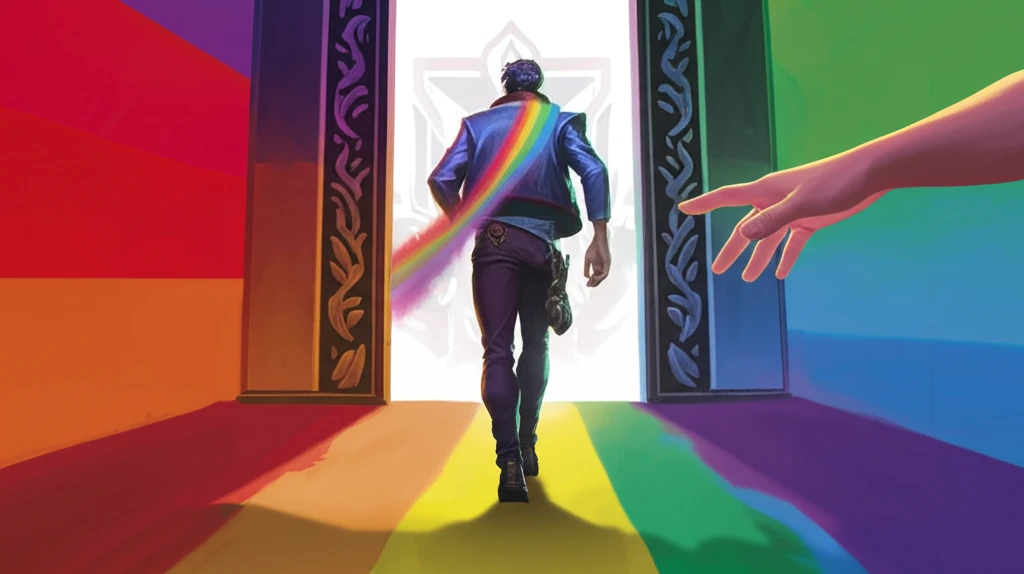
LGBTQ+ character walking from a Pride colorful world to the black and white

Coming Out in the Digital Age: The Economic and Social Costs of Disclosure

"New research reveals the subtle yet significant economic and social penalties individuals face when disclosing their sexual orientation online, impacting preferences and choices in unexpected ways."


In an era increasingly defined by digital interactions, the complexities of identity and social acceptance are playing out in new arenas. While progress has been made in advancing LGBTQ+ rights, subtle forms of prejudice and discrimination persist, often hidden beneath the surface of everyday life. Understanding these hidden biases is crucial, especially as more individuals navigate the challenges of disclosing their sexual orientation in various social and professional contexts.

New research leverages a unique data source to explore the economic and social costs associated with 'coming out.' By analyzing user behavior within a popular online game, this study uncovers how revealing one's sexual orientation can subtly shift perceptions and preferences, leading to tangible social and economic consequences. This innovative approach provides a fresh perspective on the challenges faced by LGBTQ+ individuals and the persistent impact of stigma in the digital age.

This article dives deep into the findings of this research, exploring the methodologies used, the surprising outcomes revealed, and the broader implications for understanding and addressing LGBTQ+ discrimination in an increasingly interconnected world. Discover how a virtual world can shed light on real-world biases, and what these insights mean for creating more inclusive and equitable environments for everyone.

The Hidden Costs of Coming Out: What the Research Reveals

LGBTQ+ character walking from a Pride colorful world to the black and white

The study, titled "The Cost of Coming Out," utilizes data from the online game League of Legends to examine how players react when a character's sexual orientation is revealed. Researchers Enzo Brox and Riccardo Di Francesco analyzed player preferences for the character Graves before and after game developers announced he was gay as part of LGBT Pride Month in June 2022.

By tracking how frequently players chose Graves before and after the announcement, the researchers were able to quantify the impact of this disclosure on player behavior. This approach allowed them to bypass many of the limitations of traditional survey methods, which can be affected by self-reporting biases and other factors. The results of their analysis were both surprising and revealing.

  • Significant Drop in Popularity: Following the announcement, there was a substantial and persistent decline in the frequency with which players selected Graves. The data showed a decline of more than 30% of the pre-treatment average preferences for that character.
  • Global Consistency: The negative impact was observed across diverse regions worldwide, suggesting that the bias isn't limited to specific geographic areas.
  • No Change in Character Strength: The character's abilities and performance within the game remained unchanged, ruling out the possibility that players were simply reacting to a perceived weakening of the character.
To ensure that these results were not influenced by other factors, the researchers employed a 'synthetic control' method, weighting other characters in the game to create a baseline of how Graves' popularity would have likely evolved without the disclosure. By comparing this baseline to the actual data, they could isolate the specific impact of the coming-out event.

What Does This Mean for the Real World?

While this study takes place in a virtual environment, its implications extend far beyond the realm of online gaming. The results highlight the subtle yet significant ways in which biases and prejudices can manifest, even in seemingly progressive spaces. By understanding these dynamics, we can work towards creating more inclusive and equitable environments for LGBTQ+ individuals in all aspects of life.

About this Article -

This article was crafted using a human-AI hybrid and collaborative approach. AI assisted our team with initial drafting, research insights, identifying key questions, and image generation. Our human editors guided topic selection, defined the angle, structured the content, ensured factual accuracy and relevance, refined the tone, and conducted thorough editing to deliver helpful, high-quality information.See our About page for more information.

This article is based on research published under:

DOI-LINK: https://doi.org/10.48550/arXiv.2403.03649,

Title: The Cost Of Coming Out

Subject: econ.gn q-fin.ec

Authors: Enzo Brox, Riccardo Di Francesco

Published: 06-03-2024

Everything You Need To Know

1

What specific research findings quantify the economic and social impact of disclosing sexual orientation?

The research, detailed in the study titled "The Cost of Coming Out", reveals a significant drop in the popularity of the character Graves in the online game League of Legends after game developers announced his sexual orientation. The data shows a decline of more than 30% in the frequency with which players selected Graves. This quantitative data highlights a tangible economic impact, demonstrating a shift in player preferences due to the disclosure. The research further notes the global consistency of this negative impact, observed across various regions worldwide, indicating that the bias is not limited to specific geographic areas.

2

How did the study in "The Cost of Coming Out" isolate the impact of sexual orientation disclosure from other potential factors?

To isolate the specific impact of the coming-out event, researchers Enzo Brox and Riccardo Di Francesco utilized a 'synthetic control' method. This approach involved weighting other characters in League of Legends to create a baseline of how Graves' popularity would have likely evolved without the disclosure. By comparing this baseline to the actual data, the researchers could determine the specific impact of the character's sexual orientation announcement, filtering out the effects of other variables like character abilities or in-game performance. They made sure the character's abilities and performance within the game remained unchanged, ruling out the possibility that players were simply reacting to a perceived weakening of the character.

3

What were the key methodologies and data sources used in the study, and how did they provide a novel approach to understanding bias?

The study leveraged data from the popular online game League of Legends, analyzing player behavior before and after the announcement of the character Graves' sexual orientation during LGBT Pride Month in June 2022. Researchers tracked player preferences for Graves, monitoring the frequency with which players selected the character. This method allowed the researchers to bypass limitations of traditional survey methods, such as self-reporting biases. The innovative use of gaming data provided a unique and objective perspective on player reactions, revealing the subtle ways in which biases and prejudices can manifest in digital environments.

4

Why is understanding the findings of "The Cost of Coming Out" crucial in today's digital age?

Understanding the research findings is crucial because it sheds light on the subtle yet significant ways biases and prejudices can persist, even in seemingly progressive digital spaces. The study's insights highlight the need to create more inclusive and equitable environments for LGBTQ+ individuals in all aspects of life. The digital age is defined by increasingly interconnected digital interactions, so understanding the social and economic consequences of disclosing one's sexual orientation becomes vital in navigating these complex realities and advocating for more inclusive policies and attitudes.

5

Beyond gaming, what are the broader implications of the research findings for LGBTQ+ individuals and society at large?

The research, conducted in the virtual environment of League of Legends, has implications that extend far beyond online gaming. The substantial decline in Graves' popularity following the disclosure suggests that similar biases and prejudices may impact LGBTQ+ individuals in real-world contexts. This could manifest in various ways, such as workplace discrimination, social exclusion, and economic disparities. The study's findings underscore the importance of recognizing and addressing these subtle forms of discrimination to foster a more inclusive and equitable society for all members of the LGBTQ+ community.

Newsletter Subscribe

Subscribe to get the latest articles and insights directly in your inbox.