
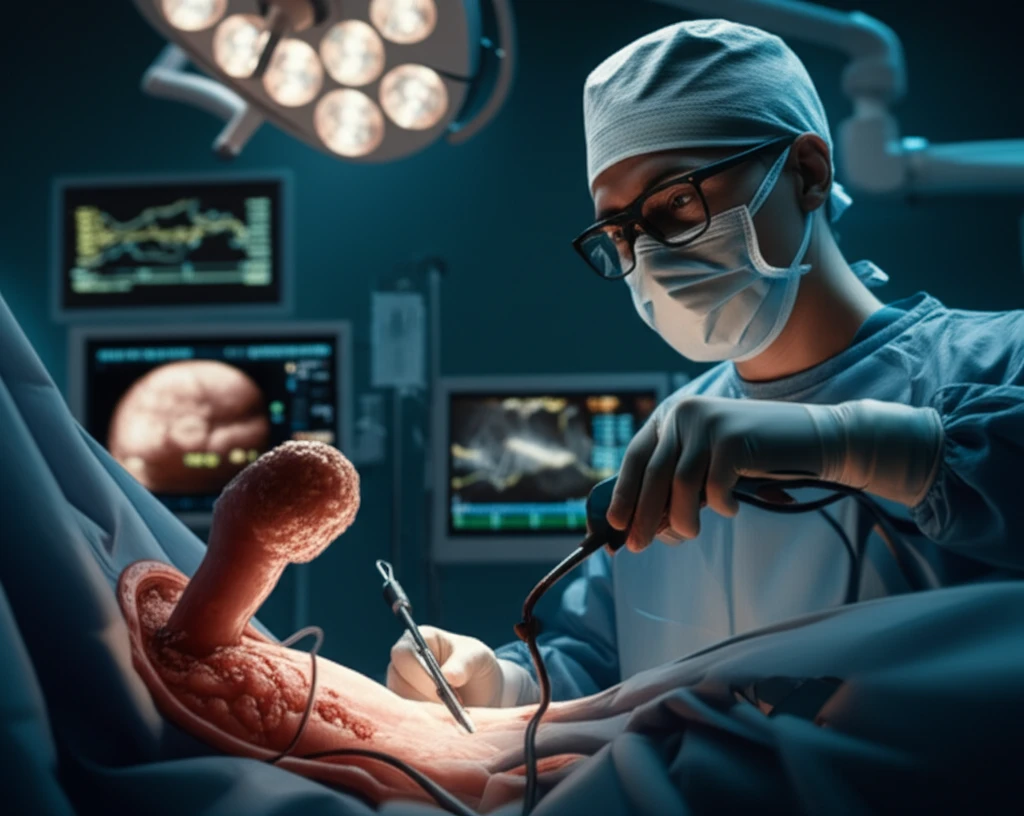
Illustration depicting a surgeon performing Combined Endo-Laparoscopic Surgery (CELS) on a colon with a polyp.

Combined Endo-Laparoscopic Surgery: A Modern Approach to Colon Polyp Removal

"Revolutionizing Colon Health: Exploring the Benefits of CELS in Treating Difficult Polyps"


In the realm of healthcare, advancements are constantly reshaping how we approach and treat various conditions. One such area experiencing significant evolution is the management of colon health. For individuals grappling with colon polyps, the traditional path often involved significant interventions. However, a new approach, known as Combined Endo-Laparoscopic Surgery (CELS), is emerging as a beacon of hope, offering a less invasive and potentially more effective solution.

CELS represents a fusion of two sophisticated techniques: endoscopy and laparoscopy. This innovative approach allows surgeons to address complex colon polyps with enhanced precision and minimal disruption to the body. By combining the strengths of both methods, CELS aims to improve patient outcomes, reduce recovery times, and decrease the need for more extensive surgical procedures.

This article delves into the world of CELS, exploring its benefits, the procedure itself, and its impact on patient care. We will examine the specific scenarios where CELS shines, compare it to traditional methods, and highlight the advantages it brings to the forefront of colon health management. Whether you're a patient, a healthcare professional, or simply curious about advancements in medical care, this guide offers valuable insights into this groundbreaking technique.

Understanding Combined Endo-Laparoscopic Surgery (CELS): A Detailed Look

Illustration depicting a surgeon performing Combined Endo-Laparoscopic Surgery (CELS) on a colon with a polyp.

Combined Endo-Laparoscopic Surgery (CELS) is a sophisticated procedure that merges two established surgical techniques: endoscopy and laparoscopy. Endoscopy involves inserting a thin, flexible tube with a camera (an endoscope) into the colon through the rectum. This allows the surgeon to visualize the inside of the colon. Laparoscopy, on the other hand, involves making small incisions in the abdomen to insert a laparoscope, a thin tube with a camera and surgical instruments, allowing for a minimally invasive approach to surgery.

The primary goal of CELS is to remove colon polyps that are difficult to access or remove using standard endoscopic techniques alone. These polyps might be large, located in hard-to-reach areas, or exhibit characteristics that suggest a higher risk of malignancy. The combined approach allows surgeons to utilize the benefits of both methods for a comprehensive and effective treatment strategy. The surgeon can directly visualize the colon from the outside (laparoscopy) while simultaneously using endoscopic tools to remove the polyp or perform other necessary actions.

  • Enhanced Visualization: Laparoscopy provides a clear, magnified view of the colon, allowing surgeons to assess the polyp and surrounding tissue.
  • Precision and Control: The combined approach offers greater control and precision in removing the polyp, minimizing the risk of complications.
  • Minimally Invasive: CELS is a minimally invasive technique, resulting in smaller incisions, reduced pain, and faster recovery times.
  • Reduced Need for Extensive Surgery: CELS can often prevent the need for more extensive procedures, such as a full colectomy (removal of the colon).
  • Improved Outcomes: Studies suggest that CELS can lead to better patient outcomes compared to traditional methods.
The CELS procedure begins with the patient under general anesthesia. The surgeon first performs a colonoscopy to assess the polyp and determine the best approach. Then, small incisions are made in the abdomen for the laparoscope and surgical instruments. The surgeon uses the laparoscope to guide the endoscopic instruments, allowing for precise removal of the polyp. The procedure typically involves mobilization of the colon, direct observation of the colon wall, and the ability to repair any injuries that might occur. If the polyp is too large or difficult to remove endoscopically, the surgeon can convert to a laparoscopic resection, ensuring the best possible outcome for the patient.

The Future of Colon Health: Embracing CELS for Better Outcomes

Combined Endo-Laparoscopic Surgery (CELS) represents a significant advancement in the treatment of challenging colon polyps. By combining the best aspects of endoscopy and laparoscopy, this minimally invasive approach offers improved outcomes, reduced recovery times, and potentially avoids the need for major surgery. As research and technology continue to evolve, CELS is poised to play an increasingly vital role in safeguarding colon health, offering hope and a better quality of life for individuals facing complex colon conditions. If you are facing colon polyp removal, discuss with your doctor about CELS and if this is the best option for you.

About this Article -

This article was crafted using a human-AI hybrid and collaborative approach. AI assisted our team with initial drafting, research insights, identifying key questions, and image generation. Our human editors guided topic selection, defined the angle, structured the content, ensured factual accuracy and relevance, refined the tone, and conducted thorough editing to deliver helpful, high-quality information.See our About page for more information.

Everything You Need To Know

1

What exactly is Combined Endo-Laparoscopic Surgery (CELS) and how does it differ from traditional colon polyp removal methods?

Combined Endo-Laparoscopic Surgery (CELS) is a minimally invasive surgical approach that merges endoscopy and laparoscopy to remove challenging colon polyps. Endoscopy involves inserting a flexible tube with a camera through the rectum to visualize the colon, while laparoscopy uses small incisions in the abdomen to insert a laparoscope, which has a camera and surgical instruments. CELS differs from traditional methods by offering enhanced visualization and precision, leading to reduced recovery times and potentially avoiding the need for major surgery like a full colectomy. Traditional methods might involve more invasive procedures with longer recovery periods.

2

In what specific situations or types of colon polyps would Combined Endo-Laparoscopic Surgery (CELS) be considered the most appropriate treatment option?

Combined Endo-Laparoscopic Surgery (CELS) is most appropriate for colon polyps that are difficult to access or remove using standard endoscopic techniques alone. This includes polyps that are large, located in hard-to-reach areas of the colon, or exhibit characteristics that suggest a higher risk of malignancy. CELS is also considered when a surgeon needs enhanced visualization and greater control, which both endoscopy and laparoscopy provide, to minimize the risk of complications. If a polyp is too large to be removed endoscopically, the surgeon can use a laparoscopic resection as part of the CELS procedure.

3

What are the key advantages of undergoing Combined Endo-Laparoscopic Surgery (CELS) compared to other surgical interventions for colon polyps, and how does it improve patient outcomes?

The key advantages of Combined Endo-Laparoscopic Surgery (CELS) include enhanced visualization, precision and control, it being minimally invasive, and a reduced need for extensive surgery. Laparoscopy offers a magnified view of the colon, allowing surgeons to assess the polyp and surrounding tissue more effectively. The combined approach offers greater control in removing the polyp, minimizing complications. Smaller incisions from laparoscopy reduce pain and lead to faster recovery times. CELS can often prevent the need for a full colectomy. These factors contribute to improved patient outcomes, with studies suggesting better results compared to traditional methods.

4

How does the integration of endoscopy and laparoscopy in Combined Endo-Laparoscopic Surgery (CELS) enhance the surgeon's ability to precisely target and remove colon polyps while minimizing potential damage to surrounding tissues?

The integration of endoscopy and laparoscopy in Combined Endo-Laparoscopic Surgery (CELS) provides a dual approach to visualizing and accessing colon polyps. Endoscopy offers a direct view inside the colon through the rectum, while laparoscopy provides an external view through small abdominal incisions. This combined visualization allows the surgeon to precisely target the polyp while assessing the surrounding tissue via laparoscopy. This minimizes potential damage by allowing the surgeon to mobilize the colon, directly observe the colon wall, and repair any injuries that might occur during the procedure.

5

What role does anesthesia play in the Combined Endo-Laparoscopic Surgery (CELS) procedure, and how is patient comfort and safety ensured throughout the process?

In Combined Endo-Laparoscopic Surgery (CELS), the patient is typically under general anesthesia. Anesthesia ensures that the patient remains comfortable and pain-free throughout the procedure. Before the surgery begins, the surgeon performs a colonoscopy to assess the polyp and determine the best surgical approach. The use of general anesthesia ensures the patient's safety and comfort, allowing the surgeon to perform both the endoscopic and laparoscopic aspects of the procedure effectively. Continuous monitoring of the patient's vital signs is carried out throughout the CELS process to ensure patient safety.

Newsletter Subscribe

Subscribe to get the latest articles and insights directly in your inbox.