
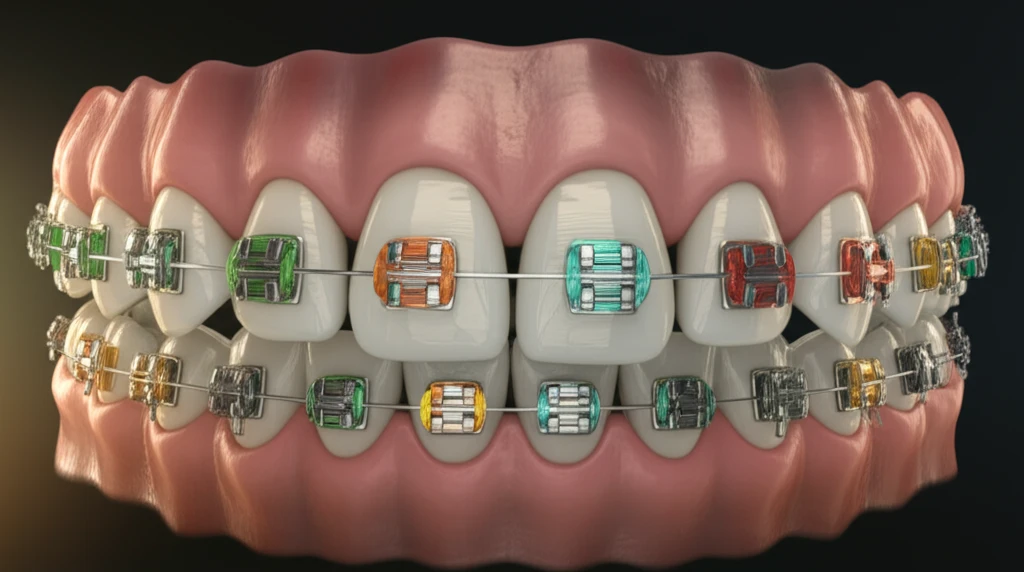
Orthodontic brackets changing color.

Color-Change Adhesives: The Future of Orthodontic Bonding?

"A closer look at how color-change adhesives can improve the orthodontic experience and outcomes."


For decades, orthodontists have relied on bonding brackets to teeth as a primary method of treatment. The advent of direct bonding techniques dramatically reduced the need for full mouth bands, enhancing patient comfort, aesthetics, and hygiene. Now, self-etching primers have further streamlined the bonding process, reducing the steps required and making the procedure more efficient.

Despite these advancements, challenges remain. One persistent issue is the difficulty in removing excess adhesive after bracket placement. Because many adhesives share a similar shade to natural enamel, identifying and removing these remnants can be tricky, potentially leading to bacterial colonization, decalcification, and gingival irritation. This has led to the development of color-changing adhesives to aid in easier and more complete cleanup.

This article explores the innovative use of color-change adhesives in orthodontic bonding. We'll delve into a study that compares the shear bond strengths of two color-change adhesives (Transbond Plus and Grengloo) with a conventional light-cure adhesive (Transbond XT), all used in conjunction with a self-etching primer. By examining their performance over time, we can gain insights into the efficacy and potential benefits of this evolving technology.

Color-Change Adhesives: A Clear Advantage?

Orthodontic brackets changing color.

A recent study investigated the bond strengths of color-change adhesives compared to traditional adhesives, focusing on ease of use and long-term effectiveness. The research team tested two color-change adhesives, Transbond Plus and Grengloo, against a control, Transbond XT, using a self-etching primer to prepare the teeth. One hundred and eighty extracted bovine incisors were used, divided into nine groups and evaluated at three different time intervals: 15 minutes, 24 hours, and 1 week.

Here's what the researchers did:

  • Preparation: Bovine incisors were mounted in acrylic resin and ground to create a uniform surface for bonding.
  • Grouping: The teeth were randomly divided into three main groups, each assigned to a different adhesive: Transbond Plus, Grengloo, or Transbond XT. Each group was further divided into three subgroups for testing at different time points.
  • Bonding: The teeth were prepared with Transbond Plus self-etching primer, following the manufacturer's instructions. Orthodontic brackets were bonded to the teeth using the assigned adhesive and light-cured.
  • Testing: The shear bond strength was tested using a universal Instron testing machine at a crosshead rate of 1.0 mm/minute.
  • Evaluation: After debonding, the Adhesive Remnant Index (ARI) was used to assess the amount of adhesive remaining on the tooth surface.
The results showed that while Transbond Plus had the highest mean shear bond strength at 1 week (14.7 mPa), Grēngloo tested at 24 hours had the lowest (11.3 mPa). Time had no significant effect on the shear bond strength of Transbond XT, Grēngloo, or Transbond Plus adhesive. Grengloo had >80% samples presenting with an ARI score of 1 at all times, which indicates less adhesive remaining on the tooth surface. Time had no statistically significant effect on the bond strengths of the adhesives.

The Future is Clear(ly Colored)

The study suggests that color-change adhesives, when used with self-etching primers, offer comparable bond strengths to traditional adhesives. One of the most important benefits is the color change that facilitates easier removal of excess adhesive. The Grengloo adhesive showed a particularly promising trend with less adhesive remaining on the tooth surface after debonding.

While in vitro studies provide valuable insights, further clinical research is needed to fully evaluate the performance of color-change adhesives in the complex oral environment. Factors such as saliva contamination, temperature fluctuations, and varying enamel composition can influence bonding outcomes. Testing these adhesives by bonding directly to the enamel surface (without a metal bracket) may also help evaluate the bond strength at the enamel-adhesive interface.

Color-change adhesives represent a step forward in orthodontic bonding, offering the potential to improve precision, reduce enamel damage, and enhance aesthetics. As technology advances, these innovative materials may become a standard tool in the orthodontist's arsenal, helping to create healthier, more beautiful smiles.

About this Article -

This article was crafted using a human-AI hybrid and collaborative approach. AI assisted our team with initial drafting, research insights, identifying key questions, and image generation. Our human editors guided topic selection, defined the angle, structured the content, ensured factual accuracy and relevance, refined the tone, and conducted thorough editing to deliver helpful, high-quality information.See our About page for more information.

This article is based on research published under:

DOI-LINK: 10.2147/cciden.s13646, Alternate LINK

Title: Bond Strength Comparison Of Color-Change Adhesives For Orthodontic Bonding Using A Self-Etching Primer

Subject: General Dentistry

Journal: Clinical, Cosmetic and Investigational Dentistry

Publisher: Informa UK Limited

Authors: Sara Ekhlassi

Published: 2011-06-01

Everything You Need To Know

1

How do color-change adhesives simplify the process of cleaning up after orthodontic bracket placement, and why is this important?

Color-change adhesives like Transbond Plus and Grengloo aid in the cleanup process during orthodontic treatment because they change color, making it easier to distinguish and remove excess adhesive. This is particularly important because leftover adhesive, if not properly removed, can lead to bacterial colonization, decalcification, and gingival irritation, potentially compromising the health and aesthetics of the teeth and gums.

2

How did the shear bond strength of the tested adhesives—Transbond XT, Transbond Plus, and Grengloo—vary over the different time intervals in the study?

The shear bond strength of Transbond XT remained consistent over the testing period, suggesting its reliability and stability once applied. In contrast, Transbond Plus showed the highest mean shear bond strength at 1 week, indicating it may achieve optimal bonding strength over time. Grengloo tested at 24 hours exhibited the lowest shear bond strength, but this doesn't necessarily indicate poor performance; instead, it suggests that its bonding characteristics may differ and further research could explore its performance over longer durations or under different conditions.

3

What does the Adhesive Remnant Index (ARI) tell us about how well an adhesive cleans up after orthodontic brackets are removed, and how did Grengloo perform in this regard?

The Adhesive Remnant Index (ARI) is used to measure the amount of adhesive remaining on the tooth surface after debonding orthodontic brackets. Grengloo showed >80% samples presenting with an ARI score of 1 at all times, which indicates less adhesive remaining on the tooth surface, meaning that less adhesive was left behind after the brackets were removed. This is a desirable quality as it reduces the risk of enamel damage during cleanup and subsequent bacterial accumulation.

4

In what ways do self-etching primers enhance the efficiency of orthodontic bonding, and how do products like Transbond Plus self-etching primer fit into this?

Self-etching primers, such as Transbond Plus self-etching primer, streamline the bonding process by reducing the number of steps required compared to traditional etching methods. Self-etching primers both condition the tooth surface and prime it for bonding in a single step, saving time and potentially reducing the risk of errors during bracket placement. Combining these primers with color-change adhesives further enhances efficiency and precision in orthodontic bonding.

5

Why were bovine incisors used in the study instead of human teeth, and what implications might this have for the real-world application of Transbond Plus, Grengloo and Transbond XT in orthodontic treatments?

The study used extracted bovine incisors instead of human teeth for practical reasons, such as availability and uniformity. While bovine teeth share similarities with human teeth in terms of structure and composition, there are also differences that could affect the results. The fact that Transbond Plus, Grengloo and Transbond XT performed well on bovine teeth suggests their potential effectiveness in human applications, but further clinical studies on human subjects are necessary to validate these findings and account for factors such as saliva, temperature variations, and dietary habits that could influence bond strength in a real-world setting.

Newsletter Subscribe

Subscribe to get the latest articles and insights directly in your inbox.