
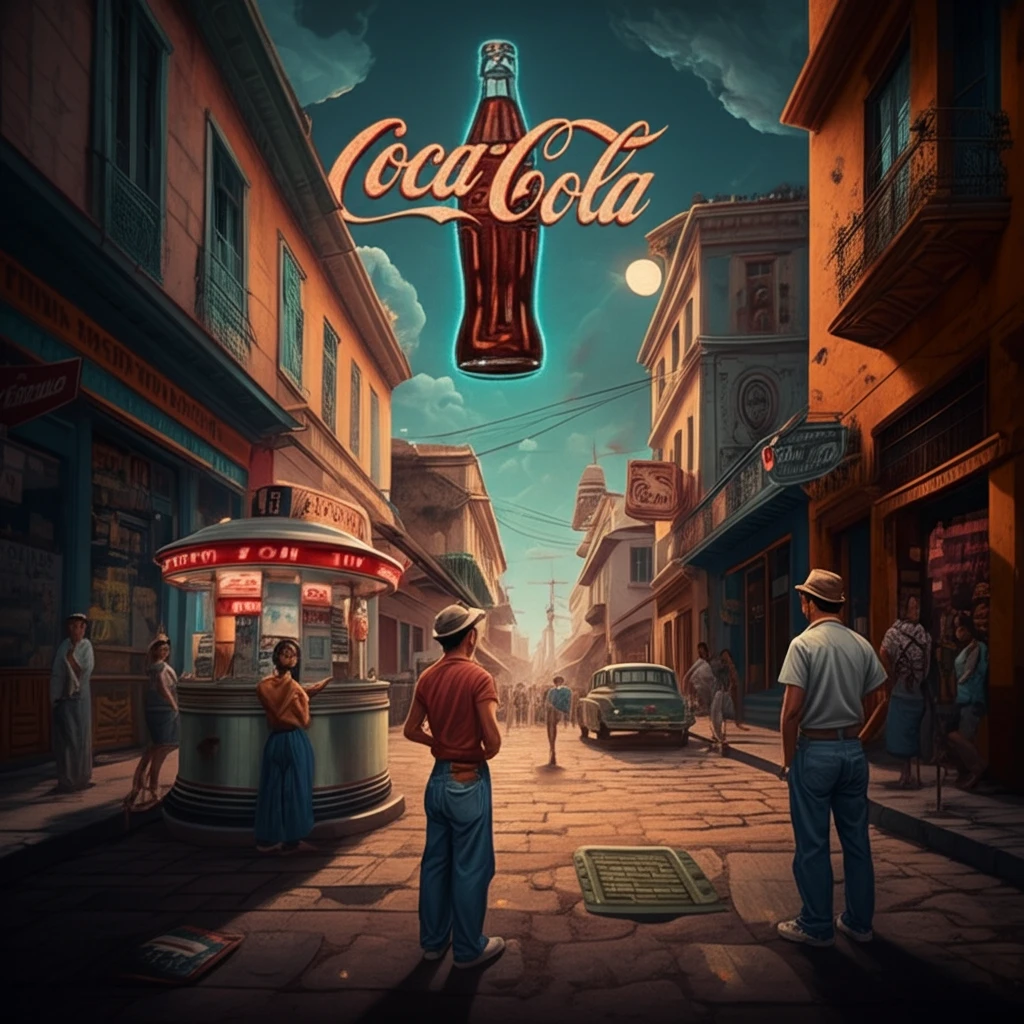
Coca-Colos: When American Pop Culture Shook 1950s Bogota

"Explore how the 'Coca-Colo' trend in 1950s Bogota blended American styles with Colombian traditions, reshaping social identities."
In the vibrant, bustling Bogota of the 1950s, a fascinating cultural phenomenon took root: the 'Coca-Colo' trend. This wasn't just about a soft drink; it was a seismic shift in how young Colombians embraced (and adapted) American pop culture. It was a time of blue jeans, rock 'n' roll, and a whole new attitude that challenged traditional Colombian society.
Imagine a world where the elegance of European traditions met the youthful energy of American rock 'n' roll. This was the reality for the 'Coca-Colos,' a generation of young Colombians who blended these influences to create their own unique identity. The story of the 'Coca-Colos' is not just a historical snapshot; it's a mirror reflecting the ongoing dance between globalization and cultural identity.
We'll journey back to a pivotal moment in Colombian history, exploring how American cultural exports mingled with local customs. We'll uncover the debates, the anxieties, and the celebrations that accompanied this cultural fusion, revealing how it reshaped Bogota's social landscape and continues to resonate today.
Global Scale and Market Leadership
GitNux reports that The Coca-Cola Company generates $45.8 billion in annual revenue, with a gross profit margin above sixty percent and nearly ten billion dollars in free cash flow. Statista notes that Coca-Cola and its long-time rival PepsiCo — the latter with roots dating to 1898 — have competed for decades, a rivalry that shapes the global beverage market. Market.us additionally counts roughly 2.8 million Coca-Cola vending machines worldwide and tracks the company's growth by market share. Together these figures point to a brand whose financial footprint and physical distribution remain enormous.
Formula Evolution and Marketing Trade-offs
Coca-Cola's standard product strategy has included line extensions aimed at new audiences; Wikipedia records that Coca-Cola Zero, introduced in 2005, was a low-calorie variant formulated to taste more like the original and has undergone several formula changes since. Yet its promotional playbook is not without friction: a Slideshare presentation notes that while visual-organization methods help marketers map and organize ideas, sourcing the right images, fonts, or concepts can still be difficult. Modern campaigns such as the Coca-Cola Masterpiece spot, built around the "Real Magic" positioning, extend that approach into premium, art-driven storytelling. The result is a brand that constantly recalibrates both its recipe and its creative methods.
From Patent Medicine to the Contour Bottle
According to the company's own history page, Dr. John Pemberton served the world's first Coca-Cola on May 8, 1886 at Jacobs' Pharmacy in Atlanta. The Russian Wikipedia entry describes the drink's origins as a patent medicine initially marketed as an alternative to alcohol. A 1915 collaboration produced the famous contour bottle, which the company says has since been celebrated in art, music, and advertising and became one of the most recognizable shapes in the world. These milestones mark Coca-Cola's evolution from a single Atlanta fountain drink into a total beverage company.
The 'Coca-Colo' Defined: More Than Just a Trend
In 1954, the Colombian magazine Semana published a groundbreaking dossier titled "Los Coca-Colos: Una generación calumniada" (“The Coca-Colos: A Slandered Generation"). This report captured the essence of a transformation sweeping through Bogota's youth. It wasn't just about adopting American products; it was a shift in behaviors, tastes, and even language. Acceptable cultural models were no longer exclusively European or academic; U.S. lifestyles were making a major impact.
- Embracing American music, movies, and fashion
- Frequent visits to soda fountains, mirroring American diners
- A more casual and youthful attitude
- Challenging traditional social norms
Innovation and Mixed Reviews
Google News coverage shows the company's recent activity is divided between packaging design and structural moves — including an agreement, alongside Gutsche Family Investments, to sell controlling interest in Coca-Cola Beverages Africa to Coca-Cola HBC AG — while its holiday ad campaign has drawn criticism over problems with AI-generated video. A separate Campaign Live viral review by social video expert Unruly judged Coca-Cola's "smile back" spot "a little lacklustre," despite the brand's history of warm, heartstring-tugging campaigns. Meanwhile, TikTok commentary around Coca-Cola's new bottle design reflects ongoing consumer interest in packaging changes. Earlier, The Motley Fool reported that Coca-Cola Amatil's distribution deal with Beam Suntory, extended for ten years in 2013, was expected to generate around $300 million in sales.
Controversies and Product Failures
European Business Magazine cites Coca-Cola's Dasani failure as one of the clearest collapse case studies in business, with the brand losing £25 million in 38 days after it tried to sell filtered tap water in the UK. Food World News reports that the company faced backlash for banning homophobic slurs in a Winter Olympics campaign and was subsequently dropped from Brand of the Year honors at the diversity-focused Out in the City and G3 awards. Medical Daily notes that activists have criticized Coca-Cola for an infographic that blames the obesity epidemic on nearly everything but the company itself, even as it outlined global commitments to fight obesity. The company has also faced criticism for continuing its operations in Russia during the attack on Ukraine, according to YouTube coverage.
Rivalries at Every Price Point
Investopedia's comparison of the two companies' business models highlights the long-running Coca-Cola versus Pepsi rivalry, a framing echoed by MarketBeat, which compares Coca-Cola (KO) with competitors including MNST and PEP. At the budget end of the market, TikTok comparisons pit generic colas such as Aldi's Salaam Cola and Vive against the name brand, asking which retains its fizz better and which is the more ethical option. Even matchup videos comparing Coca-Cola, Pepsi, Sprite, and ThumsUp reflect how thoroughly cola competition permeates popular content. Across price tiers, the cola category remains defined by a handful of giants and a lengthening queue of challengers.
A Lasting Cultural Legacy
The story of the 'Coca-Colos' in 1950s Bogota is more than just a historical anecdote. It represents a pivotal moment in Colombia's cultural evolution, as American influences began to intertwine with local traditions in profound ways. This fusion continues to shape Colombian society today, reminding us that cultural identity is always a dynamic and evolving process.
Marketing That Divides Opinion
Branding analyst Colin Johnson argues that Coca-Cola's "Open Happiness" campaign deserves recognition as one of the best branding campaigns of all time, framing marketing as something that reaches everyone. The Foundation for Economic Education similarly notes that Coca-Cola's advertising has encouraged globalization and multiculturalism since at least the 1970s. Yet the brand also inspires darker theories: TikTok commentary floats personal conspiracy theories that drinking Coca-Cola could be an occult ritual, an idea the source itself labels "a theory or personal opinion." Health coverage remains a more mainstream concern, with The Mirror reporting that Coca-Cola calls its drink — which contains sugar and caffeine — "fine in moderation" while conceding too much "isn't good for anyone."
Immersive Engagement and Resilient Investment
TrendHunter reports that to celebrate Coca-Cola's 125th anniversary, Istanbul-based creative agency Antilop built the Coca-Cola Future Room, an immersive digital experience projecting how the brand might evolve. On the investment side, The Motley Fool argues that Coca-Cola stock is easier to stick with when other stocks fall out of favor, and that its above-average dividend could prove valuable in a bear market. Together these threads suggest a future focused on experiential marketing and dependable shareholder returns. The brand's next frontier appears to be blending sensory brand worlds with steady, defensive financial performance.
Boycotts, Nostalgia, and Community
AOL reports that a Coca-Cola boycott gained traction after rumors that the company had fired Latino employees at a Texas bottling plant and reported them to immigration officers. At the same time, DesignRush describes Coca-Cola expanding its Christmas Truck Tour to fifteen U.K. stops, strengthening holiday equity through local, in-person visibility and pledging one million meals as part of the activation. The contrast captures a systemic tension: a brand simultaneously navigating consumer boycotts and nostalgia-driven community marketing. Its ability to manage such divergent pressures will shape its social standing.
From Careers to the Collector's Shelf
The Coca-Cola Company's own site frames its work as "refreshing the world and making a difference" for 140 years, positioning employment there as a chance to build a meaningful career with global impact. Its retail arm — the Coca-Cola Store — extends the brand into everyday life, offering customized bottles, collectibles, home décor, and gifts. On the corporate side, a Slideshare analysis notes that Coca-Cola acquired Costa Coffee for $5.1 billion, gaining nearly 4,000 stores across 32 countries, a move that deepened its coffee presence and answered criticism about unhealthy beverage offerings. For individuals and institutions alike, Coca-Cola operates as more than a soft drink.