
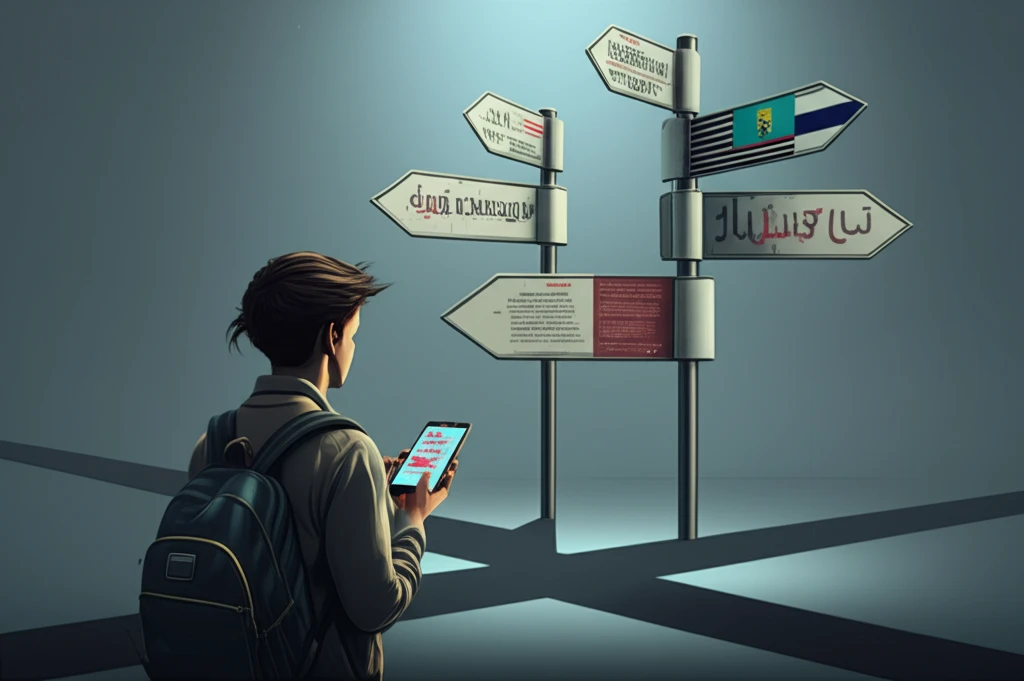
Decoding the Language Switch: Why Multilingual Students Code-Switch and What It Means

"Uncover the reasons behind code-switching in multilingual students and the influence of language attitudes and social dynamics in their linguistic choices."
In today's interconnected world, multilingualism is increasingly common, and with it comes the fascinating phenomenon of code-switching. Code-switching, the practice of alternating between two or more languages in conversation, is a natural and complex linguistic behavior. It is used by students to simplify communication, negotiate social identities, and navigate the multifaceted landscape of their daily interactions, especially in multilingual settings.
International schools, like the French School of Kuwait (LFK), provide a rich environment for studying code-switching. These schools bring together students from various cultural and linguistic backgrounds, creating dynamic interactions where languages mix and evolve. In such environments, code-switching is not merely a random occurrence but a strategic tool that reflects students' linguistic competence, social awareness, and cultural identities.
This article delves into the intricate world of code-switching, examining its underlying motivations, the influence of language attitudes, and its implications for multilingual students. By understanding code-switching, educators and parents can better support students in their linguistic development and foster inclusive learning environments that value linguistic diversity.
Data Scarcity in Code-Switching Research
Despite code-switching being a widespread phenomenon among multilingual speakers, annotated resources and standardized datasets remain scarce for code-switched languages, even when one or both of the languages involved are individually well-resourced. This gap has hampered the development of robust computational models for detecting and analyzing code-switched speech and text. Token-level language identification efforts, such as those for Twi–English conversational data, represent early steps toward building the granular statistics needed to understand code-switching patterns in specific language pairs. However, the field still lacks the kind of large-scale, standardized benchmarks that would enable systematic cross-linguistic comparison.
Defining and Categorizing Code-Switching
Code-switching refers to the practice of alternating between two or more languages or varieties of language in conversation, a behavior common among bilingual and multilingual speakers worldwide. Linguists have traditionally classified code-switching into several types, including intra-sentential switching (within a single sentence), inter-sentential switching (between sentences), and tag-switching (inserting a short phrase from one language into another). These categories have served as the standard framework for analyzing code-switching behavior in both linguistic research and educational contexts. While this taxonomy provides useful analytical structure, it has been critiqued for oversimplifying the fluid and context-dependent nature of real-world language alternation, which often defies neat categorical boundaries.
Foundations of Code-Switching Research
Research into code-switching emerged as a formal area of linguistic inquiry in the latter half of the twentieth century, as scholars began to move beyond viewing language mixing as a sign of deficiency toward recognizing it as a rule-governed, meaningful communicative strategy. Early foundational work established that code-switching follows identifiable grammatical constraints, countering the once-common misconception that bilingual speakers switch languages randomly or due to incomplete mastery. The development of sociolinguistic frameworks in the 1970s and 1980s was particularly pivotal, as researchers like Carol Myers-Scotton and others demonstrated that speakers deploy code-switching strategically to negotiate identity, power dynamics, and social distance. These milestones transformed code-switching from a curiosity into a central topic in bilingualism research.
The Sociolinguistics of Code-Switching: More Than Just a Mix of Languages
Code-switching has evolved from being seen as a flawed practice due to a lack of competence, to a valuable communication tool in today's society. Today, code-switching is seen as an important strategy for success in communication. Schools, teachers, and educators generally see code-switching in a negative light, but it is found to be useful in social situations as it is socially important and accomplishes goals.
- Quotations: Inserting phrases or sentences from another language.
- Reiteration: Repeating a message in a different language for emphasis or clarity.
- Interjections: Using words or phrases from another language to express emotion or attitude.
Contemporary Directions in Code-Switching Research
Recent research has expanded the study of code-switching beyond traditional bilingual pairs to include a wider range of language combinations and communicative contexts, including social media, digital platforms, and informal learning environments. Studies have examined code-mixing practices on platforms like Instagram as a form of informal English learning, highlighting how learners naturally blend languages in digital spaces to negotiate meaning and build competence. Psycholinguistic research has continued to investigate the cognitive mechanisms underlying code-switching within sentences, examining how bilingual speakers manage two grammatical systems simultaneously. Cross-cultural studies have also explored how International Medical Graduates use code-switching to navigate professional and cultural differences in new practice environments.
Challenges in Code-Switching Scholarship
One persistent critique in code-switching research is the lack of unified methodological standards across studies, making it difficult to compare findings across different linguistic populations and contexts. The absence of standardized evaluation benchmarks has been a recurring obstacle, as highlighted by efforts to develop shared tasks and datasets that would enable more rigorous cross-study comparison. Additionally, some scholars have questioned whether findings from well-studied language pairs (such as Spanish–English or Mandarin–English) generalize to less-researched combinations, particularly those involving lower-resourced languages. These challenges underscore the need for more inclusive and standardized research frameworks in the field.
Cross-Linguistic and Cross-Contextual Comparisons
Comparative analysis of code-switching across different language pairs reveals both universal tendencies and language-specific patterns. Studies comparing code-switching behavior across Arabic–English, Spanish–English, and Twi–English contexts, for example, show that while the pragmatic functions of switching (such as emphasis, identity marking, or topic shifting) tend to be consistent, the grammatical constraints on where switches can occur vary significantly depending on the syntactic structures of the languages involved. Research on code-mixing in digital contexts further demonstrates that the platform and medium of communication shape code-switching patterns, with social media environments often encouraging more fluid and creative language blending than formal educational settings.
Embracing Linguistic Diversity: The Path Forward
Understanding code-switching is crucial for creating inclusive and supportive educational environments. By recognizing the complex motivations behind this linguistic behavior, educators and parents can move away from negative perceptions and instead view code-switching as a valuable tool. Encouraging students to develop their linguistic skills in all their languages while also fostering an appreciation for linguistic diversity can lead to greater academic success and a stronger sense of cultural identity.
Code-Switching as Connection and Identity
Scholars and commentators increasingly frame code-switching not as a linguistic deficit but as a sophisticated social tool for building connection and negotiating identity. As noted in commentary on political and social contexts, code-switching serves functions analogous to other bonding activities—it is a way that humans use language to connect with one another, employing colloquial registers and dialect shifts to signal belonging and solidarity. Research examining code-switching patterns among BIPOC young adults on platforms like YouTube has explored whether males or females engage in code-switching more frequently, contributing to ongoing debates about how gender intersects with language-switching behavior. Expert commentary continues to emphasize that understanding code-switching requires attending to both its linguistic structure and its deep social and cultural significance.
Emerging Trends in Multilingual Communication Research
The future of code-switching research lies in leveraging computational and data-driven approaches to analyze increasingly large and diverse multilingual datasets. As digital communication platforms generate vast quantities of naturally occurring multilingual text, researchers have new opportunities to study code-switching at scale and across a broader range of language pairs than ever before. The development of multilingual NLP tools and evaluation benchmarks, such as those being explored in shared-task settings, represents a promising frontier for both advancing computational capabilities and deepening linguistic understanding. These efforts may ultimately bridge the gap between descriptive linguistic research and applied technology development.
Institutional and Structural Barriers
Code-switching research faces systemic challenges related to resource allocation, institutional support, and the historical marginalization of multilingual scholarship within predominantly monolingual academic frameworks. The scarcity of annotated datasets and standardized evaluation tools for code-switched languages reflects broader inequities in linguistic research funding, where high-resource languages receive disproportionate attention. These structural barriers not only slow scientific progress but also have practical consequences for multilingual communities whose language practices are underrepresented in both research and educational policy. Addressing these challenges requires deliberate investment in inclusive research infrastructure and collaboration across linguistic communities.
Code-Switching in Everyday Life and Learning
Beyond its linguistic and computational dimensions, code-switching has profound real-world implications for multilingual individuals navigating educational, professional, and social environments. International medical graduates, for instance, use cross-cultural code-switching to adapt to new professional cultures and practice effectively in countries different from their training origins. For multilingual students in educational settings, code-switching is often a natural and functional strategy for making sense of new academic content, drawing on their full linguistic repertoire to build understanding. Recognizing code-switching as a legitimate and valuable communicative skill—rather than a sign of language confusion—has important implications for how educators and institutions support multilingual learners.