
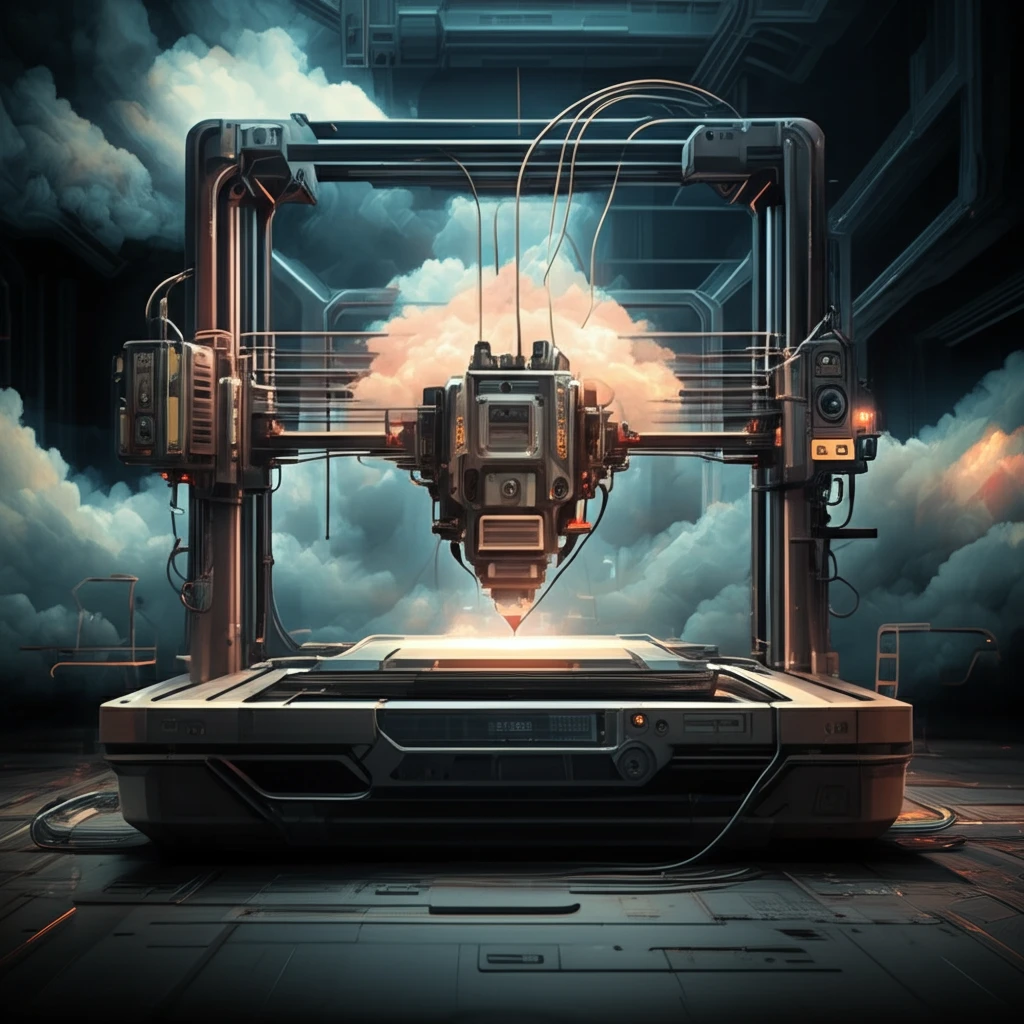
Cloud Control: Is the Future of 3D Printing in the Palm of Our Hand(s)?

"Discover how cloud-based 3D printing is revolutionizing manufacturing, offering faster speeds and unmatched control, all while solving the challenges of traditional printing limitations."
Imagine controlling a 3D printer from anywhere in the world, accessing advanced features and improved performance without needing expensive hardware. This vision is becoming a reality with Control as a Service (CaaS), an emerging approach that moves the low-level control of devices, like 3D printers, to the cloud. This shift promises to overcome many limitations of traditional 3D printing, making the technology more accessible and efficient.
Traditional 3D printers rely on local controllers, often microcontrollers with limited processing power. This restricts the complexity of control algorithms they can handle, impacting printing speed and accuracy. CaaS offers a solution by leveraging the vast computational resources of the cloud. By moving the control processes to powerful cloud servers, 3D printers can access sophisticated algorithms and advanced functionalities previously out of reach.
This article explores how cloud-based control is transforming 3D printing, making it faster, more accurate, and more versatile. We'll delve into the benefits, challenges, and future possibilities of this exciting technology.
A Field Still Taking Shape
Cloud-based control of 3D printing remains an emerging area, and reliable, widely agreed-upon statistics on its adoption are not yet readily available. Early descriptions treat cloud services broadly as computing resources delivered over the Internet, which suggests the underlying infrastructure for remote print control already exists and continues to mature. Because formal usage data for cloud-managed additive manufacturing is still limited, claims about its current reach should be treated as preliminary rather than settled. What seems clear is that the technological building blocks for such systems are in place, even if large-scale evidence of impact is still catching up.
Common Practices and Open Questions
The conventional approach to controlling 3D printers locally relies on a direct, machine-connected setup, though observers increasingly describe cloud platforms as a complementary layer of services running on remote servers. Widely accepted methods for cloud-based printing are still being standardized, and no single dominant workflow has yet emerged across the industry. As a result, the limitations of existing approaches—such as connectivity dependencies and interoperability between hardware and cloud platforms—remain areas of active discussion. Because consensus on best practices is still developing, any characterization of a standard method should be regarded as provisional.
Roots in Broader Computing History
The history of moving control and computation away from a local device toward remote servers predates 3D printing itself, and this trajectory informs today's cloud-based manufacturing concepts. Milestones in this lineage include the rise of centralized computing and, more recently, the broad consumer and enterprise adoption of cloud services. For additive manufacturing specifically, the foundational discoveries are harder to pin down, as the field has largely adapted capabilities that were developed for other cloud uses. As a result, the precise milestones of cloud-controlled printing have not yet been clearly documented in a way that can be confidently stated.
Why Cloud-Based 3D Printing is a Game Changer?
The limitations of local controllers in 3D printers are becoming increasingly apparent. Many desktop 3D printers, in particular, have limited computational resources, which can hinder their performance. Cloud-based control overcomes this bottleneck by utilizing the immense processing power available in the cloud.
- Access to Advanced Algorithms: Cloud-based systems can run complex motion control algorithms that would be impossible on a local controller, leading to improved accuracy and speed.
- Improved Performance: By offloading processing to the cloud, 3D printers can operate more efficiently, resulting in faster printing times.
- Remote Management: Users can monitor and control their 3D printers from anywhere with an internet connection, offering greater flexibility and convenience.
- Scalability and Flexibility: Cloud resources can be scaled up or down as needed, providing greater flexibility for handling complex print jobs or multiple printers.
- Data Sharing and Collaboration: The cloud facilitates data sharing and collaboration among users, enabling the development of new printing techniques and materials.
The Cloud as Enabling Layer
Recent material frames the cloud primarily as a shared pool of servers and software accessed over the Internet, which forms the infrastructure on which remote print management can be built. Cloud platforms are described as addressing business challenges through AI-driven services, data management, and hybrid and multi-cloud arrangements, pointing to the capabilities that could support connected manufacturing workflows. Consumer-facing services such as iCloud show how the same model extends to personal data like photos and documents, illustrating the breadth of the cloud ecosystem. Taken together, these sources indicate that the underlying cloud services needed to monitor and control 3D printers remotely are well established.
The Case for the Edge
One counter-narrative to fully centralized cloud control is the argument that modern applications increasingly run at the network edge, closer to where computing actually happens. This perspective suggests that relying entirely on distant servers for time-sensitive operations such as 3D printing may carry drawbacks, including latency and connectivity dependence. Providers like Cloudflare position themselves as powering the next generation of applications, signaling a shift toward distributing compute nearer to the user or device. Such reasoning implies that hybrid models—combining local processing with cloud services—may be more practical than a fully cloud-only approach.
Comparing Control Models
A direct comparison between local and cloud-based control of 3D printers is difficult because authoritative, side-by-side evaluations are not yet widely published. Local control offers the advantage of operating without a network dependency, while cloud models promise remote access, monitoring, and centralized management. Each approach carries trade-offs in reliability, latency, and ease of use that are not yet settled by the literature. As such, any verdict on which model is superior should be treated as an open question rather than a demonstrated conclusion.
The Future is in the Clouds
Cloud-based 3D printing is more than just a technological advancement; it's a gateway to new possibilities in manufacturing, design, and accessibility. As the technology matures and network infrastructure improves, expect cloud-controlled 3D printers to become increasingly commonplace, empowering individuals and businesses to create and innovate like never before. The journey to fully realize the potential of cloud 3D printing is underway, and the possibilities are virtually limitless.
Weighing the Evidence
Pulling together the available material, the case for cloud-controlled 3D printing rests on mature cloud infrastructure rather than on published metrics of success. Expert commentary in the sources focuses on cloud services broadly, leaving the specifics of additive manufacturing control largely underexplored. This gap suggests that the topic is promising but still evolving, with consensus yet to form. Any synthesis should therefore emphasize capability and potential over demonstrated outcomes.
A Trajectory Still Unfolding
Looking forward, the direction of cloud-controlled 3D printing will likely track broader trends in cloud computing, including distributed and hybrid architectures. As providers emphasize next-generation applications, remote and collaborative manufacturing workflows may become increasingly feasible. However, the sources offer no firm predictions specific to additive manufacturing, so these possibilities remain speculative. The future outlook is best characterized as open-ended and dependent on continued platform maturity.
Systemic Dependencies
Cloud-based control sits within wider systemic considerations, including the reliability of internet connectivity, data privacy, and the interoperability of hardware with differing cloud platforms. These challenges are characteristic of cloud computing in general and apply analogously to additive manufacturing. The available material does not resolve how these systemic issues would specifically affect 3D printing. Consequently, they remain important considerations rather than fully addressed concerns.
Implications for Users
For everyday users, cloud control could mean greater convenience in managing printers remotely, though the sources provide little direct evidence of real-world adoption. The human dimension—how designers, hobbyists, and manufacturers actually interact with such systems—remains largely uncharacterized in the available material. While the appeal of palm-of-the-hand control is intuitive, its practical impact has yet to be demonstrated. This makes any claims about user-level benefits appropriately hedged.