
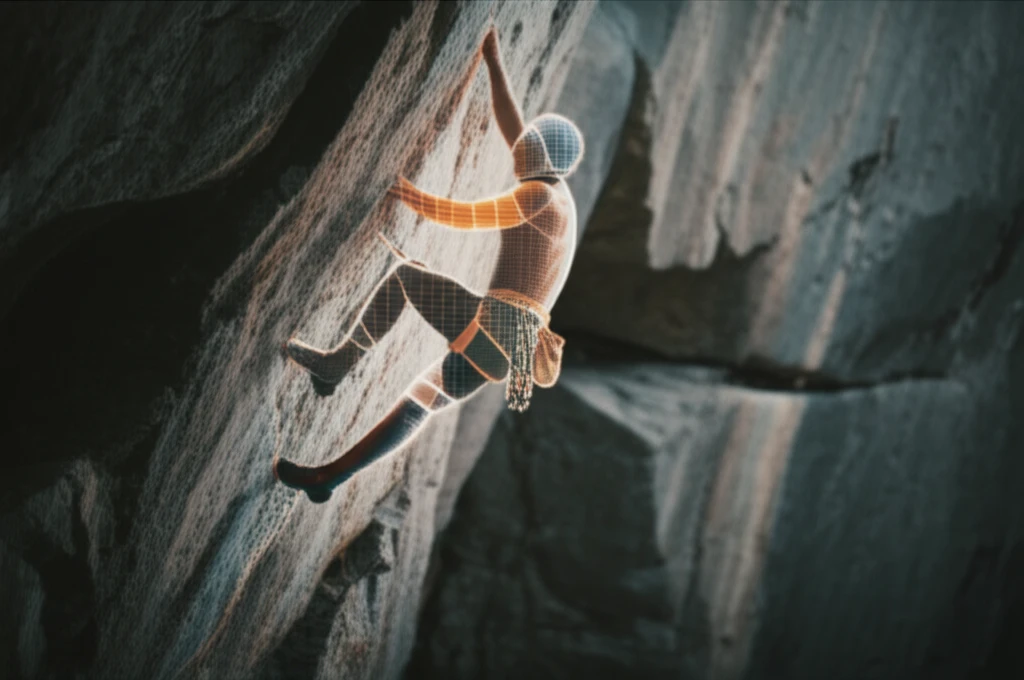
Rock climber with dynamic value overlay.

Climb Smarter: How Dynamic Value Can Save Your Ascent

"Unlock the secrets of attention allocation in extreme sports. Learn how to prioritize safety gear placement for smarter, safer climbing."


Rock climbing is a dynamic dance between upward progress and ensuring safety. Unlike static environments, each move alters the risk of a fall, demanding constant reassessment. Think of it: the higher you climb above your last piece of protection, the more critical that next placement becomes. This ever-changing risk landscape makes rock climbing an ideal testing ground for understanding how we allocate our attention in high-stakes, dynamic situations.

Enter the SEEV model – a framework for understanding attention allocation that considers Salience, Effort, Expectancy, and Value. While all four components are crucial, 'Value' can be particularly tricky to pin down objectively. How do you quantify the importance of a specific action, like placing a cam in a crack, at any given moment? This is where the concept of dynamic value comes in, offering a new perspective on how we perceive and prioritize safety in a constantly evolving environment.

This article delves into a fascinating study that explores dynamic value in rock climbing. By understanding how experienced climbers prioritize gear placement, we can gain valuable insights applicable not only to climbing but also to other high-pressure, dynamic environments where split-second decisions matter.

The Dynamic Value of Protection: It's All About Timing

Rock climber with dynamic value overlay.

The core idea of dynamic value is that the importance of placing protection changes as you climb. Imagine you've just placed a solid cam. The immediate need for another piece is relatively low. However, as you move upwards, the potential consequences of a fall increase, and with it, the urgency – or 'value' – of placing the next piece of gear.

Researchers assessed this by prompting climbers to rate the priority of placing gear at different points during their climb, using video replays to jog their memory. They then compared these ratings to the time elapsed since their last gear placement, controlling for climbing speed. This allowed them to isolate how the perceived value of protection changed as climbers moved further from their last anchor.

  • Key Finding: Both expert and non-expert climbers showed a clear trend: the longer they climbed above their last piece of gear, the higher they rated the priority of placing the next piece. This supports the idea that the 'value' of protection is not constant but increases with exposure.
  • Why Time Matters: The study used time as a proxy for distance, assuming a relatively consistent climbing speed. While this isn't perfect (climbers may slow down on difficult sections), it provided a useful way to estimate how far a climber was above their last protection.
  • Expert vs. Non-Expert: Interestingly, the study didn't find significant differences between experts and non-experts in how they perceived the increasing value of protection. This suggests that the basic principle of dynamic value applies to climbers of all skill levels.
So, what does this mean for your climbing? Recognizing that the value of protection increases the further you climb from your last piece can help you make smarter decisions about gear placement. It encourages a proactive approach to safety, prompting you to assess the risk not just in terms of the difficulty of the next moves, but also in terms of the potential fall distance.

Beyond the Crag: Applying Dynamic Value to Everyday Life

While this study focused on rock climbing, the concept of dynamic value has broader implications. Think about driving: the 'value' of checking your mirrors increases as you approach an intersection. Or consider surgery: the 'value' of monitoring vital signs spikes during critical moments of the procedure. In any dynamic environment where risk levels change rapidly, understanding and applying the principles of dynamic value can lead to better decision-making and improved safety.

By recognizing how the importance of different actions shifts with changing circumstances, we can train ourselves to allocate our attention more effectively. This might involve developing checklists, using visual cues, or simply cultivating a heightened awareness of the dynamic nature of risk.

Ultimately, the research highlights the importance of understanding how we perceive and respond to changing risk levels. Whether you're scaling a rock face or navigating a busy city street, a greater awareness of dynamic value can help you make smarter, safer choices.

About this Article -

This article was crafted using a human-AI hybrid and collaborative approach. AI assisted our team with initial drafting, research insights, identifying key questions, and image generation. Our human editors guided topic selection, defined the angle, structured the content, ensured factual accuracy and relevance, refined the tone, and conducted thorough editing to deliver helpful, high-quality information.See our About page for more information.

This article is based on research published under:

DOI-LINK: 10.1177/1541931218621387, Alternate LINK

Title: Assessing Dynamic Value For Safety Gear During A Rock Climbing Task

Subject: General Medicine

Journal: Proceedings of the Human Factors and Ergonomics Society Annual Meeting

Publisher: SAGE Publications

Authors: Emily Wright, Elizabeth C. Pinyan, Christopher D. Wickens, John Keller, Anne C. Mclaughlin

Published: 2018-09-01

Everything You Need To Know

1

What does 'dynamic value' mean in the context of rock climbing?

Dynamic value in climbing refers to the changing importance of placing protection as you climb higher. As the distance from your last piece of gear increases, so does the potential fall distance, making the placement of the next piece of protection more critical. It's about recognizing that the need for protection isn't constant; it increases with exposure.

2

What is the SEEV model, and how does 'dynamic value' fit into it?

The SEEV model is a framework used to understand how we allocate attention, particularly in dynamic situations like climbing. It considers four components: Salience, Effort, Expectancy, and Value. Dynamic value, as discussed, falls under the 'Value' component, highlighting how the perceived importance of an action (like placing gear) changes over time and with varying circumstances.

3

How did the research measure dynamic value, and what are the limitations of that approach?

While the study mentioned used time as a proxy for distance in assessing dynamic value, it's important to remember that this isn't a perfect measure. Climbing speed can vary depending on the difficulty of the terrain. A more precise measurement might involve directly assessing the potential fall distance or considering the climber's perceived level of security at different points.

4

Did the study find differences in how expert and non-expert climbers perceive dynamic value, and what are the implications?

The study revealed that both experienced and less experienced climbers demonstrate an understanding of dynamic value. This suggests that the concept is intuitive. Recognizing that the value of protection increases with distance from the last placement is a fundamental principle applicable to climbers of all skill levels. However, it doesn't speak to decision making or risk tolerance.

5

Beyond climbing, where else might the concept of 'dynamic value' be useful?

Outside of climbing, the concept of dynamic value can be applied to numerous situations where risk levels fluctuate. Consider driving, where the importance of checking mirrors increases as you approach an intersection. Similarly, in surgery, monitoring vital signs becomes more critical during key moments of the procedure. Recognizing dynamic value promotes better decision-making and improves safety in high-pressure, dynamic environments.

Newsletter Subscribe

Subscribe to get the latest articles and insights directly in your inbox.