
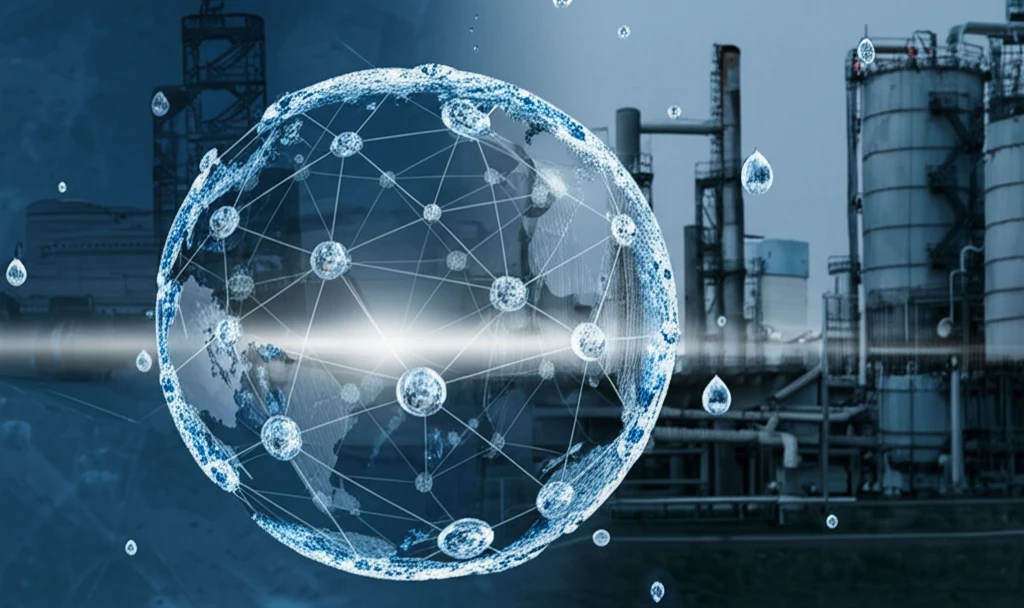
Clean Water Revolution: How Innovative Filtration Tech is Changing the Game

"Discover how cutting-edge membrane technology and advanced water treatment systems are making waves in industries and communities worldwide, ensuring cleaner, safer, and more sustainable water resources."
In a world where access to clean water is increasingly critical, innovative filtration technologies are stepping up to meet the challenge. Across industries and communities, advancements in membrane technology and water treatment systems are not just improving water quality but also fostering sustainability and resource efficiency. This article dives into some of the latest developments, showcasing how these technologies are making a real-world impact.
From large-scale industrial applications to community-focused projects, the drive for cleaner, safer water is spurring remarkable innovation. We'll explore projects that are pushing the boundaries of what's possible, from treating hazardous waste to creating potable water from reclaimed sources. These advancements aren't just about technology; they're about a commitment to a healthier planet and a more sustainable future for all.
Whether it's optimizing industrial processes or ensuring access to safe drinking water, the innovations in this field are reshaping our relationship with water. Join us as we explore the projects, partnerships, and technologies that are at the forefront of this clean water revolution.
The Measured Reach of Modern Filtration
Water filtration systems are changing outcomes across both industrial sites and households, with industrial filtration reducing wastewater generation by 25 to 35%. The margin for clean water remains tight: the share of household demand met by utilities is projected to rise to 95.2% in 2026, while losses still consume 13.7% of treated water along the way. Field-level data reinforces the picture, with one study of biosand filters finding 29 filters still in use, with durations of filter use ranging from less than 1 year up to 12 years.
Proven Methods and Their Known Limits
Purified water is typically produced through methods such as reverse osmosis, carbon filtration, boiling, or deionization, which can remove up to 99% of contaminants while sometimes retaining beneficial minerals. Standard pitcher filters, by contrast, are designed primarily to improve the taste and odor of water, and activated carbon remains the most popular consumer choice. These methods carry real limitations: excessive organic matter in the water or a high pH value can reduce effectiveness, and the filter media must be changed frequently to keep working.
From Cloth Bags to Multi-Stage Filters
As far back as 500 BC, the Greek scientist Hippocrates is believed to have invented the first early water filter in the form of a cloth bag, part of ancient purification practices that stretch from roughly 2000 BCE into the 500 CE era. Boiling water remained a common companion technique until the late 1600s, the period when both the first multi-stage filter and the microscope were invented. Each of these milestones reflects the long-running human quest for clean drinking water.
Porvair's Expansion into France and North Africa
Porvair Filtration Group, a leader in filtration products for industrial and commercial markets, is strategically expanding its reach by appointing Sofise, an industrial process specialist, as its distributor in France. This move will significantly bolster Porvair's presence not only in France but also across North Africa, tapping into Sofise's extensive experience and established network.
- Enhanced product availability in France and North Africa.
- Access to Sofise's specialist knowledge and local market expertise.
- Improved customer support and optimized filtration solutions.
- Expansion of Porvair's global distribution network.
Where Filtration Research Is Heading
The relevance of ongoing filtration research stems from the progressive dynamics of pollution affecting surface water, groundwater, and soils around irrigation networks, which leads to deterioration and erosion. Laboratory breakthroughs continue, including reports that MXene-coated filters show enhanced performance and reusability. Alongside this research, consumer-oriented guides, product reviews, and comparison charts help households navigate the latest filtration technologies and compare options side by side.
When Filters Fall Short
Not every product marketed as a filter actually filters: only refrigerators with permanent water line connections, typically models manufactured after 2005, contain real filtration systems. Regulatory guidance is equally exacting, requiring that filtered water turbidity stay below required limits, pesticides remain below parametric values, and the integrity of the filtration barrier be confirmed. Industrial buyers face a similar reality, since the right system depends on contaminant type and industry, with depth, bag, RO, UF, UV, and self-cleaning options all behaving differently in practice.
Filtration vs. Reverse Osmosis vs. the Alternatives
The main difference between basic filtration and reverse osmosis is the particle size each method can remove, which is why RO is generally more thorough but a distinct choice for drinking water. Carbon block filters, reverse osmosis, and proprietary systems such as PristineHydro are commonly compared head-to-head as drinking water options. Independent lab testing also ranks specific products, with the Epic Pure Water Filter Dispenser cited as the most affordable Berkey alternative while earning the fifth-highest contaminant-reduction score. Filtration itself is distinct from water softening, which exchanges hard minerals rather than removing contaminants.
Looking Ahead: A Sustainable Future
As we continue to face the challenges of water scarcity and pollution, the innovations highlighted in this article offer a glimpse of a more sustainable future. From community projects reclaiming water to industrial solutions optimizing resource use, the path forward lies in embracing these advancements and fostering collaboration across industries and communities. By investing in and promoting these technologies, we can ensure a cleaner, safer, and more sustainable water supply for generations to come.
What Experts Say About Choosing a Filter
Experts warn that water filtration is a highly specific industry, and manufacturers often try to sell products designed for a single purpose as wide-ranging solutions — a mismatch that experts treat as the first step in evaluating any filter. Editorial and expert picks for well water systems likewise emphasize matching the system to the specific contaminants in the supply. Filtration specialists add that households should first ask whether their water needs filtering at all, then identify which option best suits their water supply.
Smart, Sustainable Filtration Ahead
The filtration and separation market is poised for robust growth driven by sustainability and technological advancements, with water treatment a key application area. The home filtration pipeline includes multi-stage systems with AI-enabled sensors and nanotechnology-based filters, while analysts note that technology allows better control over quality and offers predictive capacity to visualize and prevent mishaps. In industrial settings, future trends promise improved cooling tower performance, reduced operational costs, enhanced sustainability, and easier compliance with environmental standards.
The System-Wide Pressures Driving Filtration
Whole-home filtration is increasingly driven by systemic issues in municipal and well supplies, with water softeners exchanging hard minerals for sodium ions and often installed alongside broader filtration, partly to address the chlorine problem in treated supply. Health concerns add urgency: the EPA regards lead presence as unsafe in drinking water, linking it to negative effects on children's neural and mental development and to kidney problems and high blood pressure in adults. Filters respond to these challenges by reducing the materials affecting taste, and choosing among reverse osmosis, activated carbon, and ultraviolet systems — with proper maintenance — underpins long-term protection.
Real-World Stakes, From Microplastics to Media
The human stakes of filtration are visible in the microplastics crisis: studies estimate that through drinking water and air exposure, people may ingest the mass equivalent of multiple credit cards of plastic each year, and researchers report that miracle tree seeds can filter microplastics from tap water, removing more than 98%. Yet real-world outcomes depend on more than spec-sheet numbers, since without knowledge of the filter media material, micron ratings are meaningless and figures like the beta ratio must be weighed against real filtration data. The gap between rated performance and real-world results is exactly where informed choices matter most.