
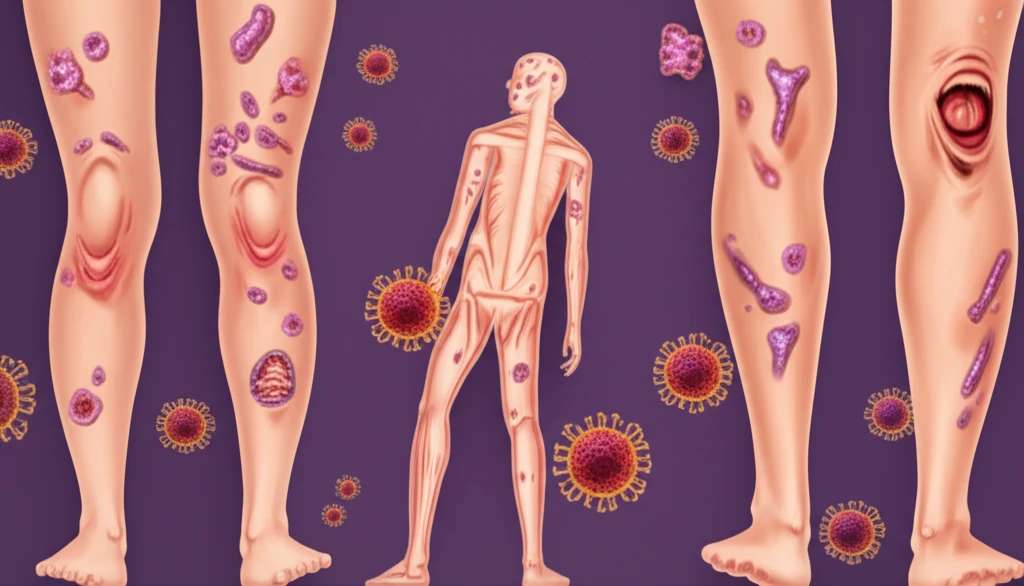
Surreal illustration of Kaposi Sarcoma lesions

Classic Kaposi Sarcoma: Understanding, Managing, and Living Well

"A comprehensive guide to classic Kaposi sarcoma, offering insights into its diagnosis, treatment options, and strategies for managing the condition effectively."


Kaposi Sarcoma (KS) is a type of cancer that develops from the cells that line blood and lymph vessels. It typically appears as lesions on the skin, in the mouth, or in other organs. Classic Kaposi Sarcoma, one of the four main types of KS, primarily affects older men of Mediterranean or Eastern European Jewish descent. Unlike other forms linked to HIV or immunosuppression, classic KS develops more slowly and is often confined to the skin.

While KS is caused by the human herpesvirus-8 (HHV-8), most people infected with HHV-8 never develop Kaposi Sarcoma. The reason why some individuals develop classic KS is not fully understood, but factors such as age, genetics, and immune system function likely play a role.

This guide aims to provide a clear and accessible overview of classic KS, drawing from a recent study of 156 cases. We will explore the key aspects of this condition, including its presentation, diagnosis, treatment options, and strategies for managing the impact on your life.

What Does Classic Kaposi Sarcoma Look Like and How Is It Diagnosed?

Surreal illustration of Kaposi Sarcoma lesions

Classic Kaposi Sarcoma typically manifests as purple, red, or brown lesions on the skin, most commonly on the lower legs and feet. These lesions may start as small macules (flat spots) and develop into larger plaques or nodules. In some cases, the lesions can ulcerate or cause swelling in the affected area.

The study of 156 patients revealed the following distribution of disease stages at diagnosis:

  • Stage I (Maculonodular): 48.1%
  • Stage II (Infiltrative): 22.4%
  • Stage III (Florid): 19.9%
  • Stage IV (Disseminated): 9.6%
Diagnosis usually involves a skin biopsy, where a small sample of tissue is removed and examined under a microscope. This confirms the presence of KS cells and helps rule out other conditions. It’s also crucial to test for HIV, though classic KS is not associated with HIV infection. The information from the study also emphasized the importance of accurate staging to guide treatment decisions.

Living Well with Classic Kaposi Sarcoma

While there is no cure for classic Kaposi Sarcoma, it is often a slow-growing condition that can be effectively managed with appropriate treatment and lifestyle adjustments. Regular follow-up with a dermatologist or oncologist is essential to monitor the disease and adjust treatment as needed.

The study highlighted the importance of local treatments such as surgery and radiation therapy, but also mentioned the role of systemic therapies like chemotherapy in more advanced cases. Working closely with your healthcare team is crucial to determine the best course of action for your individual situation.

Remember, a KS diagnosis isn't the end of an active life. Connect with support groups and other individuals affected by KS. Sharing experiences and tips can greatly improve your emotional well-being.

About this Article -

This article was crafted using a human-AI hybrid and collaborative approach. AI assisted our team with initial drafting, research insights, identifying key questions, and image generation. Our human editors guided topic selection, defined the angle, structured the content, ensured factual accuracy and relevance, refined the tone, and conducted thorough editing to deliver helpful, high-quality information.See our About page for more information.

This article is based on research published under:

DOI-LINK: 10.1016/j.dsi.2018.06.005, Alternate LINK

Title: Classic Kaposi'S Sarcoma: A Review Of 156 Cases

Subject: Dermatology

Journal: Dermatologica Sinica

Publisher: Medknow

Authors: Bulent Cetin, Bilge Aktas, Oznur Bal, Efnan Algin, Tulay Akman, Lokman Koral, Mehmet Ali Kaplan, Umut Demirci, Dogan Uncu, Ahmet Ozet

Published: 2018-12-01

Everything You Need To Know

1

What does Classic Kaposi Sarcoma look like, and how is it diagnosed?

Classic Kaposi Sarcoma appears as lesions on the skin, often presenting as purple, red, or brown spots, most commonly on the lower legs and feet. These can progress from flat spots (macules) to larger plaques or nodules, and in some cases, they can ulcerate or cause swelling. The diagnosis of Classic Kaposi Sarcoma is usually confirmed through a skin biopsy, where a tissue sample is examined under a microscope to identify KS cells. Accurate diagnosis is crucial for distinguishing Classic Kaposi Sarcoma from other conditions and guiding treatment decisions.

2

Who is most likely to be affected by Classic Kaposi Sarcoma?

Classic Kaposi Sarcoma primarily affects older men of Mediterranean or Eastern European Jewish descent. Unlike other forms of Kaposi Sarcoma, Classic Kaposi Sarcoma is not typically linked to HIV infection or immunosuppression. The reasons for the development of Classic Kaposi Sarcoma in specific individuals are not fully understood but are thought to involve a combination of factors, including age, genetics, and the function of the immune system. Being aware of these risk factors can help in early detection and management.

3

What causes Classic Kaposi Sarcoma?

While the exact cause is not fully understood, Classic Kaposi Sarcoma is associated with the human herpesvirus-8 (HHV-8). However, the presence of HHV-8 alone does not guarantee the development of Classic Kaposi Sarcoma; other factors play significant roles. The virus's interaction with an individual's age, genetic makeup, and immune system function determines whether Classic Kaposi Sarcoma manifests. Understanding the connection between HHV-8 and these other elements is key to managing and understanding the condition.

4

How is Classic Kaposi Sarcoma treated?

The treatment for Classic Kaposi Sarcoma is not discussed in detail, but the text does say that regular follow-up with a dermatologist or oncologist is essential to monitor the disease. With treatment, lifestyle adjustments and ongoing monitoring, managing the disease is possible. The study of 156 cases highlights the importance of understanding the stage of the disease for guiding treatment decisions. The distribution of stages at diagnosis was: Stage I (Maculonodular) - 48.1%, Stage II (Infiltrative) - 22.4%, Stage III (Florid) - 19.9%, and Stage IV (Disseminated) - 9.6%.

5

How can individuals live well with Classic Kaposi Sarcoma?

Although there is no cure for Classic Kaposi Sarcoma, it is often a slow-growing condition that can be effectively managed with appropriate treatment and lifestyle adjustments. Regular check-ups with a dermatologist or oncologist are vital for monitoring the disease's progression and adapting treatment strategies as needed. By focusing on appropriate care and staying informed about the condition, individuals can maintain a good quality of life. The management of the condition underscores the importance of a proactive approach involving medical care and lifestyle adaptations.

Newsletter Subscribe

Subscribe to get the latest articles and insights directly in your inbox.