
Civil War Medicine: How Photography Revolutionized Battlefield Care

"Uncover the untold story of how medical photography transformed Civil War treatment and shaped modern medical practices."
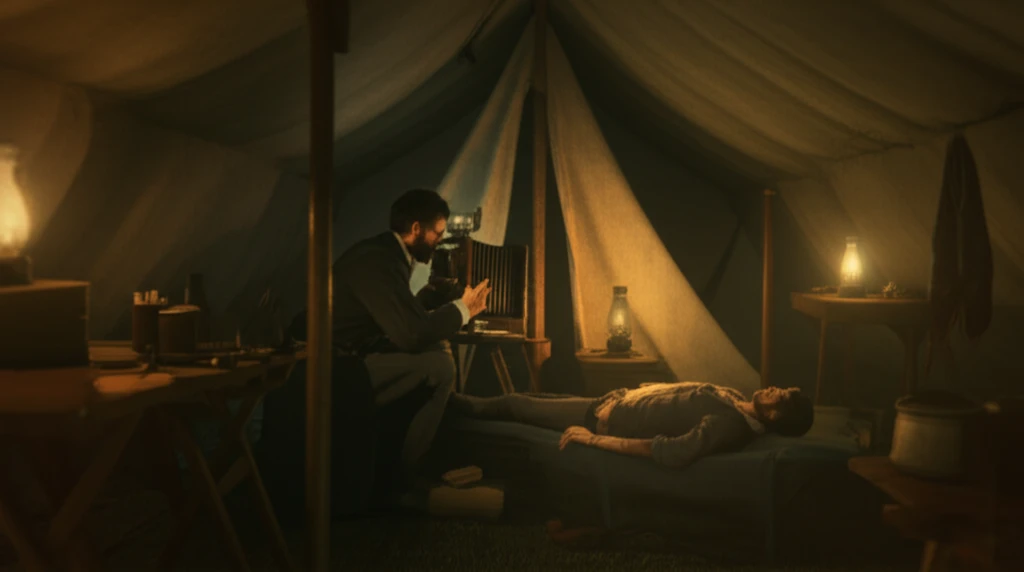
The American Civil War (1861-1865) was a crucible of innovation, not just in weaponry and tactics, but also in medical care. Amidst the carnage, a new approach emerged: medical photography. Dr. Reed Brockway Bontecou, a pioneering surgeon and photographer, documented the realities of battlefield injuries with unprecedented clarity. His work not only aided in immediate treatment but also left a lasting impact on medical education and our understanding of wartime trauma.
Before Bontecou, medical illustration relied on drawings and descriptions, often subjective and lacking the stark realism of photography. Bontecou's photographs offered a precise visual record of wounds, surgical procedures, and patient outcomes. This innovation came at a crucial time, as advancements in weaponry like the Minié ball caused devastating injuries that required new surgical techniques and documentation methods.
This article delves into the story of Bontecou's work, exploring how his photographs revolutionized medical practices during the Civil War and examining their enduring legacy on modern medicine. We'll uncover how these images were used for education, treatment planning, and even pension evaluations, offering a unique glimpse into the challenges and innovations of 19th-century medicine.
Bontecou's Photographic Revolution: Documenting the Unseen
Dr. Bontecou's approach was revolutionary for its time. Commissioned to collect medical specimens and documentation, including photography, for the Army Medical Museum, his medical photography showed the war's visual and visceral realities. He systematically photographed patients before and after surgery, creating a visual record of treatments and outcomes, which contrasted sharply with idealized or romanticized depictions common at the time. Bontecou also used the Victorian industrialization innovation, where war images quickly found their way to other continents and teaching establishments.
- Objective Documentation: Bontecou moved away from the romanticized portraiture of his contemporaries and developed a systematic approach to pre and postoperative images, sometimes years apart.
- Educational Tool: Photographs of procedures and afflictions were utilised as "specimens". Comparable to pathological samples of bone and tissue, this is perhaps one of the first sanctioned citations of the weight photography had over other artistic mediums in its autonomous representation of a medical condition.
- Metadata Integration: Majority of subjects also hold a chalkboard, with name, regiment and affliction scripted across its surface, an early predecessor to the use of metadata attached to patient's digital images in current medical photography.
The Enduring Legacy: From Battlefield to Modern Medicine
Dr. Bontecou's work laid the groundwork for modern medical photography and documentation. His commitment to objectivity, systematic recording, and integration of visual evidence into medical practice remains relevant today.
Today, medical imaging is integral to diagnosis, treatment planning, and education. From X-rays and MRIs to endoscopic procedures and digital photography, visual records play a crucial role in healthcare. Bontecou's pioneering efforts paved the way for these advancements, demonstrating the power of visual documentation to improve patient care and advance medical knowledge. These foundations are now used within modern clinical SRP.
The story of Bontecou's Civil War photography serves as a reminder of the transformative potential of innovation in the face of adversity. It highlights the importance of visual records in medicine and honors the legacy of a pioneer who helped shape our understanding of wartime trauma and the practice of modern medicine. The social economic traits of the 19th century and the continuation of Paris medicine saw change and innovation explode across the developing world.