
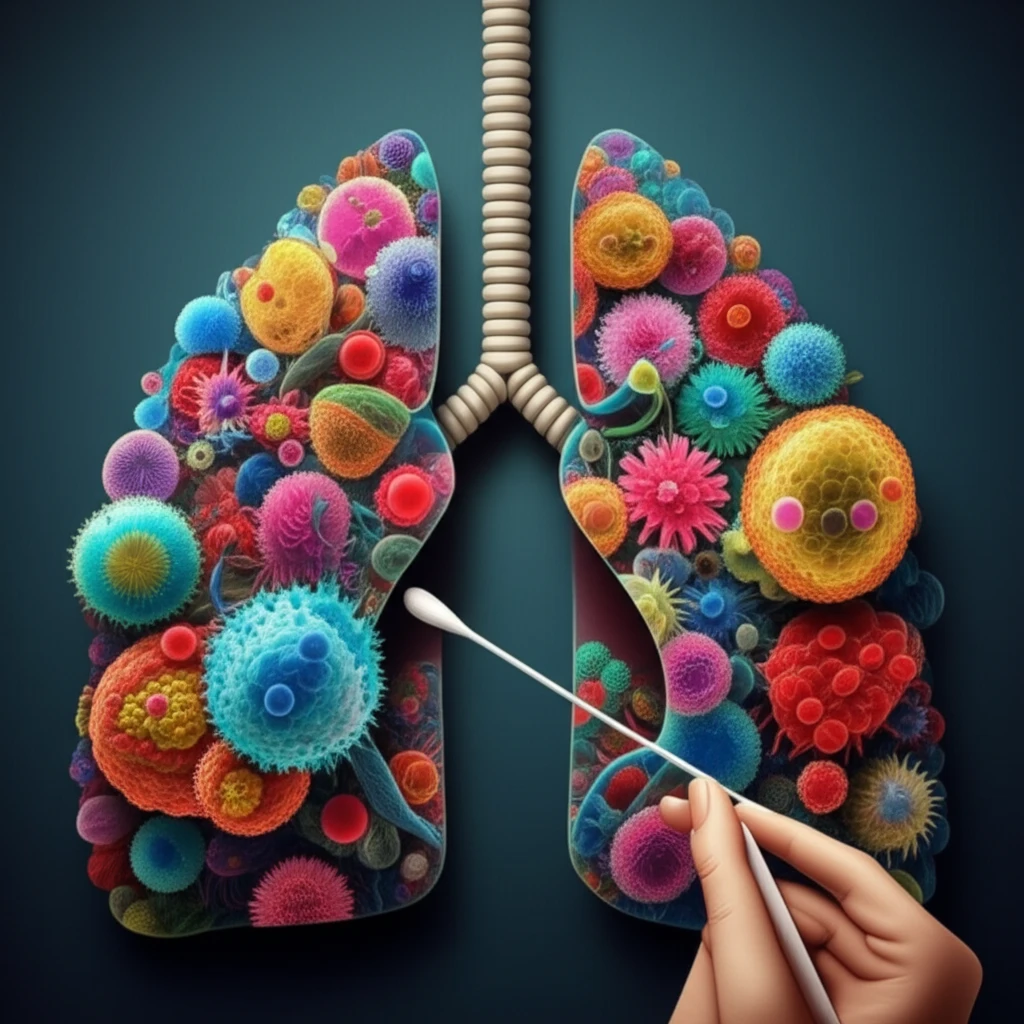
Illustration of lung health with cheek swab.

Cheek Swabs: A New Frontier in Lung Cancer Detection?

"Research explores how a simple cheek swab could reveal early signs of lung cancer, especially in smokers."


Lung cancer remains a formidable health challenge, with a stubbornly low five-year survival rate of approximately 16%. A significant reason for this grim statistic is late diagnosis; over half of lung cancer patients are diagnosed at an advanced stage, limiting treatment options and impacting outcomes. This underscores the critical need for effective screening methods that can catch the disease in its earliest, most treatable phases.

Currently, screening for lung cancer primarily involves methods like chest X-rays and low-dose computed tomography (LDCT). While LDCT has shown promise in reducing lung cancer mortality, it suffers from a high false-positive rate, leading to unnecessary anxiety and invasive procedures for many individuals. This highlights the importance of developing more precise and less invasive screening tools to identify those at genuine risk.

Imagine a world where a simple cheek swab could provide an early warning sign for lung cancer. Recent research explores the potential of using buccal (cheek) cells to detect changes at the molecular level that could indicate the presence of lung cancer. This approach leverages the concept of 'field carcinogenesis,' where exposure to carcinogens like tobacco smoke causes changes not only in the lungs but also in other tissues, including the lining of the mouth.

How Cheek Cells Mirror Lung Health: The MicroRNA Connection

Illustration of lung health with cheek swab.

The study, published in the International Journal of Oncology, investigated whether microRNAs (miRNAs) found in buccal cells could serve as biomarkers for lung cancer. MicroRNAs are small molecules that play a crucial role in regulating gene expression. Changes in their levels can indicate the presence of disease, including cancer.

Researchers compared the miRNA profiles of buccal cells from lung cancer patients and healthy individuals (smokers) . The results revealed a distinct pattern: 68 miRNAs were upregulated (increased) and 3 were downregulated (decreased) in the buccal cells of lung cancer patients. This suggests that the molecular changes occurring in the lungs due to cancer are also reflected in the cells lining the mouth.

  • Non-Invasive Potential: Cheek swabs are easy to collect, making this a potentially attractive screening method.
  • Early Detection: The ability to detect lung cancer-related changes in seemingly normal buccal cells offers hope for earlier diagnosis.
  • Personalized Screening: The study also identified gender-specific miRNA signatures, suggesting the possibility of tailoring screening approaches based on individual risk profiles.
The performance characteristics of these selected miRNAs were impressive, with an average AUROC (area under the receiver operating characteristic curve) of >0.80, indicating excellent accuracy in distinguishing between individuals with and without lung cancer. This level of accuracy suggests that these miRNAs could be reliable biomarkers for identifying individuals who may benefit from further screening.

A Promising Step, But More Research Needed

While these findings are encouraging, it's crucial to recognize this as an early-stage study. The researchers themselves acknowledge several limitations, including the relatively small sample size and the need for validation in larger, independent cohorts.

One particularly interesting aspect of the study is the identification of gender-specific miRNA signatures. This aligns with the growing recognition that lung cancer can manifest differently in men and women, with variations in molecular characteristics and risk factors. Further research is needed to fully understand the implications of these gender-specific biomarkers and how they can be incorporated into screening strategies.

The prospect of using a simple cheek swab to detect early signs of lung cancer is undeniably appealing. If validated in future studies, this approach could revolutionize lung cancer screening, making it more accessible, less invasive, and potentially more effective in catching the disease at its most treatable stages.

About this Article -

This article was crafted using a human-AI hybrid and collaborative approach. AI assisted our team with initial drafting, research insights, identifying key questions, and image generation. Our human editors guided topic selection, defined the angle, structured the content, ensured factual accuracy and relevance, refined the tone, and conducted thorough editing to deliver helpful, high-quality information.See our About page for more information.

This article is based on research published under:

DOI-LINK: 10.3892/ijo.2014.2495, Alternate LINK

Title: Buccal Microrna Dysregulation In Lung Field Carcinogenesis: Gender-Specific Implications

Subject: Cancer Research

Journal: International Journal of Oncology

Publisher: Spandidos Publications

Authors: Ramesh K. Wali, Thomas A. Hensing, Daniel W. Ray, Mart Dela Cruz, Ashish K. Tiwari, Andrew Radosevich, Lisa Jepeal, Hiran C. Fernando, Virginia R. Litle, Marjory Charlot, Navneet Momi, Vadim Backman, Hemant K. Roy

Published: 2014-06-11

Everything You Need To Know

1

How do microRNA levels in cheek swabs differ between lung cancer patients and healthy individuals?

The study found that specific microRNAs in buccal cells of lung cancer patients showed different levels compared to healthy smokers. Specifically, 68 microRNAs were upregulated (increased), while 3 were downregulated (decreased). This distinctive pattern suggests molecular changes linked to lung cancer are detectable in the mouth.

2

How does the cheek swab method compare to current lung cancer screening methods like low-dose computed tomography (LDCT)?

Currently, lung cancer screening relies on methods such as chest X-rays and low-dose computed tomography (LDCT). While LDCT improves mortality rates, it often yields false positives, causing unnecessary anxiety and invasive procedures. The cheek swab method offers a potentially less invasive alternative for initial screening.

3

What is 'field carcinogenesis,' and how does it relate to detecting lung cancer using cheek swabs?

This research suggests that changes in microRNA levels within buccal cells, influenced by 'field carcinogenesis,' can mirror lung health. Exposure to carcinogens, like tobacco smoke, prompts changes not only in lung tissue but also in other tissues, including the lining of the mouth, making cheek swabs a viable diagnostic tool.

4

How accurate are cheek swabs in detecting lung cancer, based on the study's findings?

The study's accuracy, measured by an AUROC (area under the receiver operating characteristic curve) of >0.80, indicates excellent potential in distinguishing individuals with and without lung cancer using microRNA biomarkers found in cheek swabs. This suggests the cheek swab method could reliably identify individuals who need further screening.

5

What are the implications of discovering gender-specific microRNA signatures for lung cancer screening?

The discovery of gender-specific microRNA signatures opens the door to personalized lung cancer screening. Tailoring screening approaches based on individual risk profiles, including gender, could improve early detection and treatment outcomes. However, more research is needed to validate these findings in larger populations and understand the full implications for clinical practice.

Newsletter Subscribe

Subscribe to get the latest articles and insights directly in your inbox.