
Checking the Manual Against What's Actually in Front of You

"Finding the right page fast is not the same job as inspecting the equipment - and it was never meant to be."
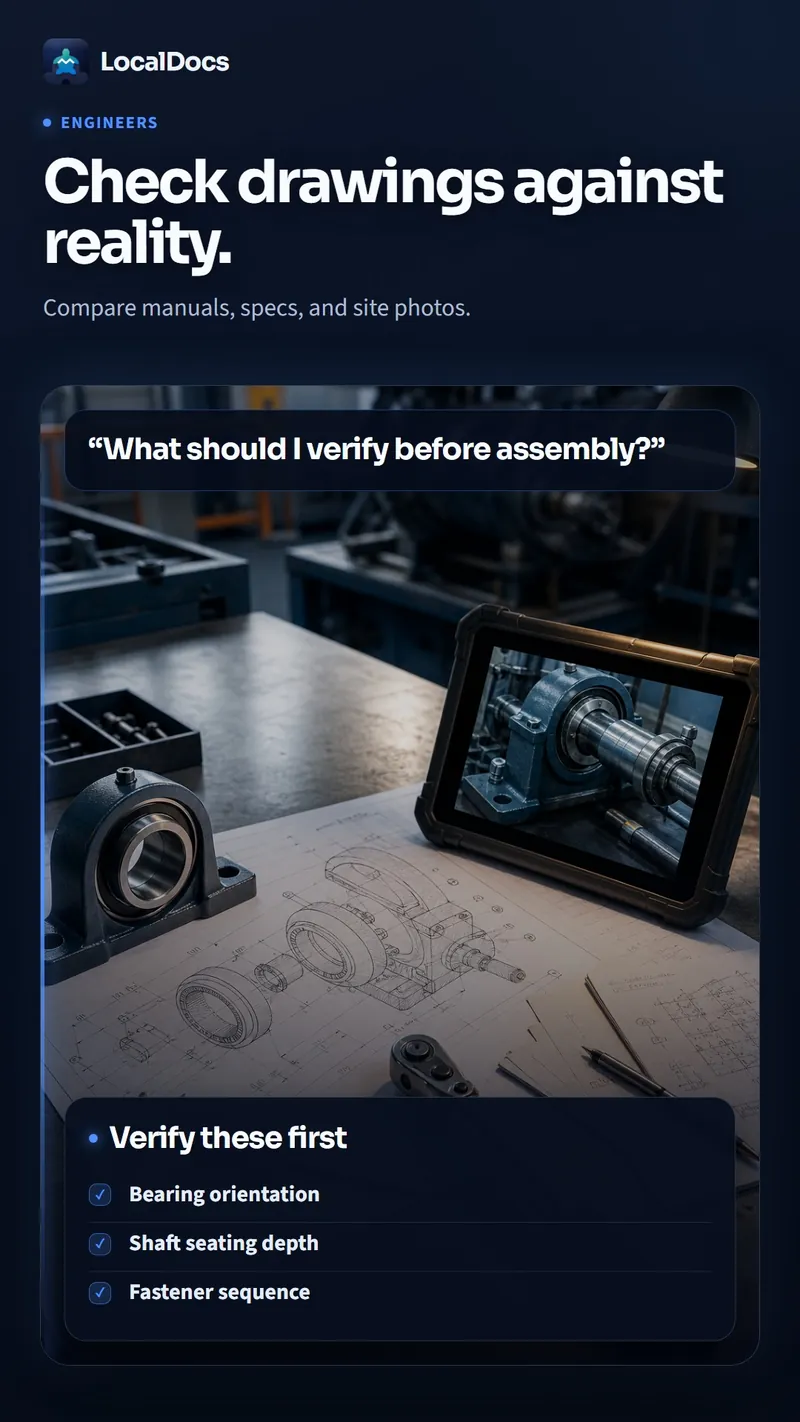
A technician on a rooftop unit is holding a printed cut sheet from a job three years ago, and the model number stamped on the unit in front of him doesn't match the one on the page. Somewhere between the original install and today, the unit got swapped under warranty, or the drawing was never updated, or he's holding the wrong revision entirely. He has three choices: guess based on what looks close enough, walk back to a truck or a trailer to dig through a binder or a laptop, or call someone in an office who may or may not pick up. None of those is a good use of the twenty minutes he has left before the next call. This kind of moment is extremely common in construction, utilities, and industrial maintenance work, and it rarely makes it into anyone's project report, because it just gets absorbed as normal friction - part of the job, not a problem worth naming.

Private, on-device AI for your documents — ask questions, get cited answers.

Multiply that by every technician, engineer, and inspector who spends part of a shift reconciling paper against reality, and it stops looking like a personal annoyance and starts looking like a pattern worth studying. Some of it is a wrong-revision problem - the drawing set in the trailer is real, it's just not current. Some of it is a findability problem - the current document exists somewhere, in a shared drive or an email attachment from eight months ago, but not in the hand of the person standing at the equipment. Either way, the gap between what's documented and what's actually installed is where time, and sometimes money, quietly disappears. It's worth naming anyway, because it isn't free: working from the wrong drawing, the wrong spec revision, or a work order that references a part that's since been superseded is a documented driver of rework - the redoing of work that was already done once - and rework is one of the most expensive line items in construction that almost nobody budgets for directly. The second half of the problem compounds the first: even when the right document does exist, finding the right page inside a two-hundred-page O&M manual or a stack of PDFs, standing at the equipment with gloves on, is its own time cost. And on a lot of the sites where this happens - a substation, a plant floor, a rural pole yard, a basement mechanical room - there often isn't a reliable signal to search for anything online even if you wanted to.
What follows is what's actually documented about that cost, why offline access to your own reference material is a genuine requirement in field work rather than a preference, and where the real limits are. Photographing a valve and asking a question about it is a fast way to find the right page to check against - it is not an inspection, and it doesn't replace one. Keep that distinction in view through the rest of this, because it's the whole point.
What the Wrong Page Actually Costs
Field documentation drifts out of sync with reality for ordinary reasons, not because anyone is careless. Equipment gets swapped under warranty and the drawing set doesn't get revised. A spec sheet gets superseded when a manufacturer updates a part number, and the printed copy in the site trailer predates that update. A work order references a component by an old designation because whoever wrote it copied the previous one. A torque spec gets corrected in a bulletin that never made it into the binder that's actually on-site. None of this is unusual - it's what happens when paperwork and physical equipment get maintained on different schedules, by different people, over years. The result, on a lot of jobs, is a technician or engineer standing in front of a piece of equipment trying to reconcile documents that don't quite agree with each other, or with the equipment itself, and having to decide in the moment which one to trust.
The cost of that isn't a guess. Autodesk and FMI Corporation's September 2021 report, "Harnessing the Data Advantage in Construction," put the cost of "bad data" - information that's inaccurate, incomplete, inaccessible, inconsistent, or simply too slow to reach the field - at an estimated $1.85 trillion globally in 2020. Of that, $88.69 billion was tied specifically to rework caused by bad data, which the report calculated at roughly 14% of all the rework performed in construction that year. That's not a small side effect; it's a meaningful share of one of the industry's biggest recurring costs, and it traces back to the same root problem as the technician on the rooftop: the information in front of someone in the field didn't match what they actually needed to know.
The offline part is just as well documented, and it predates the current wave of AI tools. McKinsey's June 2016 report, "Imagining construction's digital future," named a lack of reliable, high-speed broadband connectivity as one of the specific reasons field crews were slow to adopt mobile and digital tools on site, alongside compatibility issues and clunky interfaces. That's not a hypothetical concern - it's a documented reason real tools failed to get used, and it hasn't gone away just because phones and AI have both improved since 2016. A tool that needs a strong signal to look something up is a tool that quietly stops working in a plant basement, a rural substation, or a job site before the network contractor has run cable.
This is roughly the shape LocalDocs takes for that specific problem - finding the right reference fast, not deciding whether the equipment is sound.
- Point it at a folder of manuals, spec sheets, drawings, and work orders you already have - PDF, .docx, plain text, Markdown, HTML - and it reads across everything in that folder to answer a typed question in plain language.
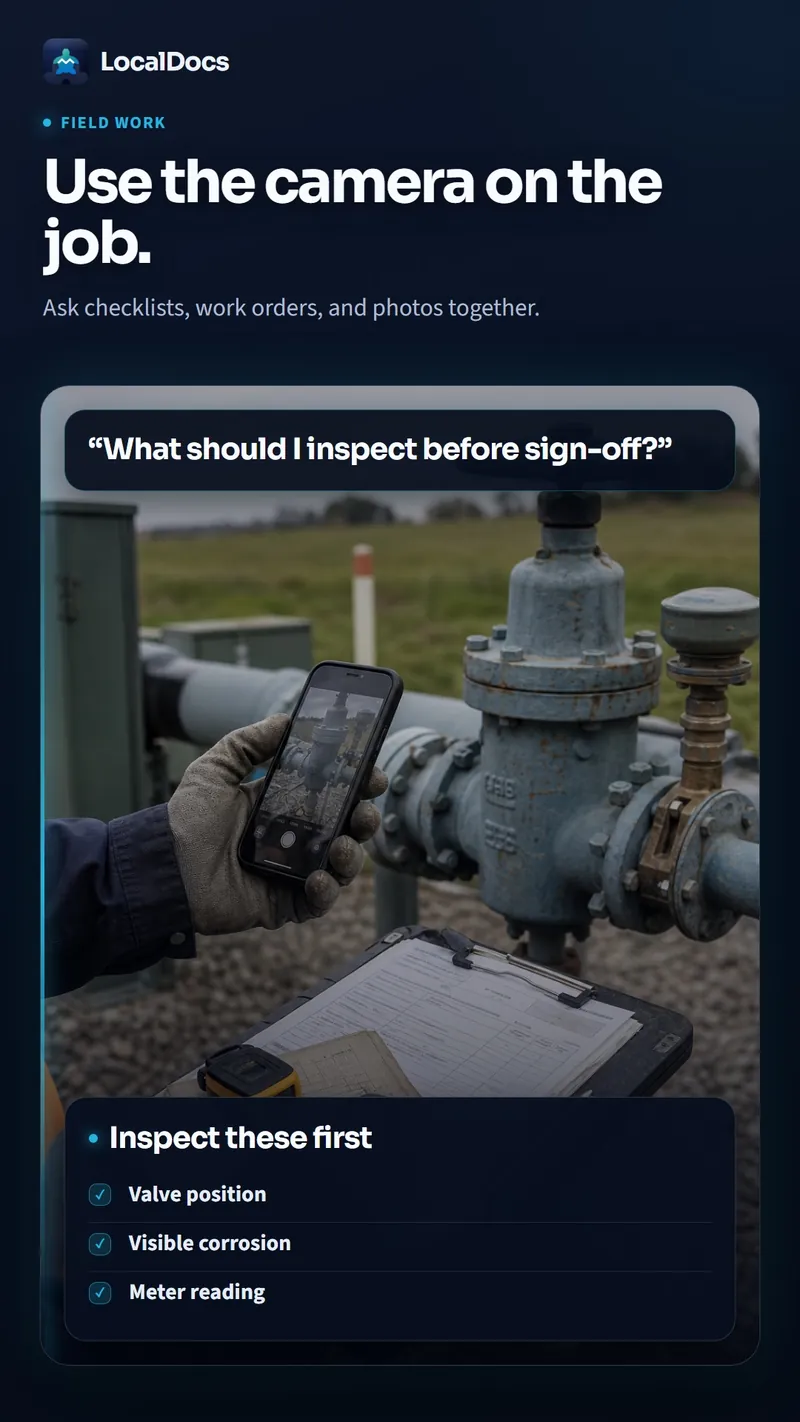
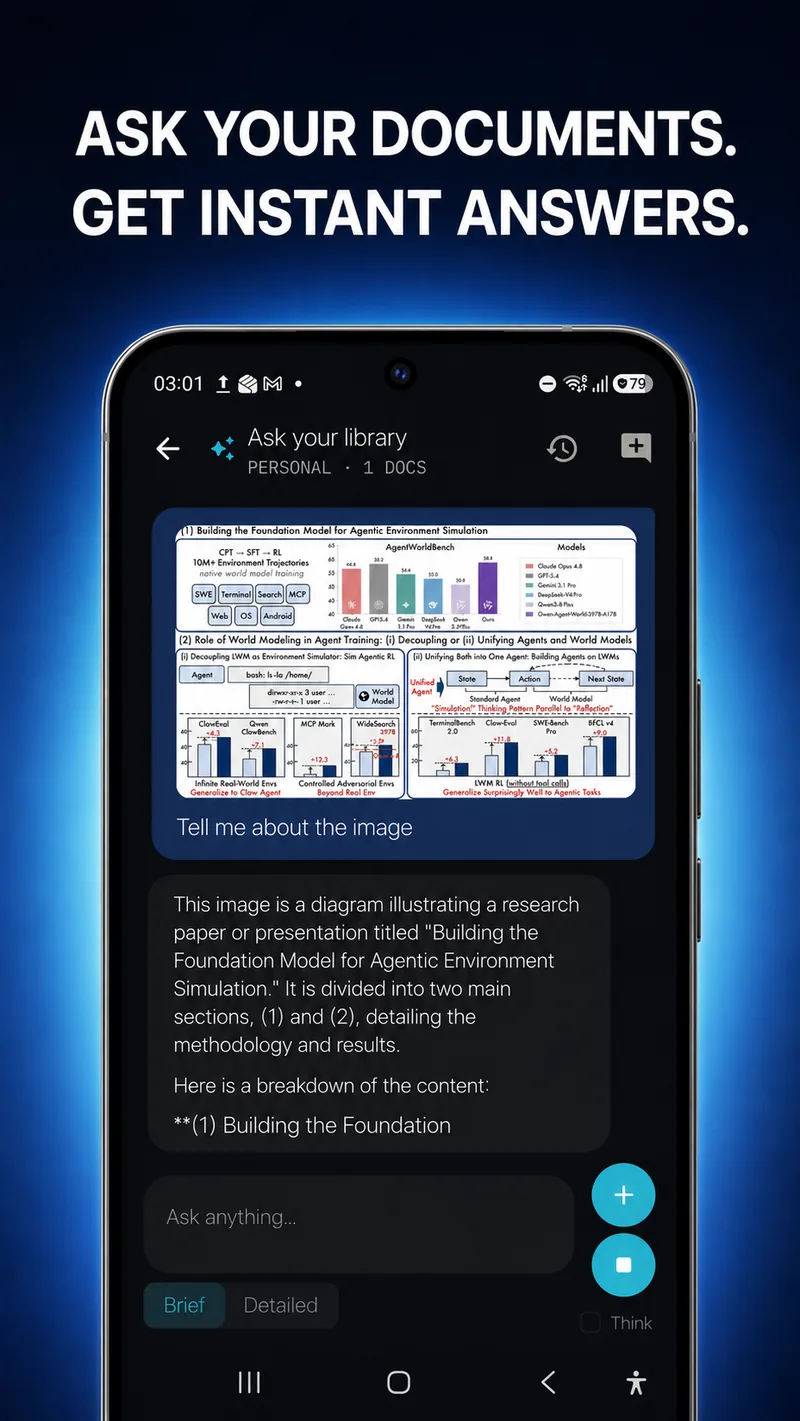
- It also takes a photo. Ask about a picture taken on-site - a nameplate, a gauge, a valve assembly, a hand-drawn field sketch - in the same conversation as your typed documents, so a photo and a spec sheet can be cross-referenced together.
- Every answer names which document it came from, and tapping the citation opens that source file directly, so instead of trusting a paraphrase, you can check the actual page yourself before acting on it.
- It's organized into folders the app calls mini libraries; a real example from Mystum's own promotional materials shows a library of 23 documents across 10 folders, roughly the scale a site's manuals, specs, and work orders reach after a year or two of use.
- Once the folder is loaded, it works entirely offline - no account, no analytics, no connection needed to ask a question - which is the part that actually matters at a site with one bar of signal or none.
None of this makes photographing a part the same thing as inspecting it. Asking a question about a photo of a valve or a gauge is a way to pull up the right reference material fast - it is not a rigorous verification step, it doesn't certify that equipment is installed correctly, and it is not a substitute for a qualified inspector's judgment or a manufacturer's official sign-off process on equipment where that process applies. Treat it as a faster way to find and cross-check your own paperwork, not as the check itself. It's also worth remembering that a small model running on a phone can misread a diagram or a photo and answer with confidence anyway - the citation on every answer exists so you can verify it against the actual document, not so you can skip that step.
LocalDocs is Mystum's own app - we built it, and we're telling you about it here directly. If you want to see how it handles a folder of your own manuals, specs, and site photos, try LocalDocs here.
Where the Line Actually Is
Two limitations are worth stating plainly rather than burying in fine print. First, the model runs on the phone's own hardware, not a data-center GPU, so indexing a large folder, or asking a question that has to draw on many documents at once, takes longer than sending the same request to a big cloud AI tool would - that's a real trade for keeping everything on the device, not a minor footnote. Second, and more important: this is a tool for finding and cross-referencing your own reference material, not a checker or approver of the work itself. If a piece of equipment is safety-critical - pressure vessels, electrical systems, lifting equipment, anything with a certification requirement - the sign-off still has to come from a qualified inspector following the actual verification process for that equipment, not from an answer generated on a phone. Nothing here changes that, and nothing here should be read as suggesting otherwise.
On the processing side, the precise claim is this: documents and questions are processed on the phone and are not uploaded to a server to generate the answer. That's a real, checkable property, and it's different from a guarantee that the information is safe in every sense. It doesn't protect a folder from someone else who has the phone or tablet unlocked in their hands - they can open the app and read whatever it can read, same as any other app. It doesn't protect against malware already running on the device, which can reach local files directly regardless of which app is installed. And it doesn't do anything for a folder that's itself synced to a cloud service - if the manuals live in a folder that also syncs to Drive or Dropbox, those files are already off the device independent of how an on-device app later reads them. None of that is specific to a job site; it's the same as it would be for any phone or tablet carrying sensitive files, and it's worth keeping in mind on a shared crew device as much as a personal one.
None of that erases the actual value here, which is narrower and more practical than a privacy pitch or a safety pitch: on a site with a spotty signal or none, being able to pull up the right page of the right manual, or ask what a photographed nameplate actually says, without waiting on a network connection that might not show up, saves real time - the same twenty minutes the rooftop technician didn't have to spend walking back to a truck. It's a faster way to find your own reference material. What you do with what you find, and who ultimately signs off on it, is still, correctly, a human decision.
Private, on-device AI for your documents — ask questions, get cited answers.