
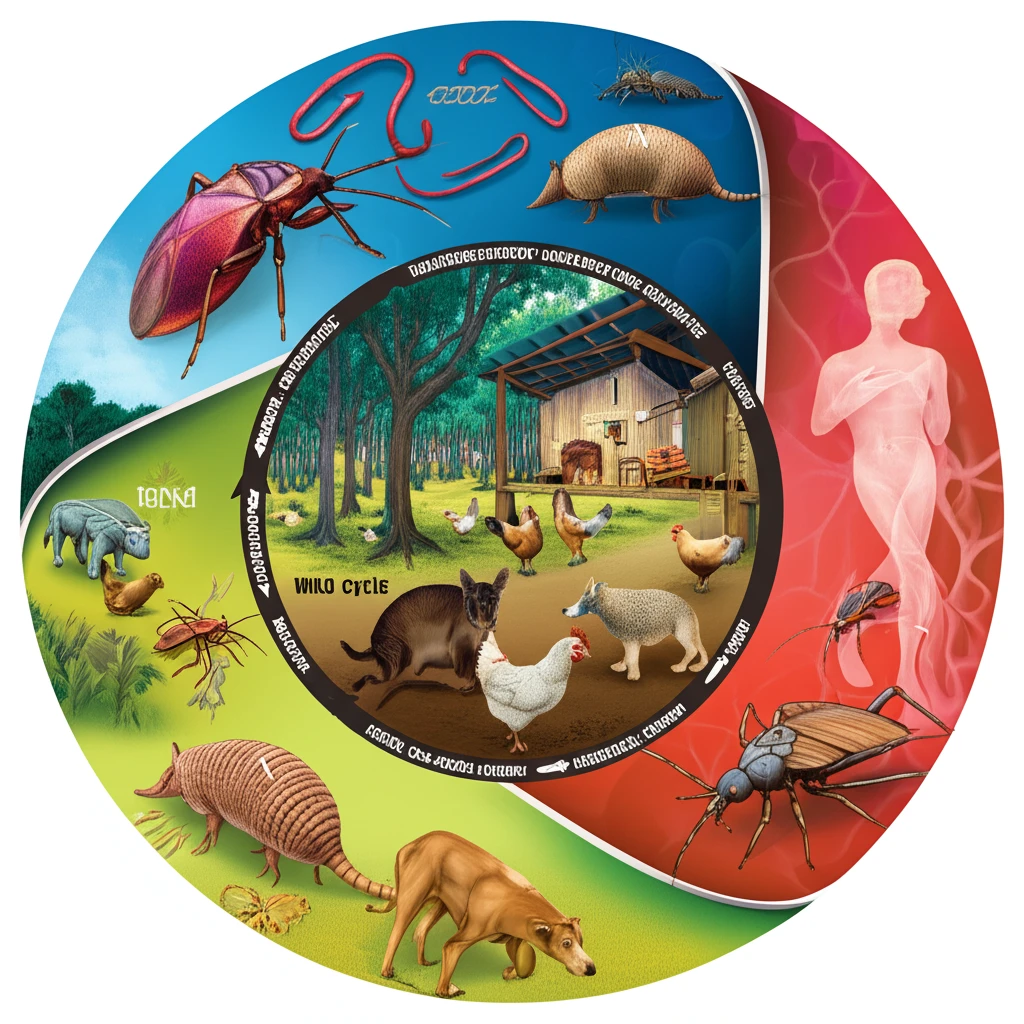
Illustration of Chagas disease transmission cycles: wild, peridomestic, and domestic

Chagas Disease: Decoding the Silent Threat and Paving the Path to a Cure

"Unveiling the Ecoepidemiology of a Neglected Disease and Charting a Course for Global Eradication"


Chagas disease, a parasitic illness caused by the protozoan Trypanosoma cruzi, poses a significant global health challenge, primarily affecting vulnerable populations in Latin America. Often referred to as the "silent killer," it can remain asymptomatic for years, leading to severe heart and digestive system complications if left untreated. This article aims to provide a comprehensive overview of Chagas disease, from its historical context and ecoepidemiological aspects to current control initiatives and the challenges faced in non-endemic regions.

The disease is primarily transmitted through the bite of infected triatomine bugs, also known as "kissing bugs." These nocturnal insects feed on blood and, when infected, can transmit the parasite to humans. Beyond vector transmission, Chagas disease can also be spread through blood transfusions, organ transplantation, and congenital transmission from mother to child. Understanding the various transmission pathways is crucial for implementing effective prevention and control strategies.

This article will explore the complex interplay between the wild, peridomestic, and domestic cycles of Chagas disease, examining the ecological factors that contribute to its spread. Furthermore, it will delve into the historical context of the disease, highlighting key discoveries and advancements in understanding and controlling Chagas disease. Additionally, the article will address the challenges posed by the migration of infected individuals to non-endemic countries and the measures being taken to address these emerging concerns.

Unraveling the Ecoepidemiology: Cycles of Transmission

Illustration of Chagas disease transmission cycles: wild, peridomestic, and domestic

Chagas disease transmission occurs through three primary cycles: the wild, peridomestic, and domestic cycles. The wild cycle, which has existed for millennia, involves the transmission of T. cruzi between triatomine bugs and wild mammals. Human infection in the wild cycle is rare, occurring primarily when people enter forested areas where the vectors reside. The peridomestic cycle involves the interaction of triatomine bugs and animals, like chickens or dogs, in close proximity to human dwellings. The domestic cycle is the most prevalent mode of transmission, where triatomine bugs colonize human homes, feeding on blood and transmitting the parasite.

The shifting dynamics of deforestation and agricultural expansion in the Americas have significantly altered the ecoepidemiology of Chagas disease. The encroachment of human activities into wild habitats has led to the displacement of wild mammals, driving triatomine bugs to seek alternative food sources in peridomestic and domestic settings. This shift has facilitated the transition of the parasite from the wild cycle to the domestic cycle, increasing the risk of human infection. In essence, ecological disruptions have brought vectors and humans into closer contact, amplifying disease transmission.

  • Wild Cycle: Transmission between triatomine bugs and wild mammals in natural habitats.
  • Peridomestic Cycle: Interaction of triatomine bugs with domestic animals like chickens and dogs.
  • Domestic Cycle: Triatomine bugs colonizing human homes, feeding, and transmitting the parasite.
Understanding the ecoepidemiology of Chagas disease is crucial for developing effective control measures. Strategies to interrupt transmission must consider the ecological factors that influence vector behavior, reservoir host dynamics, and human exposure. By targeting the different cycles of transmission, public health interventions can mitigate the risk of infection and reduce the burden of Chagas disease.

A Call to Action: The Future of Chagas Disease Control

Chagas disease presents a complex and evolving global health challenge. Addressing this "silent killer" requires a multi-pronged approach involving disease surveillance, vector control, early diagnosis, and effective treatment. Continued research, international collaboration, and community engagement are essential to combating Chagas disease and improving the lives of those affected. By working together, we can move closer to a world free from the burden of this neglected tropical disease.

About this Article -

This article was crafted using a human-AI hybrid and collaborative approach. AI assisted our team with initial drafting, research insights, identifying key questions, and image generation. Our human editors guided topic selection, defined the angle, structured the content, ensured factual accuracy and relevance, refined the tone, and conducted thorough editing to deliver helpful, high-quality information.See our About page for more information.

Everything You Need To Know

1

What is Chagas disease and what are its primary modes of transmission?

Chagas disease is a parasitic illness caused by the protozoan Trypanosoma cruzi. It is primarily transmitted through the bite of infected triatomine bugs, also known as "kissing bugs." Beyond vector transmission, it can spread through blood transfusions, organ transplantation, and congenitally from mother to child. Effective prevention strategies require an understanding of these various transmission pathways.

2

What are the different cycles of transmission for Chagas disease, and how do they impact the spread of the disease?

Chagas disease transmission occurs through three main cycles: the wild, peridomestic, and domestic cycles. The wild cycle involves transmission between triatomine bugs and wild mammals. The peridomestic cycle includes interaction between triatomine bugs and animals near human dwellings. The domestic cycle, where triatomine bugs colonize human homes, poses the greatest risk. The shifting dynamics of deforestation and agricultural expansion has increased the risk of human infection by bringing vectors and humans into closer contact, thus amplifying the disease transmission.

3

How has deforestation and agricultural expansion affected the spread of Chagas disease?

Deforestation and agricultural expansion have altered the ecoepidemiology of Chagas disease by encroaching on wild habitats. This displacement has driven triatomine bugs to seek alternative food sources in peridomestic and domestic settings. Consequently, it has facilitated the transition of the parasite from the wild cycle to the domestic cycle, thus increasing the risk of human infection.

4

What are the long-term health implications for someone infected with Trypanosoma cruzi?

If left untreated, Chagas disease can remain asymptomatic for years, yet potentially leading to severe complications. These can include significant heart and digestive system damage. The disease's insidious nature makes early detection and treatment extremely important to mitigate these serious health consequences.

5

What are the key components of a successful strategy to control and eradicate Chagas disease?

Controlling and eradicating Chagas disease requires a multi-pronged approach. This includes comprehensive disease surveillance, rigorous vector control, early and accurate diagnosis, and effective treatment options. Furthermore, continued research efforts, robust international collaboration, and consistent community engagement are critical in combating this neglected tropical disease and improving the health outcomes for affected populations. Targeting all the cycles of transmission by considering ecological factors is crucial.

Newsletter Subscribe

Subscribe to get the latest articles and insights directly in your inbox.