
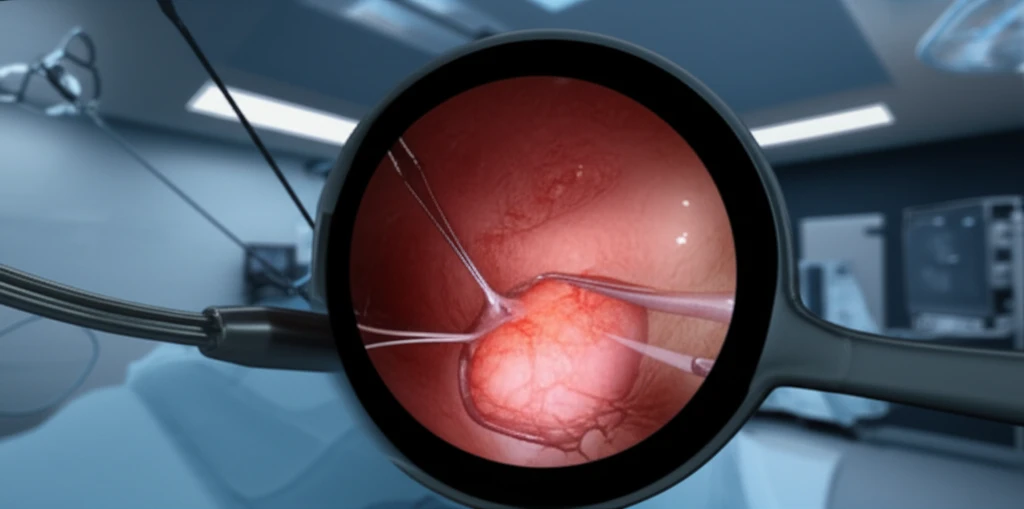
Combined Endoscopic and Laparoscopic Surgery (CELS) illustration.

CELS Procedure: Is Combined Endoscopic and Laparoscopic Surgery Right for You?

"Discover how Combined Endoscopic and Laparoscopic Surgery (CELS) offers a minimally invasive alternative to traditional colon resections, improving outcomes and reducing costs."


Colon polyps, particularly large or hard-to-reach ones, can pose a significant challenge. Traditionally, these polyps often require a colon resection, a surgical procedure to remove a portion of the colon. While laparoscopic techniques have improved outcomes, bowel resections still carry risks and can lead to significant complications.

Enter Combined Endoscopic and Laparoscopic Surgery, or CELS, a innovative approach blending the best of both worlds. CELS combines the precision of laparoscopy with the non-invasive nature of endoscopy to safely and effectively remove challenging colon polyps. This method may reduce the need for extensive bowel resections, leading to better patient outcomes and lower healthcare costs.

This article delves into the details of CELS, exploring its benefits, the procedure itself, patient selection, and expected outcomes. Whether you're a patient seeking information or a healthcare professional looking to expand your knowledge, this guide provides a comprehensive overview of this trending surgical technique.

What is Combined Endoscopic and Laparoscopic Surgery (CELS)?

Combined Endoscopic and Laparoscopic Surgery (CELS) illustration.

CELS is a minimally invasive surgical technique used to remove colon polyps that are difficult or impossible to remove through standard colonoscopy. The procedure combines two approaches:

Laparoscopy: Small incisions are made in the abdomen through which a surgeon inserts a camera and specialized instruments to visualize and manipulate the colon.

  • Endoscopy: A colonoscope, a long, flexible tube with a camera, is inserted through the anus to locate and visualize the polyp.
By combining these techniques, surgeons can precisely locate, manipulate, and remove polyps while minimizing the need for a large incision and bowel resection.

Is CELS the Right Choice for You?

CELS represents a significant advancement in the treatment of complex colon polyps. By offering a less invasive alternative to traditional surgery, CELS can improve patient outcomes, reduce recovery times, and lower healthcare costs. If you're facing a challenging colon polyp, discuss CELS with your doctor to determine if it's the right option for your individual needs.

About this Article -

This article was crafted using a human-AI hybrid and collaborative approach. AI assisted our team with initial drafting, research insights, identifying key questions, and image generation. Our human editors guided topic selection, defined the angle, structured the content, ensured factual accuracy and relevance, refined the tone, and conducted thorough editing to deliver helpful, high-quality information.See our About page for more information.

Everything You Need To Know

1

What exactly is Combined Endoscopic and Laparoscopic Surgery (CELS)?

Combined Endoscopic and Laparoscopic Surgery, known as CELS, is a minimally invasive surgical technique designed to remove colon polyps that are too large or difficult to remove using a standard colonoscopy. It strategically combines laparoscopy, where small incisions are made for camera and instrument insertion, with endoscopy, which involves using a colonoscope to visualize and locate the polyp. This dual approach allows surgeons to precisely target and remove polyps, reducing the need for extensive bowel resections.

2

Why is Combined Endoscopic and Laparoscopic Surgery considered significant?

CELS is important because it offers a less invasive alternative to traditional colon resections, especially when dealing with challenging colon polyps. By combining laparoscopy and endoscopy, CELS aims to improve patient outcomes, shorten recovery times, and potentially lower healthcare costs. The procedure reduces the necessity for large incisions and extensive bowel resections, it marks a significant advancement in treating complex colon polyps, offering a balanced approach that minimizes invasiveness while maximizing precision.

3

Can you explain what happens during a Combined Endoscopic and Laparoscopic Surgery procedure?

During a Combined Endoscopic and Laparoscopic Surgery procedure, surgeons make small incisions in the abdomen for laparoscopy and insert a colonoscope through the anus for endoscopy. The laparoscopic instruments and camera allow the surgeon to visualize and manipulate the colon from the outside, while the colonoscope provides a view from the inside. Together the surgeon can precisely locate and remove the polyp. This combined approach ensures accurate removal while minimizing the trauma to surrounding tissue. The combination of both endoscopic and laparoscopic techniques allows the surgeon to access and remove polyps that might otherwise require a more invasive surgery.

4

What are the benefits of having Combined Endoscopic and Laparoscopic Surgery?

CELS can lead to several potential benefits, including reduced recovery times, lower healthcare costs, and improved patient outcomes. By minimizing the need for large incisions and bowel resections, patients may experience less pain, shorter hospital stays, and a quicker return to normal activities. Additionally, the precision of CELS can lead to more effective polyp removal, potentially reducing the risk of recurrence and the need for further interventions. The reduced invasiveness and improved outcomes associated with CELS may also contribute to lower overall healthcare costs.

5

How do I know if Combined Endoscopic and Laparoscopic Surgery is the right option for me?

Whether CELS is the right choice depends on individual patient factors, such as the size, location, and characteristics of the colon polyp, as well as the patient's overall health and medical history. A doctor will evaluate these factors to determine if CELS is a suitable option. The decision-making process involves assessing the complexity of the polyp and whether it can be safely and effectively removed using this technique. Patients should discuss their specific situation with their healthcare provider to determine if CELS aligns with their needs and goals.

Newsletter Subscribe

Subscribe to get the latest articles and insights directly in your inbox.