
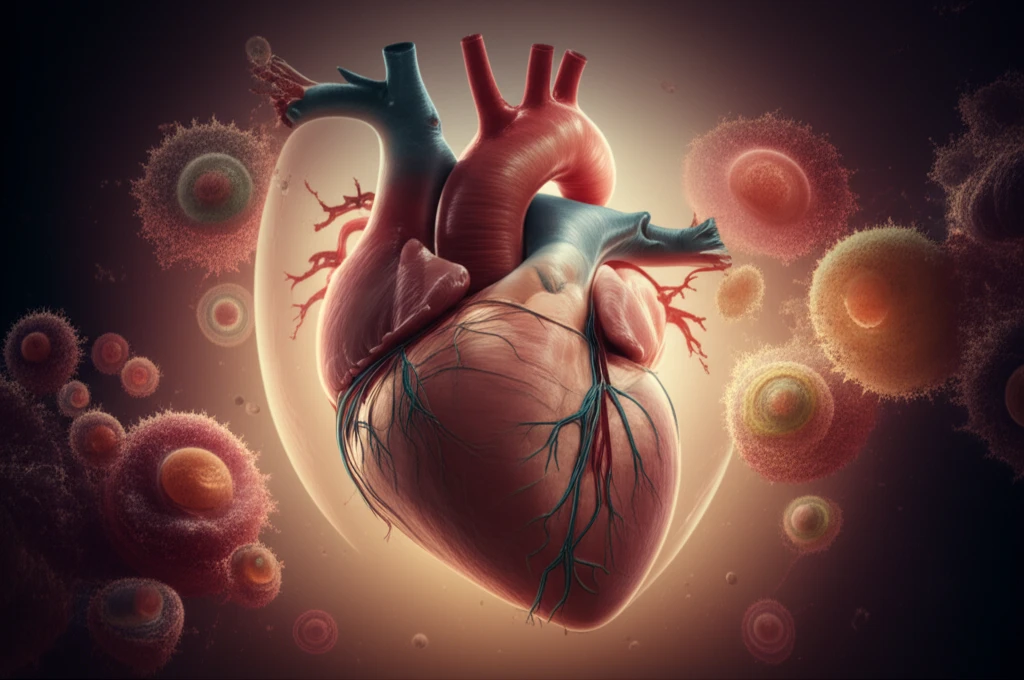
Heart protected by a cellular shield, symbolizing salubrinal's protective effects against cellular stress.

Cellular Stress Shield: How Salubrinal Could Guard Your Heart

"Emerging research highlights salubrinal's potential to protect heart cells from damage caused by stress, offering new avenues for heart health strategies."


Heart disease remains a leading cause of death worldwide, often linked to conditions that deprive heart cells of oxygen, a state known as hypoxia. While medical science has made strides, the quest for more effective treatments continues, especially those that can protect the heart at a cellular level. Recent studies suggest that targeting endoplasmic reticulum stress (ERS) could be a game-changer in preventing heart damage.

The endoplasmic reticulum (ER) is a critical component within our cells, responsible for ensuring proteins are correctly folded. When cells experience stress, this process can be disrupted, leading to what's known as ER stress. Tunicamycin (TM), a substance that interferes with protein synthesis in the ER, and hypoxia both impair ER functions, triggering a cascade of events that can lead to cell damage and death. Understanding how to mitigate ER stress is crucial for developing new therapies.

Enter salubrinal, a selective inhibitor of eIF2a dephosphorylation, recently developed as a protective agent against ERS-mediated apoptosis. This article explores how salubrinal works to protect heart cells from stress-induced damage, potentially offering new hope in the fight against heart disease.

What is Salubrinal and How Does it Protect Heart Cells?

Heart protected by a cellular shield, symbolizing salubrinal's protective effects against cellular stress.

Salubrinal is a compound designed to prevent the dephosphorylation of eIF2α, a crucial step in protein translation. By inhibiting this dephosphorylation, salubrinal helps to reduce the production of misfolded proteins, thus alleviating stress on the endoplasmic reticulum. This action is particularly important in conditions like hypoxia, where cells are already struggling to function correctly.

A study published in the Journal of Geriatric Cardiology investigated the effects of salubrinal on rat cardiomyocytes (heart muscle cells) subjected to tunicamycin and hypoxia. The researchers found that salubrinal:

  • Protected cardiomyocytes from apoptosis (cell death) induced by tunicamycin and hypoxia.
  • Induced eIF2α phosphorylation, which helps to regulate protein synthesis and reduce the load of misfolded proteins.
  • Down-regulated the expression of CHOP and cleaved caspase-12, proteins that promote apoptosis under ER stress.
These findings suggest that salubrinal operates through the PERK-eIF2α signaling pathway, a critical mechanism for managing ER stress. By modulating this pathway, salubrinal helps heart cells survive under stressful conditions, paving the way for potential therapeutic applications.

The Future of Salubrinal in Heart Health

The research indicates that salubrinal has the potential to protect heart cells from damage caused by hypoxia and ER stress. While these findings are promising, further research is needed to fully understand the long-term effects of salubrinal and how it can be effectively translated into clinical treatments. As we continue to explore new ways to combat heart disease, salubrinal offers a beacon of hope for future therapies.

About this Article -

This article was crafted using a human-AI hybrid and collaborative approach. AI assisted our team with initial drafting, research insights, identifying key questions, and image generation. Our human editors guided topic selection, defined the angle, structured the content, ensured factual accuracy and relevance, refined the tone, and conducted thorough editing to deliver helpful, high-quality information.See our About page for more information.

Everything You Need To Know

1

What exactly is salubrinal, and how does it work to protect heart cells?

Salubrinal is a compound that protects cells from stress, specifically endoplasmic reticulum stress (ERS). It works by preventing the dephosphorylation of eIF2α, which helps to control protein synthesis. By inhibiting this process, salubrinal reduces the production of misfolded proteins, alleviating stress on the endoplasmic reticulum and helping cells function correctly, especially under conditions like hypoxia.

2

What is the endoplasmic reticulum, and why is endoplasmic reticulum stress important in the context of heart health?

The endoplasmic reticulum (ER) is an important part of cells. Its main job is to ensure that proteins are folded correctly. If cells experience stress, this process can be disrupted, leading to ER stress. Conditions like hypoxia and substances like tunicamycin (TM) can impair ER functions, triggering events that can lead to cell damage and death. Mitigating ER stress is therefore crucial for developing new therapies to protect cells.

3

What is hypoxia, and why is it important in the context of heart disease?

Hypoxia is a condition where heart cells are deprived of oxygen. It is significant because it is often linked to heart disease, a leading cause of death worldwide. When heart cells don't get enough oxygen, they experience stress, leading to cellular damage and potentially cell death. Protecting heart cells from the effects of hypoxia is a key focus in heart disease research and treatment.

4

How does salubrinal work to protect heart cells from stress at a molecular level?

Salubrinal operates through the PERK-eIF2α signaling pathway. This pathway is a critical mechanism for managing endoplasmic reticulum stress (ERS). By modulating this pathway, salubrinal helps heart cells to survive under stressful conditions. In studies, salubrinal has been shown to induce eIF2α phosphorylation and down-regulate the expression of CHOP and cleaved caspase-12, proteins that promote apoptosis under ER stress.

5

What is tunicamycin, and why is it relevant to the study of cellular stress and heart health?

Tunicamycin (TM) is a substance that interferes with protein synthesis in the endoplasmic reticulum (ER). When protein synthesis is disrupted by tunicamycin, it impairs ER functions, triggering a cascade of events that can lead to cell damage and death. In research settings, exposing cells to tunicamycin can help scientists study ER stress and test potential treatments like salubrinal.

Newsletter Subscribe

Subscribe to get the latest articles and insights directly in your inbox.