
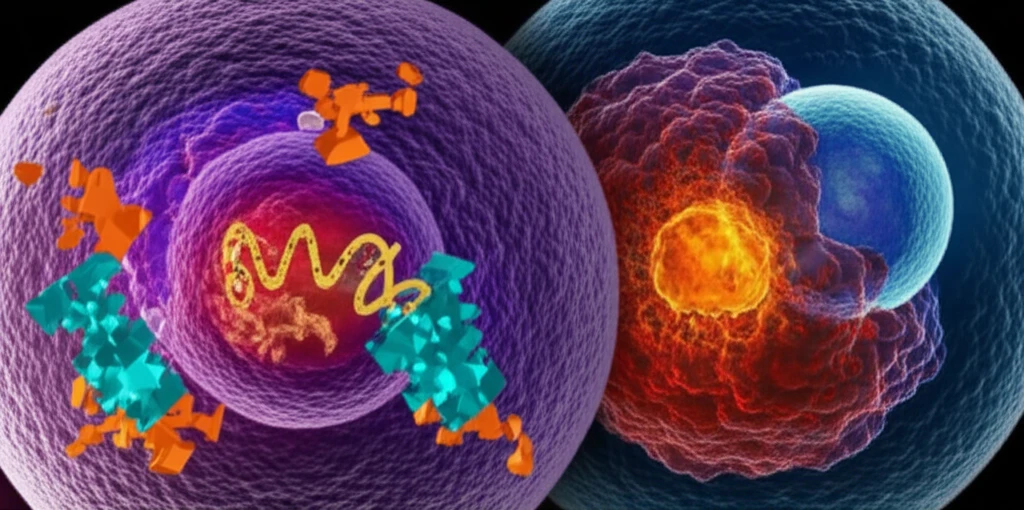
Cellular Secrets Unveiled: How a Tiny Protein Could Revolutionize Cancer Therapy

"Scientists Discover a New Mechanism for Regulating Cancer Cell Behavior, Potentially Paving the Way for More Effective Treatments"
In the relentless battle against cancer, researchers are constantly seeking new strategies to outsmart this complex disease. Now, a recent study published in the journal FEBS Letters sheds light on a previously unknown mechanism within our cells that could revolutionize cancer therapy. This research centers around a small protein named SIRT7, which plays a pivotal role in regulating the activity of other cellular components, ultimately influencing how cancer cells behave and respond to treatment.
The study, conducted by a team of researchers from Fudan University in China, along with collaborators from the University of North Carolina and the University of California San Diego, delves into the intricate world of cellular processes. Their findings reveal that SIRT7 can control the activity of the CRL4 E3 ligase complex, a key player in regulating protein levels within cells. By understanding this interaction, scientists believe they can develop new therapies that target cancer cells more effectively and with fewer side effects.
This discovery could represent a significant leap forward in cancer treatment, with the potential to improve patient outcomes and quality of life. This article will break down the key findings of this study, explaining the role of SIRT7, the implications for cancer treatment, and what this means for the future of cancer research.
Unraveling the Mystery: What is SIRT7 and Why Does It Matter?
SIRT7, or Sirtuin 7, belongs to a family of proteins called sirtuins, which are known for their roles in various biological processes, including aging, metabolism, and DNA repair. Sirtuins are a group of proteins that have generated substantial scientific interest. SIRT7 specifically, is found primarily in the nucleolus, the part of the cell responsible for producing ribosomes, which are essential for protein synthesis. Unlike many other sirtuins, the exact functions of SIRT7 have been less understood, making this new research particularly exciting.
- SIRT7 is a sirtuin protein primarily located in the nucleolus.
- SIRT7 interacts with the CRL4 E3 ligase complex.
- The CRL4 complex regulates protein levels through ubiquitination.
- SIRT7's role in this process influences the behavior of cancer cells.
A Promising Future for Cancer Treatment
The findings of this study offer a new perspective on how we can target cancer cells. By understanding how SIRT7 interacts with and controls the CRL4 complex, scientists can develop new therapies that specifically affect cancer cells and potentially have fewer side effects. This research opens exciting possibilities for the development of new cancer treatments, and it reinforces the critical need for ongoing research in this complex and devastating disease. As we continue to unravel the mysteries of the cell, we move closer to the day when we can conquer cancer and improve the lives of millions worldwide.