
Cell Death Decoded: How Our Cells Battle Deadly Bacteria & Win!

"Scientists Discover a 'Dock-and-Lock' Mechanism That Helps Cells Fight Infections and Stay Alive."
Our bodies are constantly under siege from microscopic invaders, and among the most dangerous are bacteria. These tiny organisms can cause serious infections, but our cells are not defenseless. They have evolved complex defense mechanisms to protect us. A recent groundbreaking study has shed light on one such mechanism, revealing how cells recognize and combat bacterial threats.
The research, published in Cell Reports, focused on the battle against Staphylococcus aureus, a bacterium responsible for a range of infections. The study highlights a 'dock-and-lock' mechanism that helps cells target and eliminate harmful toxins produced by these bacteria. This discovery offers a new understanding of how cells survive and recover from bacterial attacks.
This article delves into the fascinating details of this mechanism, exploring how it works, why it matters, and what implications it might have for future treatments. We'll unpack the science behind the 'dock-and-lock' system and explore how it could revolutionize our ability to fight infections.
The Expanding Cellular Defense Landscape
Cell-autonomous innate immunity encompasses intracellular strategies that protect organisms from bacterial threats. Recent research shows that bacteria possess a broad arsenal of defenses against bacterial viruses, or phages, and that the complexity of this repertoire has only recently become clear. Reviews also examine how eukaryotic cells recognize and kill bacteria, while emphasizing that innate immunity is the first line of defense against microbial pathogens.
Established Methods and Their Gaps
Traditional antimicrobial evaluation commonly uses disk diffusion and broth dilution methods. These approaches remain widely used, but reviews report limitations involving reproducibility and time. Culture-based antimicrobial-resistance detection can also have limited sensitivity, slow turnaround, and difficulty identifying all potential resistance genes, motivating interest in aptamer-based assays and cell-based or cell-inspired strategies.
Abortive Infection as Cellular Sacrifice
A foundational example of bacterial defense is abortive infection. In this strategy, an infected bacterial cell pre-emptively triggers its own lysis to protect neighboring kin from the spread of a phage infection. The example illustrates how cell death can function as a defense mechanism at the population level.
The 'Dock-and-Lock' Mechanism: A Cellular Defense System
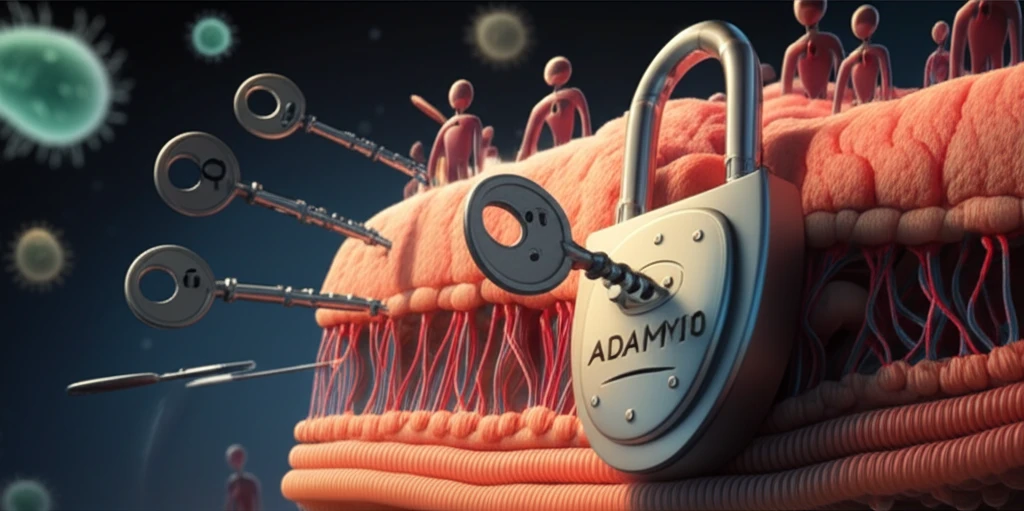
The core of this defense system revolves around a specific receptor called ADAM10. This receptor acts like a lock, waiting to bind with a key, which in this case, is a toxin from S. aureus. Once the toxin binds, it initiates a cascade of events that can lead to cell death. However, the 'dock-and-lock' mechanism provides a strategic advantage to the cell.
- PLEKHA7: It anchors the ADAM10 to cell junctions, making the receptor readily available to bind with the toxin.
- PDZD11: This protein acts as a key component of the anchoring system.
- Tspan33: Helps docking ADAM10 to junctions by binding to the WW domain of PLEKHA7
A Fast-Moving Research Frontier
Research on cell-intrinsic antibacterial defense is expanding across both prokaryotic and eukaryotic systems. Current reviews examine how cells recognize bacteria, activate killing mechanisms, and develop anti-infective strategies inspired by cellular functions. Because these approaches remain an active research area, their eventual clinical roles are still being defined.
Evidence Requires Careful Interpretation
Cell-death-based antibacterial strategies should not be treated as universally effective solutions. Their performance may depend on the pathogen, the host environment, and whether findings come from experimental systems or clinical settings. The broader field therefore requires careful testing of durability, specificity, safety, and resistance before promising mechanisms can be considered reliable therapies.
Cell-Based and Bacterial Defenses
Cell-based and cell-inspired anti-infective strategies are being developed as complementary approaches for refractory bacterial infections. In parallel, bacteria defend themselves against bacteriophages through complex systems that include apoptosis-like mechanisms. These examples show that cellular defense can be compared across therapeutic strategies and microbial survival systems, although their purposes differ.
Implications for the Future of Infection Treatment
This discovery opens exciting avenues for future research and potential treatments. The 'dock-and-lock' mechanism could be targeted to boost the cell's natural defenses. By manipulating this system, scientists might be able to enhance our cells' ability to fight off bacterial infections and prevent the severe outcomes. Furthermore, this research provides a better understanding of how cells respond to threats, leading to more effective strategies for combating bacterial infections and improving human health.
Shared Roots of Innate Immunity
Recent findings point to conservation between prokaryotic and eukaryotic innate immune pathways. The bacterial connection may therefore help researchers identify previously unknown molecular players in eukaryotic innate immunity. This perspective treats bacterial defense mechanisms not only as microbial survival tools but also as possible guides for understanding host defense.
Mapping the Bacterial Immune System
The field is expanding rapidly, with hundreds of novel bacterial defense mechanisms reportedly described annually. Researchers are also examining ancient bacterial defenses, including their mechanisms, evolution, and clinical implications, while cell-based and cell-inspired strategies are being proposed for bacterial infections. A key future challenge is distinguishing an observed anti-infection phenotype from a demonstrated evolutionary adaptation, since the terms “defense” and “immune” can imply more than the evidence establishes.
From Mechanism to Application
The promise of cellular antibacterial strategies exists within a wider challenge of translating complex biological mechanisms into dependable interventions. Progress will likely require linking laboratory discoveries with reproducible detection, safety evaluation, and practical treatment design. Because the available evidence is still developing, broad claims about effectiveness should remain appropriately cautious.
Why Microbial Defense Matters
Microbial defense systems protect bacteria and archaea from invasive genetic elements such as plasmids and bacteriophages. Reported system classes include restriction-modification systems, CRISPR-Cas systems, toxin-antitoxin modules, and abortive infection systems. Understanding this diversity has implications for microbial ecology and biotechnology, areas that can ultimately shape how researchers approach bacterial infection and genetic defense.