
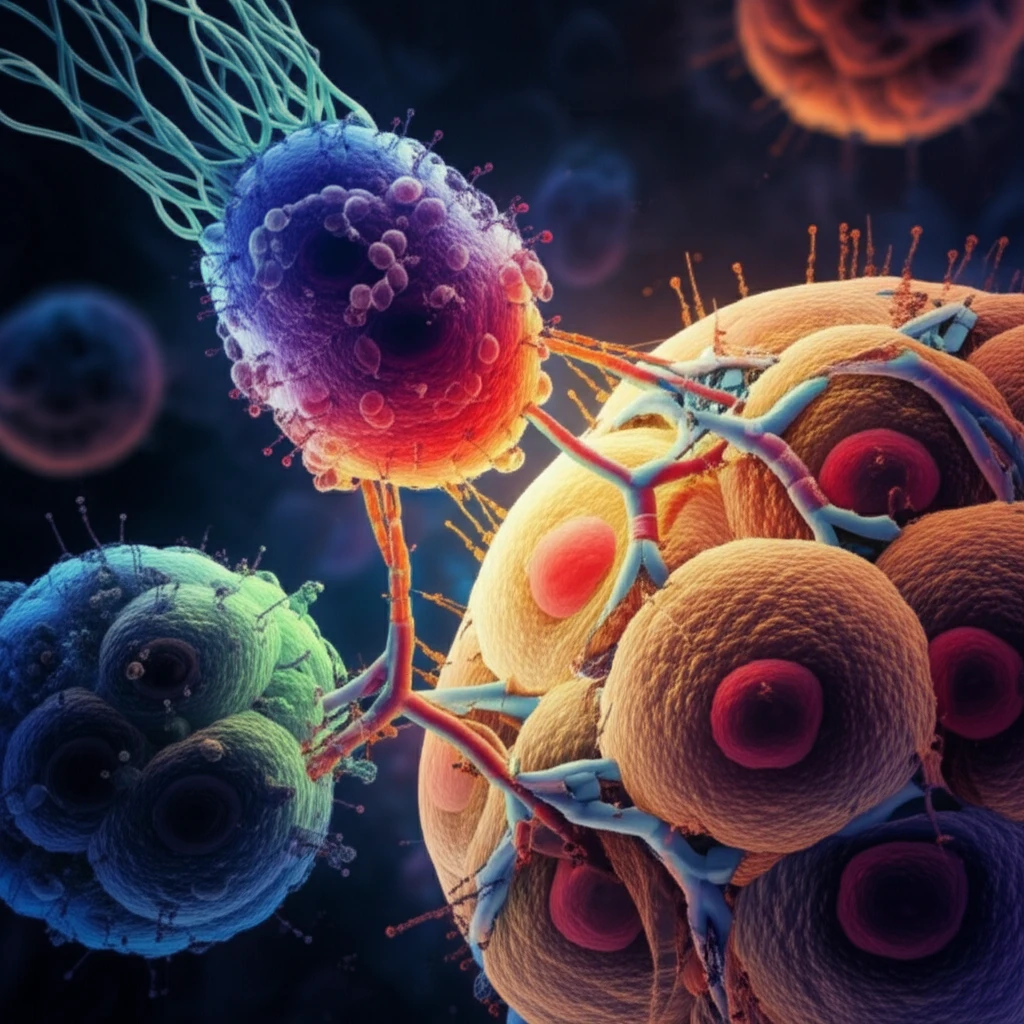
Illustration of the dock-and-lock mechanism where bacterial toxins target human cells.

Cell Death Decoded: How a New 'Dock-and-Lock' Mechanism Could Stop Bacterial Toxins

"Scientists uncover a crucial process in cell biology, potentially paving the way for new treatments against deadly bacterial infections like those caused by Staphylococcus aureus."


Our bodies are constantly battling unseen invaders—bacteria, viruses, and other pathogens. While our immune system is typically the first line of defense, sometimes these microscopic foes deploy a more sinister weapon: toxins. One particularly nasty culprit is the bacterium Staphylococcus aureus (S. aureus), which releases a potent toxin known as alpha-toxin. This toxin wreaks havoc by puncturing our cells, ultimately leading to their demise.

For years, scientists have been trying to understand precisely how alpha-toxin does its dirty work. It's clear that the toxin targets and binds to a protein on the surface of our cells called ADAM10. Think of ADAM10 as a doorway. Once the toxin is inside, it begins to cluster together, forming pores—essentially tiny holes—in the cell membrane. These pores disrupt the delicate balance within the cell, causing it to die. But the details of this process have remained murky.

Now, a new study published in Cell Reports sheds light on this deadly game. Researchers have uncovered a sophisticated 'dock-and-lock' mechanism that S. aureus uses to ensure alpha-toxin effectively kills our cells. This discovery not only deepens our understanding of bacterial infections but also points toward potential new strategies for treatment.

The 'Dock-and-Lock' System: A Closer Look

Illustration of the dock-and-lock mechanism where bacterial toxins target human cells.

The key to this new understanding lies in a group of proteins that hang around cell junctions—the areas where cells come into contact with each other. Specifically, the researchers focused on a protein complex called PLEKHA7-PDZD11. Previous research had hinted that these proteins might play a role in how cells respond to alpha-toxin, but their exact function was unknown. This study reveals that PLEKHA7-PDZD11 acts as a kind of anchor point for ADAM10.

The process unfolds like this:

  • Docking: A protein called Tspan33 acts as the bridge, physically linking ADAM10 to the PLEKHA7-PDZD11 complex. Tspan33 essentially 'docks' ADAM10 at the cell junction.
  • Locking: Once ADAM10 is in place, another protein, afadin, steps in to 'lock' it there. Afadin binds directly to ADAM10, ensuring it remains clustered at the cell junction.
This 'dock-and-lock' mechanism has a profound effect. By concentrating ADAM10 at cell junctions, the cell becomes more susceptible to alpha-toxin. The toxin pores form more efficiently and are more stable, ultimately leading to cell death. Conversely, when the researchers disrupted the PLEKHA7-PDZD11 complex, ADAM10 was no longer properly clustered. The toxin pores became unstable and were removed from the cell surface through a process called endocytosis—essentially, the cell 'swallowed' the pores, preventing them from causing further damage. This process allowed the cells to survive.

New Avenues for Treatment

This research provides a valuable new target for therapies aimed at combating S. aureus infections. By interfering with the 'dock-and-lock' mechanism, it may be possible to prevent alpha-toxin from effectively killing cells. This could involve developing drugs that disrupt the interaction between Tspan33 and PLEKHA7-PDZD11, or that prevent afadin from locking ADAM10 in place. While still in the early stages, this discovery holds significant promise for the development of new and more effective treatments against this dangerous bacterium.

About this Article -

This article was crafted using a human-AI hybrid and collaborative approach. AI assisted our team with initial drafting, research insights, identifying key questions, and image generation. Our human editors guided topic selection, defined the angle, structured the content, ensured factual accuracy and relevance, refined the tone, and conducted thorough editing to deliver helpful, high-quality information.See our About page for more information.

Everything You Need To Know

1

What is the role of alpha-toxin in causing cell death, and which bacterium produces it?

Alpha-toxin, produced by the bacterium *Staphylococcus aureus* (*S. aureus*), is a potent toxin that causes cell death by puncturing cell membranes. It targets a protein on the cell surface called ADAM10, forming pores that disrupt the cell's internal balance, ultimately leading to its demise. The study focused on how *S. aureus* ensures the effective action of alpha-toxin.

2

What is the 'dock-and-lock' mechanism, and how does it relate to ADAM10 and cell junctions?

The 'dock-and-lock' mechanism is a sophisticated process employed by *S. aureus* to enhance the effectiveness of alpha-toxin. The process involves several proteins near cell junctions. Tspan33 acts as a bridge to dock ADAM10 at the cell junction. Afadin then 'locks' ADAM10 in place. This clustering of ADAM10 at cell junctions makes the cell more vulnerable to alpha-toxin, as it allows for more efficient pore formation and cell death.

3

Which proteins are involved in the 'dock-and-lock' mechanism, and what are their specific functions?

The 'dock-and-lock' mechanism involves the following proteins: PLEKHA7-PDZD11 complex, Tspan33, and afadin. The PLEKHA7-PDZD11 complex serves as an anchor point for ADAM10. Tspan33 acts as a bridge, connecting ADAM10 to the PLEKHA7-PDZD11 complex, thus docking it at the cell junction. Afadin then locks ADAM10 in place by directly binding to it. This orchestrated process ensures that the target, ADAM10, is optimally positioned for alpha-toxin to exert its destructive effects.

4

How does disrupting the 'dock-and-lock' mechanism protect cells from alpha-toxin, and what is the process called?

Disrupting the 'dock-and-lock' mechanism, particularly the PLEKHA7-PDZD11 complex, leads to ADAM10 not being properly clustered. This causes the toxin pores to become unstable and be removed from the cell surface through endocytosis. Endocytosis is the process where the cell 'swallows' the pores, preventing further damage and allowing the cells to survive, thus offering a way to prevent cell death caused by alpha-toxin.

5

What potential therapeutic strategies are suggested by the discovery of the 'dock-and-lock' mechanism, and what are the implications?

The discovery of the 'dock-and-lock' mechanism presents new targets for therapies against *S. aureus* infections. Potential strategies include developing drugs that interfere with the interaction between Tspan33 and PLEKHA7-PDZD11, or that prevent afadin from locking ADAM10 in place. By disrupting this mechanism, it may be possible to prevent alpha-toxin from effectively killing cells, potentially leading to new and more effective treatments for infections caused by *S. aureus*. The implications of this discovery extend beyond understanding bacterial infections; it paves the way for developing interventions that could save lives by halting the progression of cellular damage caused by bacterial toxins.

Newsletter Subscribe

Subscribe to get the latest articles and insights directly in your inbox.