
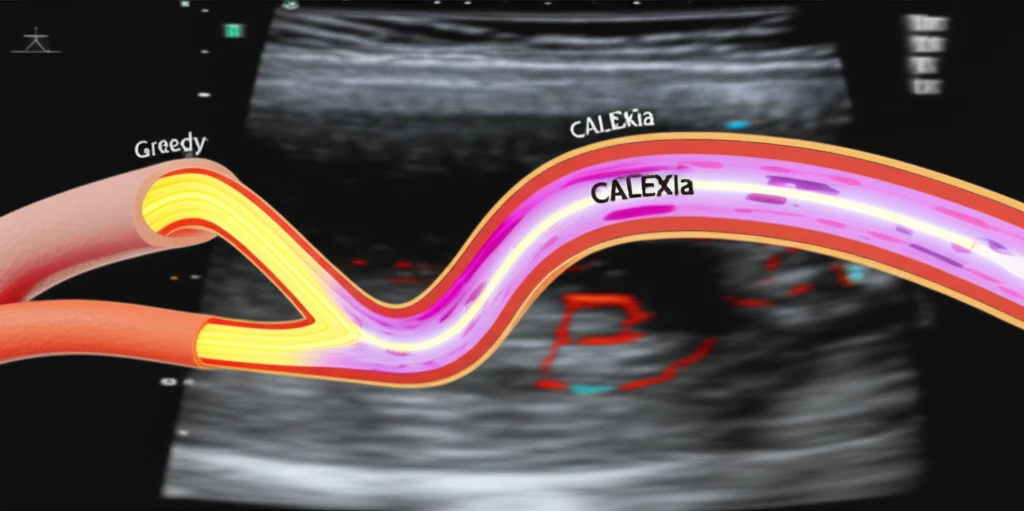
Digital illustration of carotid artery with glowing layers, representing combined ultrasound techniques.

Carotid Artery Health: Can a New "Greedy" Technique Improve Ultrasound Accuracy?

"Researchers develop an innovative approach combining two existing methods to more precisely measure intima-media thickness, a key indicator of cardiovascular risk."


Atherosclerosis, a disease characterized by arterial wall thickening and narrowing due to lipid buildup, poses significant cardiovascular risks. Monitoring the intima-media thickness (IMT) of carotid arteries, typically via ultrasound, is a valuable tool for assessing this risk. Accurate IMT measurement is crucial for early detection and prevention of serious cardiovascular events.

Traditionally, IMT is measured manually on ultrasound images, a process that's time-consuming and subject to operator variability. Computer-based techniques have emerged to automate this process, but many still require some degree of user interaction, limiting their full potential.

Recent research has focused on developing fully automated techniques for carotid artery segmentation and IMT measurement. This article explores a study that introduces a novel "greedy" technique designed to enhance the accuracy of IMT measurements by combining the strengths of two existing automated methods, potentially revolutionizing how we assess cardiovascular risk through ultrasound.

The "Greedy" Approach: Combining the Best of Both Worlds

Digital illustration of carotid artery with glowing layers, representing combined ultrasound techniques.

Researchers developed two distinct automated techniques for segmenting carotid arteries in ultrasound images: CULEXsa (Completely User-independent Layer EXtraction based on signal analysis) and CALEXia (Completely Automated Layers EXtraction based on integrated approach). CULEXsa relies on local statistics and signal analysis, while CALEXia integrates feature extraction, line fitting, and classification.

The study revealed that CULEXsa performed better in segmenting the lumen-intima (LI) boundary, while CALEXia excelled in segmenting the media-adventitia (MA) boundary. This complementary performance led to the development of a "greedy" approach that strategically combines these techniques to optimize IMT measurement.

  • Starting Point: The greedy technique begins with the method demonstrating lower system error – CULEXsa for the LI boundary and CALEXia for the MA boundary.
  • Iterative Swapping: The algorithm iteratively swaps vertices (points) of the profiles from the two techniques, assessing the overall distance to a manually traced "ground truth" boundary by experts.
  • Minimization: The process continues until the overall distance to the manual boundary is minimized.
  • Fusion: The final boundary, dubbed the "Greedy boundary," consists of points strategically selected from both CULEXsa and CALEXia segmentations.
The polyline distance was employed as a metric for both performance evaluation and error minimization. This approach was tested on a database of 200 carotid longitudinal B-mode ultrasound images, comparing the performance against the original CULEXsa and CALEXia techniques.

The Future of IMT Measurement: Towards Earlier Cardiovascular Risk Detection

The results demonstrated that the greedy technique significantly improved the accuracy of IMT measurement. The mean error for the LI boundary was reduced to 0.42 ± 0.89 pixel (26.3 ± 55.6 µm), a 12.5 ± 5.6% improvement over CULEXsa. For the MA boundary, the error was 0.26 ± 0.56 pixel (16.2 ± 31.3 µm), a 16.1 ± 6.7% improvement over CALEXia. Overall, the IMT measurement error was reduced to 1.33 ± 0.99 pixel (83.1 ± 61.8 µm), a 3.6 ± 1.4% improvement over CULEXsa alone.

These findings suggest that the greedy technique offers a more accurate and reliable method for IMT measurement in carotid artery ultrasounds. By strategically combining the strengths of CULEXsa and CALEXia, this approach minimizes the impact of noise and other artifacts, leading to more precise assessments of cardiovascular risk.

While promising, further research is needed to refine and validate this technique. Future studies should focus on addressing the remaining sources of error and exploring its potential for integration into clinical practice. The goal is to find the specific image region for IMT measurement that is less biased when compared with the ground truth data, improving IMT measurement. Ultimately, wider adoption of such advanced techniques could lead to earlier and more effective interventions for preventing cardiovascular disease.

About this Article -

This article was crafted using a human-AI hybrid and collaborative approach. AI assisted our team with initial drafting, research insights, identifying key questions, and image generation. Our human editors guided topic selection, defined the angle, structured the content, ensured factual accuracy and relevance, refined the tone, and conducted thorough editing to deliver helpful, high-quality information.See our About page for more information.

This article is based on research published under:

DOI-LINK: 10.1177/154431671003400201, Alternate LINK

Title: Greedy Technique And Its Validation For Fusion Of Two Segmentation Paradigms Leads To An Accurate Intima–Media Thickness Measure In Plaque Carotid Arterial Ultrasound

Subject: Cardiology and Cardiovascular Medicine

Journal: Journal for Vascular Ultrasound

Publisher: SAGE Publications

Authors: Filippo Molinari, Guang Zeng, Jasjit S. Suri

Published: 2010-06-01

Everything You Need To Know

1

What is Intima-media thickness (IMT) and why is it important?

Intima-media thickness (IMT) is a measurement of the combined thickness of the innermost layers (intima and media) of the carotid artery walls. It's a critical indicator used to assess cardiovascular risk because it reflects the presence of atherosclerosis, a condition where arterial walls thicken and narrow due to plaque buildup. By measuring IMT, healthcare professionals can detect early signs of cardiovascular disease, allowing for timely interventions and potentially preventing serious events like heart attacks and strokes. Accurate IMT measurement is thus fundamental in early diagnosis and preventative healthcare strategies.

2

What is the "greedy" technique and how does it work?

The "greedy" technique is a novel approach that combines two existing automated methods, CULEXsa and CALEXia, to improve the accuracy of Intima-media thickness (IMT) measurements in carotid artery ultrasound. CULEXsa is known to perform well in segmenting the lumen-intima (LI) boundary, while CALEXia excels at segmenting the media-adventitia (MA) boundary. The greedy approach capitalizes on these strengths by starting with the better-performing method for each boundary and then iteratively swapping points between the two methods, optimizing the overall segmentation until it closely matches a manually traced "ground truth." This strategic combination allows for more precise and reliable IMT measurements.

3

What are CULEXsa and CALEXia, and how do they relate to the "greedy" technique?

CULEXsa (Completely User-independent Layer EXtraction based on signal analysis) and CALEXia (Completely Automated Layers EXtraction based on integrated approach) are both automated techniques for segmenting carotid arteries in ultrasound images. CULEXsa employs local statistics and signal analysis to identify the boundaries of the artery layers, particularly the lumen-intima (LI) boundary. CALEXia integrates feature extraction, line fitting, and classification to segment the layers, and it is particularly effective at identifying the media-adventitia (MA) boundary. Although both methods have their strengths and weaknesses, the greedy technique utilizes their individual advantages to enhance overall measurement accuracy.

4

Why is the "greedy" technique important?

The significance of the "greedy" technique lies in its potential to improve the accuracy of carotid artery ultrasound measurements. It reduces operator variability and automates the process, leading to more consistent and reliable results. By combining CULEXsa and CALEXia, the "greedy" approach enhances the precision of Intima-media thickness (IMT) measurements. These improvements allow for earlier and more precise detection of cardiovascular risks, as it provides a more accurate assessment of arterial wall thickness, which is a key indicator of the presence and progression of atherosclerosis. This ultimately facilitates timely medical interventions, such as lifestyle changes or medication, to mitigate the risk of cardiovascular events.

5

How does the "greedy" technique actually work?

The "greedy" approach utilizes a strategic methodology that enhances the accuracy of Intima-media thickness (IMT) measurements. It commences by leveraging the superior performance of CULEXsa for the lumen-intima (LI) boundary and CALEXia for the media-adventitia (MA) boundary. The core of the technique involves iteratively swapping vertices (points) between the boundaries segmented by CULEXsa and CALEXia, assessing the distance to a manually traced "ground truth." The algorithm aims to minimize this distance. This process culminates in a final "Greedy boundary" that strategically integrates points from both CULEXsa and CALEXia. This "Greedy boundary" optimizes segmentation, leading to significantly improved IMT measurements and, consequently, more precise assessments of cardiovascular risk.

Newsletter Subscribe

Subscribe to get the latest articles and insights directly in your inbox.