
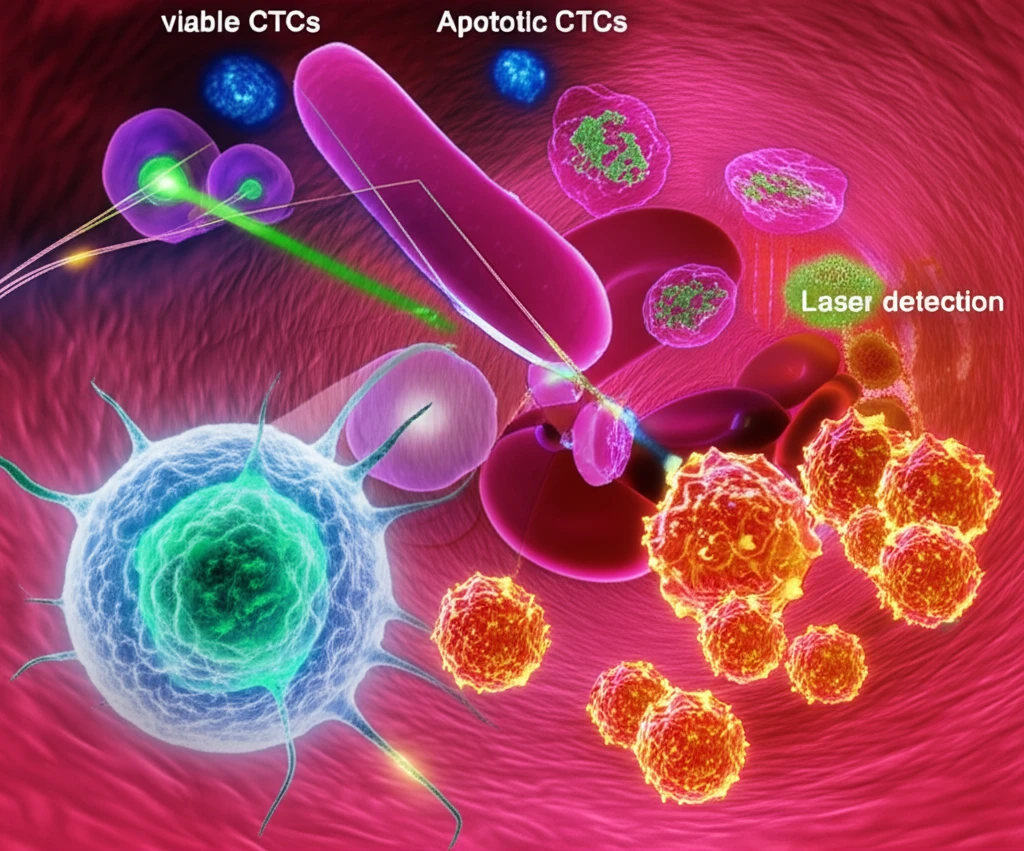
Cancer Breakthrough: New In-Vivo Technology Detects Deadly Cells, Promising Earlier Detection & Treatment

"Groundbreaking fluorescence flow cytometry offers a real-time method to identify and monitor circulating tumor cells, revolutionizing cancer detection and therapy."
Cancer, a disease that touches so many lives, continues to challenge medical science. The relentless spread of cancerous cells, known as metastasis, is often the critical factor in determining patient outcomes. But what if there was a way to track these dangerous cells in real-time, offering the potential for earlier detection and more effective treatment? The answer may lie in an innovative technology called in-vivo fluorescence flow cytometry.
This groundbreaking technique provides a new approach to analyzing circulating tumor cells (CTCs) directly within the bloodstream. Unlike traditional methods, this technology offers real-time analysis, which helps in identifying and enumerating these cells. This advancement could revolutionize how we detect, monitor, and treat various types of cancer, offering a new level of precision in personalized medicine.
This article delves into the science behind this technology, its potential impact, and the promising future it holds for cancer patients. By understanding how this technology works, we can appreciate its potential to improve outcomes and provide hope for those battling this formidable disease. We'll explore the benefits of this technology and how it might revolutionize how cancer is diagnosed and treated.
Unveiling the Science: How Fluorescence Flow Cytometry Works
At the heart of this technology is fluorescence flow cytometry, a sophisticated method for analyzing cells in a flowing liquid. This in-vivo approach involves using a laser to illuminate a circulating object directly within the bloodstream. This generates fluorescent light, which is then detected by sensitive sensors. This setup is coupled with advanced software, which analyzes each peak in real time to identify specific cells.
- Real-time Analysis: Enables immediate detection and monitoring of CTCs.
- In-vivo Approach: Analyzing cells directly within the bloodstream, avoiding potential distortions from traditional methods.
- Two-Color FFC: This technology can detect viable and apoptotic circulating tumor cells.
- Potential for Personalized Medicine: Facilitates customized cancer therapy based on real-time cellular data.
The Future of Cancer Treatment: A New Era of Hope
The development of in-vivo fluorescence flow cytometry marks a significant step forward in the fight against cancer. As research progresses, this technology is poised to become an indispensable tool in cancer diagnostics and therapy. By providing a deeper understanding of cancer progression and treatment response, this new approach holds the promise of improved patient outcomes and a brighter future for all. This technology represents a major leap toward precision medicine, offering hope and the potential for more effective and personalized cancer care.