
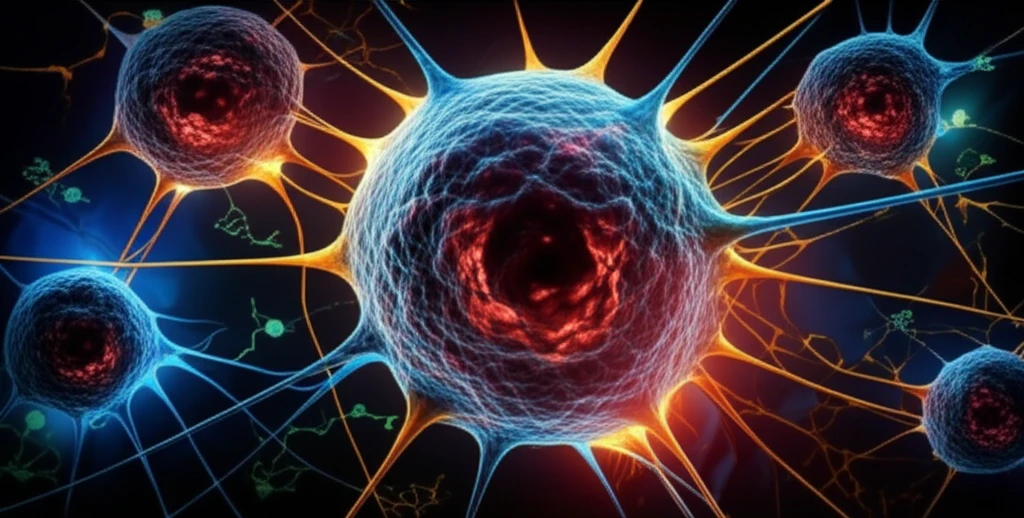
Illustration of activated fibroblasts surrounding a tumor cell, representing cancer-associated stroma.

Cancer Breakthrough: How Aroused Fibroblasts Impact Tumor Growth

"Unlocking the Secrets of Cancer-Associated Stroma and Its Role in Tumor Invasion"


In the complex world of cancer research, understanding the microenvironment surrounding tumors is crucial. Solid tumors are not simply masses of cancer cells; they exist within a supportive stroma, a network of cells and extracellular matrix. Among the key players in this stroma are cancer-associated fibroblasts (CAFs), also known as activated fibroblasts or myofibroblasts. These cells have a significant impact on how tumors grow, invade, and metastasize.

Recent research has shed light on the mechanisms regulating the activation of fibroblasts and their role in initiating invasive tumorigenesis. One protein, palladin, has been found to be upregulated in the myofibroblasts surrounding various solid cancers. This discovery has sparked interest in exploring palladin's function and how it influences the behavior of fibroblasts.

A study using a pancreatic cancer model investigated the functional consequences of overexpressing exogenous palladin in normal fibroblasts. The findings reveal how palladin activates fibroblasts, promoting tumor invasion and highlighting potential new targets for cancer therapy.

What is the Role of Palladin in Activating Fibroblasts?

Illustration of activated fibroblasts surrounding a tumor cell, representing cancer-associated stroma.

The study's principal findings indicate that palladin expression in stromal fibroblasts occurs very early in tumorigenesis. In vivo, the researchers observed a concordant expression of palladin and alpha-smooth muscle actin (α-SMA), a marker of myofibroblasts, at the dysplastic stages in peri-tumoral stroma. This expression progressively increased as pancreatic tumorigenesis advanced.

In vitro experiments showed that introducing exogenous 90 kD palladin into normal human dermal fibroblasts (HDFs) induced activation of these cells into myofibroblasts. This activation was marked by the induction of α-SMA and vimentin, as well as physical changes in cell morphology. Moreover, palladin expression enhanced cellular migration, invasion through the extracellular matrix, and the creation of tunnels through which cancer cells could follow.

Here's a breakdown of the key effects of palladin overexpression:
  • Induction of myofibroblast markers (α-SMA and vimentin)
  • Changes in cell morphology
  • Enhanced cellular migration and invasion
  • Creation of tunnels in the extracellular matrix
The fibroblast invasion and creation of tunnels resulted from the development of invadopodia-like cellular protrusions, which expressed invadopodia proteins and proteolytic enzymes. Interestingly, palladin expression in fibroblasts was triggered by the co-culture of normal fibroblasts with k-ras-expressing epithelial cells.

The Implications of Palladin Activation in Cancer Progression

Overall, the study concludes that palladin expression can impart myofibroblast properties, in turn promoting the invasive potential of peri-tumoral cells with invadopodia-driven degradation of the extracellular matrix. This process can be triggered by k-ras expression in adjacent epithelial cells, supporting a model whereby palladin-activated fibroblasts facilitate stromal-dependent metastasis and outgrowth of tumorigenic epithelium. This data supports a model whereby palladin-activated fibroblasts facilitate stromal-dependent metastasis and outgrowth of tumorigenic epithelium.

About this Article -

This article was crafted using a human-AI hybrid and collaborative approach. AI assisted our team with initial drafting, research insights, identifying key questions, and image generation. Our human editors guided topic selection, defined the angle, structured the content, ensured factual accuracy and relevance, refined the tone, and conducted thorough editing to deliver helpful, high-quality information.See our About page for more information.

This article is based on research published under:

DOI-LINK: 10.1371/journal.pone.0030219, Alternate LINK

Title: Arousal Of Cancer-Associated Stroma: Overexpression Of Palladin Activates Fibroblasts To Promote Tumor Invasion

Subject: Multidisciplinary

Journal: PLoS ONE

Publisher: Public Library of Science (PLoS)

Authors: Teresa A. Brentnall, Lisa A. Lai, Joshua Coleman, Mary P. Bronner, Sheng Pan, Ru Chen

Published: 2012-01-23

Everything You Need To Know

1

What are cancer-associated fibroblasts (CAFs), and why are they important in tumor development?

Cancer-associated fibroblasts (CAFs) are specialized cells within the tumor's supportive stroma, the microenvironment surrounding solid tumors. These CAFs, also known as activated fibroblasts or myofibroblasts, significantly impact how tumors grow, invade, and metastasize. The stroma is a network of cells and extracellular matrix. CAFs promote tumor invasion by creating tunnels in the extracellular matrix and facilitating stromal-dependent metastasis.

2

How does palladin influence the behavior of fibroblasts in the context of cancer?

Palladin, a protein upregulated in the myofibroblasts surrounding various solid cancers, activates fibroblasts. The study shows that when normal fibroblasts are exposed to palladin, they transition into myofibroblasts, characterized by the induction of α-SMA and vimentin. This activation also leads to changes in cell morphology, enhanced cellular migration and invasion, and the formation of tunnels through the extracellular matrix, all of which promote tumor invasion.

3

What is the role of α-SMA and vimentin in the context of palladin activation?

α-SMA (alpha-smooth muscle actin) and vimentin are markers of myofibroblasts. When palladin activates normal fibroblasts, the expression of α-SMA and vimentin is induced, indicating that the fibroblasts are transforming into myofibroblasts. This transformation is a key step in the process by which CAFs contribute to tumor progression, as these cells then promote tumor invasion and metastasis.

4

What are the key findings of the study regarding palladin overexpression in fibroblasts?

The study found that introducing palladin into normal human dermal fibroblasts (HDFs) induced the activation of these cells into myofibroblasts. This activation was marked by the induction of α-SMA and vimentin, as well as physical changes in cell morphology. Moreover, palladin expression enhanced cellular migration, invasion through the extracellular matrix, and the creation of tunnels through which cancer cells could follow. Palladin expression in fibroblasts was triggered by the co-culture of normal fibroblasts with k-ras-expressing epithelial cells.

5

How does the co-culture of normal fibroblasts with k-ras-expressing epithelial cells impact palladin expression and tumor progression?

The co-culture of normal fibroblasts with k-ras-expressing epithelial cells triggers palladin expression in fibroblasts. This is crucial because it initiates a cascade of events that promotes tumor invasion and metastasis. Palladin-activated fibroblasts develop invadopodia-like cellular protrusions, which express invadopodia proteins and proteolytic enzymes. This facilitates stromal-dependent metastasis and outgrowth of tumorigenic epithelium. This process supports a model where palladin-activated fibroblasts enhance tumor progression and invasion.

Newsletter Subscribe

Subscribe to get the latest articles and insights directly in your inbox.