
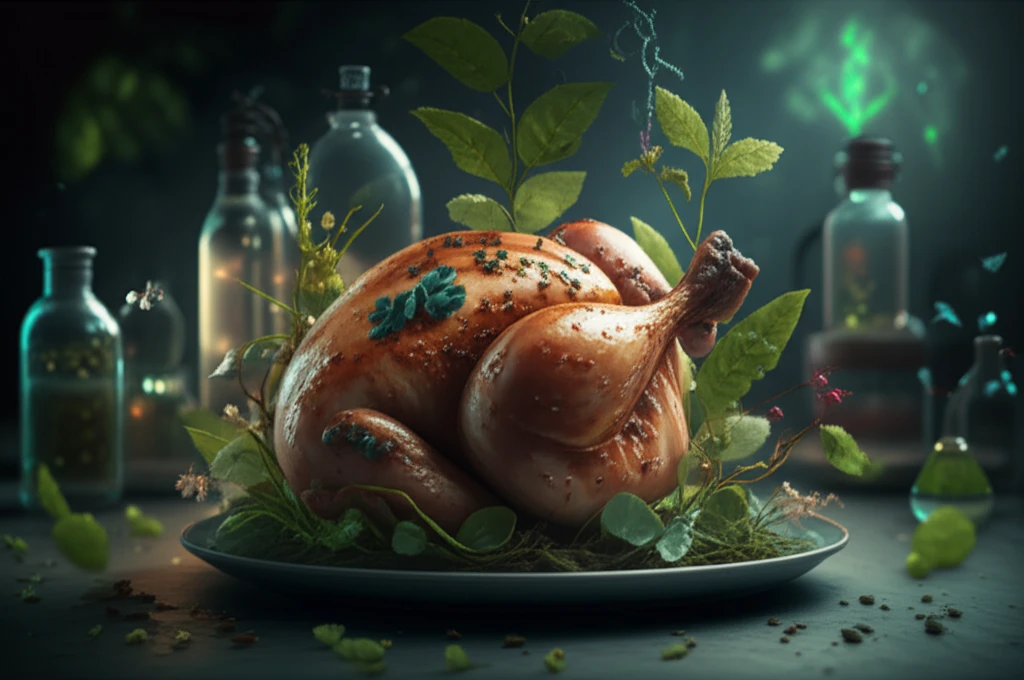
Illustration depicting a chicken in a lab environment with plant extracts, symbolizing the combination of science and nature in food preservation.

Can Science Supercharge Your Chicken? Unveiling the Secrets of Safer, Tastier Meat

"Groundbreaking research reveals how plant extracts could revolutionize the ready-to-cook chicken industry, ensuring both safety and flavor."


In a world increasingly focused on health, convenience, and sustainability, the demand for ready-to-cook (RTC) foods is booming. Among these, chicken products are a staple, but ensuring their safety and extending their shelf life presents a constant challenge. Traditional methods often rely on chemical preservatives, raising concerns among health-conscious consumers. But what if nature itself held the key to a better solution?

Recent research published in the Journal of Food Safety has unveiled a fascinating breakthrough: the combined power of two plant extracts, Alpinia malaccensis and Terminalia catappa, to combat foodborne pathogens and spoilage bacteria in ready-to-cook chicken. This isn't just about preserving meat; it's about enhancing flavor, reducing waste, and offering consumers a healthier, more sustainable option.

This article delves into the science behind this exciting development, explaining how these natural extracts work, what benefits they offer, and what it means for the future of your chicken dinner. Prepare to discover how science is supercharging your chicken, one delicious, safe bite at a time.

The Dynamic Duo: Alpinia Malaccensis and Terminalia Catappa Unite for Chicken Safety

Illustration depicting a chicken in a lab environment with plant extracts, symbolizing the combination of science and nature in food preservation.

The study, conducted by researchers at the University of Sri Jayewardenepura and The Open University of Sri Lanka, focused on the antibacterial properties of Alpinia malaccensis (known locally as "Ran-kiriya") and Terminalia catappa ("Kottamba"). These plant extracts were tested against common foodborne pathogens like Listeria monocytogenes and Staphylococcus aureus, as well as spoilage bacteria that can compromise the quality and safety of chicken.

The process was straightforward: chicken pieces were inoculated with the bacteria, marinated with a mixture of the plant extracts, vacuum-packed, and stored at different temperatures. The researchers then monitored the microbial count, lipid oxidation, pH levels, and color changes over time to assess the effectiveness of the extracts.

  • Reduced Bacterial Growth: The combination of plant extracts significantly inhibited the growth of both S. aureus and L. monocytogenes, indicating a potent antimicrobial effect.
  • Lower Lipid Oxidation: The extracts also helped to reduce lipid oxidation, a process that leads to rancidity and off-flavors, thus preserving the quality of the chicken.
  • Extended Shelf Life: The study demonstrated that the extracts could extend the shelf life of the ready-to-cook chicken by several days, offering both consumers and the food industry significant benefits.
These findings are particularly relevant given the increasing consumer demand for minimally processed foods. The research suggests that these natural extracts could be a viable alternative to synthetic preservatives, providing a safer, more natural way to keep chicken fresh and delicious for longer. The researchers emphasized that combining these plant extracts could extend the shelf life of ready-to-cook fresh chicken meat products, making it more economically viable for the food industry.

A Delicious Future for Chicken: The Science of Safe and Flavorful Eating

The research on Alpinia malaccensis and Terminalia catappa offers a glimpse into a future where food safety and flavor enhancement go hand in hand. By harnessing the power of nature, scientists are paving the way for healthier, more sustainable food options. As we move forward, expect to see more innovative applications of plant extracts and other natural compounds to ensure that your favorite foods are not only safe but also incredibly delicious. The future of chicken is looking bright, and it's packed with flavor and science!

About this Article -

This article was crafted using a human-AI hybrid and collaborative approach. AI assisted our team with initial drafting, research insights, identifying key questions, and image generation. Our human editors guided topic selection, defined the angle, structured the content, ensured factual accuracy and relevance, refined the tone, and conducted thorough editing to deliver helpful, high-quality information.See our About page for more information.

Everything You Need To Know

1

What are Alpinia malaccensis and Terminalia catappa, and why are they important for ready-to-cook chicken?

Alpinia malaccensis, known locally as 'Ran-kiriya,' and Terminalia catappa, known as 'Kottamba,' are plant extracts with antibacterial properties. Research indicates that these extracts, when combined, can combat foodborne pathogens like Listeria monocytogenes and Staphylococcus aureus, as well as spoilage bacteria, thus preserving the quality and safety of ready-to-cook chicken. This offers a natural alternative to synthetic preservatives.

2

How do Alpinia malaccensis and Terminalia catappa extracts extend the shelf life of ready-to-cook chicken?

The combination of Alpinia malaccensis and Terminalia catappa extracts inhibits the growth of bacteria like S. aureus and L. monocytogenes, which commonly cause foodborne illnesses. Furthermore, these extracts reduce lipid oxidation, a process that leads to rancidity and off-flavors in chicken. By controlling bacterial growth and reducing oxidation, the extracts effectively extend the shelf life of ready-to-cook chicken.

3

What specific benefits were observed when Alpinia malaccensis and Terminalia catappa were used on ready-to-cook chicken?

Research demonstrated that using Alpinia malaccensis and Terminalia catappa extracts on ready-to-cook chicken led to reduced bacterial growth of common foodborne pathogens, lower lipid oxidation (preventing rancidity), and an extended shelf life. These benefits collectively contribute to a safer, more flavorful, and longer-lasting product for consumers.

4

Are there any implications for the food industry and consumers if Alpinia malaccensis and Terminalia catappa are used as preservatives?

Yes, there are significant implications. For the food industry, using Alpinia malaccensis and Terminalia catappa extracts could offer a more economically viable way to extend the shelf life of ready-to-cook chicken, reducing waste and potentially increasing profits. For consumers, it means access to chicken products with fewer synthetic preservatives, aligning with the growing demand for natural and minimally processed foods. However, widespread adoption would also depend on factors like the cost-effectiveness and scalability of extract production.

5

How does the use of Alpinia malaccensis and Terminalia catappa in preserving chicken align with current trends in food consumption?

The use of Alpinia malaccensis and Terminalia catappa aligns strongly with consumer trends favoring health, convenience, and sustainability. As demand rises for ready-to-cook foods, especially chicken, these natural extracts provide a way to meet safety and shelf-life requirements without relying on chemical preservatives. This resonates with health-conscious consumers seeking minimally processed options. Moreover, by reducing food spoilage through extended shelf life, these extracts contribute to sustainability by minimizing food waste.

Newsletter Subscribe

Subscribe to get the latest articles and insights directly in your inbox.