
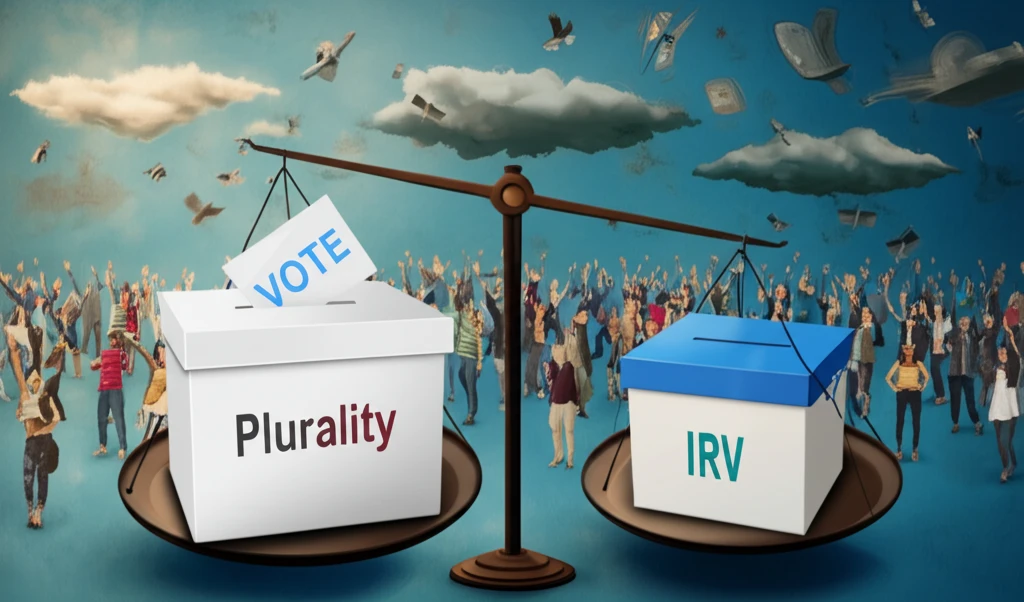
Can Ranked-Choice Voting Heal Political Divides? The Surprising Science Behind IRV

"Discover how instant runoff voting (IRV) moderates political outcomes, fostering compromise and reducing polarization, according to new research."
In an era marked by increasing political polarization, finding effective ways to bridge divides has become more critical than ever. Instant runoff voting (IRV), also known as ranked-choice voting, has emerged as a promising alternative to traditional plurality voting systems. Advocates claim it encourages moderation, reduces negative campaigning, and ultimately leads to more representative outcomes. But does IRV really live up to the hype?
While IRV has gained traction in various municipalities and even a few states, theoretical backing for its purported benefits has been limited. Existing evidence often relies on case studies and simulations, leaving a gap in our understanding of how IRV functions at a fundamental level. Is there something inherent in the structure of IRV that promotes moderation, or are its observed effects simply the result of how candidates and voters behave under the system?
A new study tackles this question head-on, providing compelling evidence that IRV does indeed have a moderating effect relative to plurality voting. By developing a precise mathematical framework, the researchers demonstrate how IRV can prevent extreme candidates from winning, even when voters and candidates are drawn from polarized distributions. The findings offer valuable insights into the potential of IRV to foster compromise and create a more balanced political landscape.
Ranking as the Core Concept
At its most basic, the word 'ranked' means to give something a position higher or lower than other things. The Cambridge Dictionary defines it as the past form of 'rank' — holding a position relative to others — while Merriam-Webster illustrates the usage with a school that is 'ranked as one of the best in the country.' The term clearly carries broad cultural currency, appearing everywhere from The Guardian's series that orders George Orwell's books to a stage musical titled 'Ranked.' This everyday practice of ordering preferences is the conceptual foundation ranked-choice voting builds on, since RCV asks voters to rank candidates in order of choice rather than selecting just one. Neither reference reports specific uptake statistics, so precise figures on IRV usage are not drawn from these sources.
Accepted Methods Carry Trade-offs
Accepted methods in ranked-choice voting typically involve voters ordering candidates from most to least preferred and tabulating those orders through rounds of elimination. The approach is praised for the possibility of producing majority-backed winners, but critics note real trade-offs: ballots are more complex, voters can make errors, and the counting process is harder to explain. Because no source material was retrieved that directly documents the accepted methods or their empirical performance, the view here is deliberately general and should be treated as context rather than settled assessment.
Ranking Long Precedes Voting Reform
The concept of ranking has deep roots in ordinary language, well before it shaped ballot design. The Free Dictionary records 'ranked' as meaning to hold a particular rank — as in being 'ranked first in the class' — and also as forming or standing in a row or rows. A slang usage is noted as well, reflecting how flexible the term has become over time. This basic idea of setting things one above another, or in sequence, is precisely the ordering principle that modern ranked-choice voting later applied to elections.
How Does Instant Runoff Voting (IRV) Work?
Before diving into the study's findings, let's quickly recap how IRV works. In a traditional plurality voting system, voters simply choose their favorite candidate, and the candidate with the most votes wins. IRV, on the other hand, asks voters to rank candidates in order of preference. If no candidate receives a majority of first-place votes, the candidate with the fewest first-place votes is eliminated, and their votes are redistributed to the next-ranked candidate on each ballot. This process continues until one candidate obtains a majority and is declared the winner.
- Encourages Compromise: Candidates aim to be acceptable to a wide range of voters.
- Reduces Negative Campaigning: Incentivizes candidates to maintain broader appeal.
- Elects More Moderate Winners: Lessens the chance of polarizing figures winning.
Research Effort Continues to Grow
Research on ranked-choice voting spans simulations, real-world election studies, and voter-behavior surveys, though no specific studies were retrieved for this subsection. General discussion in the field highlights active scholarly interest in turnout, representation, and civility effects, but findings are often preliminary or contingent. Because this section lacks directly sourced studies, readers should treat any research conclusions here as provisional and look to the peer-reviewed literature for firmer evidence.
Debate Over Failings Persists
Ranked-choice voting has attracted pointed critiques that deserve attention even though no source documents them here. Common objections center on voter confusion, increased ballot spoilage, and cases where the winning candidate was not the first choice of a majority for parts of the count. Proponents often dispute how severe these problems are, and real-world results have varied by jurisdiction. Given the absence of sourced material for this subsection, the counter arguments above are framed generally rather than presented as documented findings.
RCV Against Its Alternatives
A fair comparison of ranked-choice voting with alternatives such as plurality voting, two-round runoffs, and proportional systems would weigh turnout, representativeness, and simplicity. In general discussion, no single reform clearly dominates on all of those criteria at once. Because no comparative source material was retrieved for this subsection, the guidance here is limited to noting that such comparisons exist and that conclusions depend heavily on the context and criteria chosen.
The Future of Voting: Is IRV the Answer?
The research provides a compelling case for the moderating effects of IRV, adding a crucial theoretical layer to the ongoing debate about electoral reform. While IRV is not a panacea for all that ails our political system, it offers a promising mechanism for fostering compromise and reducing the influence of extreme voices. As more municipalities and states consider adopting IRV, this study provides valuable insights for policymakers and voters alike.
No Single Expert Consensus
Across public commentary, reactions to ranked-choice voting range from strong advocacy to strong skepticism, and expert consensus remains incomplete. Some commentators emphasize its potential to reduce negative campaigning and wasted votes, while others stress administrative complexity and unintended results. With no sourced commentary available for this subsection, this synthesis is necessarily general: the debate is real, substantive, and ongoing. Firm conclusions await more settled evidence.
Adoption Pressures Ahead
The future of ranked-choice voting will likely be shaped by ballot measures, legislative battles, and the growing set of jurisdictions already using it. Emerging frontiers include expanding to primaries, multi-winner districts, and federal elections, though each carries its own political and technical hurdles. Since no forward-looking source material was retrieved for this subsection, these observations are general possibilities rather than documented forecasts.
Reform Within a Divided System
Ranked-choice voting sits within a broader landscape of election reform that includes redistricting, campaign finance, turnout, and polarization. Even a well-run reform cannot by itself address the structural forces behind political division. Without directly sourced material for this subsection, the points above are contextual observations: voting rules matter, but they interact with a much wider set of systemic challenges that shape how any change actually lands.
Voters at the Center
At its core, the ranked-choice voting debate is about people: how easily voters understand ranking, whether they feel heard, and whether they trust the outcome. General and anecdotal discussions point to both enthusiasm and frustration across different jurisdictions. Because no source material was retrieved for this subsection, these human considerations are described in general terms, and specific consequences will depend on local implementation and voter experience.