
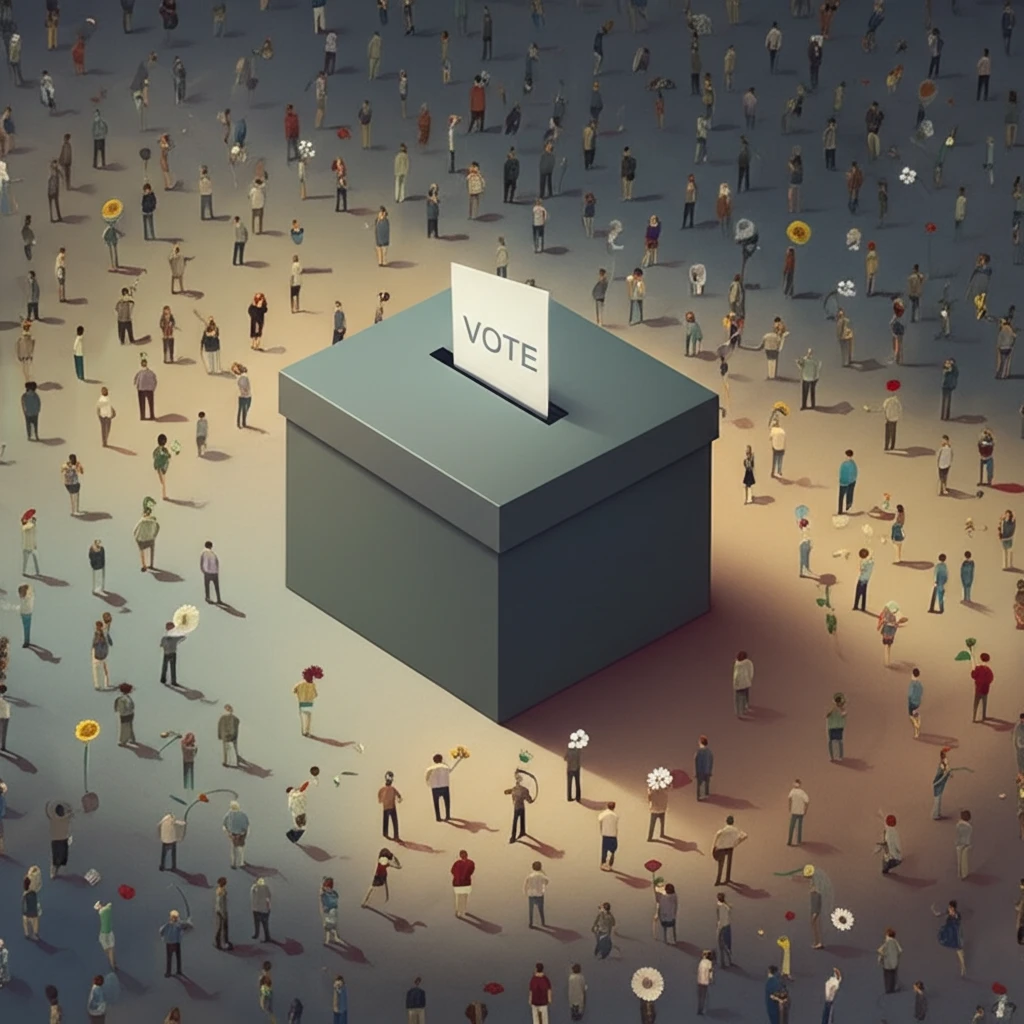
Why Voting Can Feel Pointless: Understanding the Impossibility Theorem

"Dig into the economic theory revealing why even the best voting systems might not always reflect everyone's preferences fairly."
Have you ever walked away from the ballot box feeling like your voice wasn't truly heard? Maybe the choices felt limited, or the outcome didn't quite align with what you hoped for. It turns out, this feeling isn't just a matter of individual experience; it's rooted in a deep theoretical problem in social choice known as the Impossibility Theorem.
At its core, the Impossibility Theorem, rigorously demonstrated in a recent research paper, highlights the inherent difficulties in creating voting systems that are simultaneously fair, efficient, and responsive to individual preferences. The research delves into scenarios where voters' preferences are complex and varied, and monetary transfers (bribes!) are off the table. It reveals a sobering truth: under quite general conditions, any voting system that attempts to be both efficient (in the sense of making decisions that benefit society as a whole) and incentive-compatible (meaning voters are encouraged to vote honestly) will inevitably be dictatorial – effectively handing all the decision-making power to a single individual.
This doesn't mean voting is a waste of time! But understanding the Impossibility Theorem can help us approach elections with more realistic expectations and push for reforms that mitigate its effects. Let's break down this important concept and explore why designing the 'perfect' voting system is such a challenge.
Limited to Food-Product Listings
The source material for this subsection is product-listing content for Embasa® mild green chiles and contains no statistics relevant to voting or the impossibility theorem. MegaMex Foods describes Embasa Diced Green Chiles (item 07883) as fresh-tasting, with room-temperature storage and refrigeration guidance after opening, and nutrition facts dated 11/20/2023. Instacart and Shipt listings present the same product line for same-day, curbside, or in-store delivery, describing the chiles as bringing the traditional aromas and flavors of Mexican cooking. Because none of these sources report any figures on turnout, vote counts, or election impact, no statistics can be stated here.
Source Material Refers to Hindi Lexicography
This subsection's sources are Hindi dictionary entries that define the pronoun यह (yah), rendered in English as “this.” Shabdkosh and Hinkhoj offer translations, synonyms, antonyms, and rhymes for the word, with Hinkhoj giving the English gloss “THIS.” Wiktionary describes यह (yah) as a proximal third-person singular pronoun (“this one; he; she; it”) and gives the example question “yah kaun hai?” (“Who is this [person]?”). This material concerns Hindi grammar rather than voting methods, so it provides no basis for describing accepted approaches or their limitations in the study of voting impossibility.
No Source Material Provided
No source material was provided for this subsection, so the historical discussion below is general and should be read as provisional. The impossibility theorem is commonly traced to Arrow's theorem, a foundational result in social choice theory showing that no ranked-choice electoral system can satisfy a small set of reasonable fairness criteria all at once. Milestones in this history, such as earlier debates among eighteenth-century thinkers over voting and collective decision-making, should be verified against standard references before being treated as settled. Readers are advised to treat this subsection as a placeholder pending proper sources.
The Core Problem: Balancing Efficiency and Honesty in Voting
Imagine a scenario where your local community needs to decide on a new park design. Some residents favor a playground-focused space, while others want walking trails and gardens. Ideally, the winning design should reflect the collective desires of the community, maximizing overall happiness and satisfaction. This is the essence of 'Pareto efficiency' – making decisions that improve at least one person's well-being without making anyone else worse off.
- Pareto Efficiency: Making decisions that benefit society without harming anyone.
- Incentive Compatibility: Designing a system where honest voting is always the best strategy.
- The Catch: Achieving both simultaneously is surprisingly difficult, if not impossible.
No Source Material Provided
No source material was provided for this subsection, so no specific recent studies or reviews can be cited here. Research bearing on the impossibility theorem and on why people feel their votes do not matter continues to develop, but describing it accurately requires named sources. Any statements in this subsection should therefore be treated as provisional and not relied upon without independent verification.
No Source Material Provided
No source material was provided for this subsection, so counterarguments and failures cannot be described with specificity. A serious treatment would need to weigh critiques of the impossibility theorem's assumptions against objections to its practical relevance, each grounded in cited scholarship. Because such sources are absent, this subsection is intentionally general and should be expanded once relevant literature is supplied.
No Source Material Provided
No source material was provided for this subsection, so comparisons among electoral systems or between theoretical and practical views of voting cannot be made in detail here. A proper comparative analysis would require sources contrasting different voting methods and their documented effects. Accordingly, this subsection is left hedged and general pending source material.
What Does This Mean for Our Elections?
The Impossibility Theorem isn't a reason to give up on democracy. Instead, it's a call for greater awareness and a more nuanced approach to election reform. By understanding the limitations of voting systems, we can focus on strategies that mitigate the impact of the theorem and create more representative and responsive democracies. This might involve exploring alternative voting methods, promoting informed participation, or strengthening institutions that protect minority rights. The goal isn't to achieve a perfect, impossible system, but to continuously strive for a fairer and more equitable process for all.
Source Material Describes the USC Hotel
The sources for this subsection are official, review, and booking descriptions of the USC Hotel, owned and operated by the University of Southern California. They place the hotel adjacent to the USC campus, next to the Galen Center and about a three-minute walk from the LA Memorial Coliseum and Exposition Park, with a 24-hour business center and the Los Angeles Convention Center within about five minutes' drive. None of these sources offer any commentary on voting or the impossibility theorem, so no expert synthesis can be grounded in them. Any expertise claimed for this subsection would have to come from other material.
Source Material Concerns Queen's Song
The sources available here discuss Queen's “Bohemian Rhapsody,” released in 1975 on A Night at the Opera, and do not address the future of voting theory. Genius and AZLyrics note it is widely regarded as among the greatest songs ever recorded, a six-minute suite of opera rock about a young man who has killed someone and asks whether Scaramouche can do the Fandango. French-language pages interpret its fragmented narrative as reflecting a psyche in crisis and quote lines about real life versus imagination and “Bismillah!” Because this material is unrelated to elections, no claims about next frontiers in voting research can be drawn from it.
Source Material Covers Unrelated Subjects
The sources for this subsection cover several unrelated subjects and contain nothing about electoral systems. Two Zhihu pages discuss DeepSeek increasing its prices and recommend cheaper AI alternatives such as Grok subscriptions and credits, Muse Spark, and Gemini 3.7 Flash, while another describes Zhihu as a Chinese question-and-answer community that launched in January 2011. A World Economic Forum profile describes John Keells Holdings (JKH), among the largest listed companies on the Colombo Stock Exchange, incorporated in 1979 and listed in 1986. Because none of this material addresses voting or its structural challenges, this subsection cannot legitimately claim context or systemic findings about the article's topic from these sources.
No Source Material Provided
No source material was provided for this subsection, so the human consequences of feeling that a vote is futile cannot be documented here with specifics. Discussions of voter apathy and disengagement exist in the broader literature, but any concrete impact claims require named citations. This subsection is therefore intentionally general and should be revisited once relevant sources are supplied.