
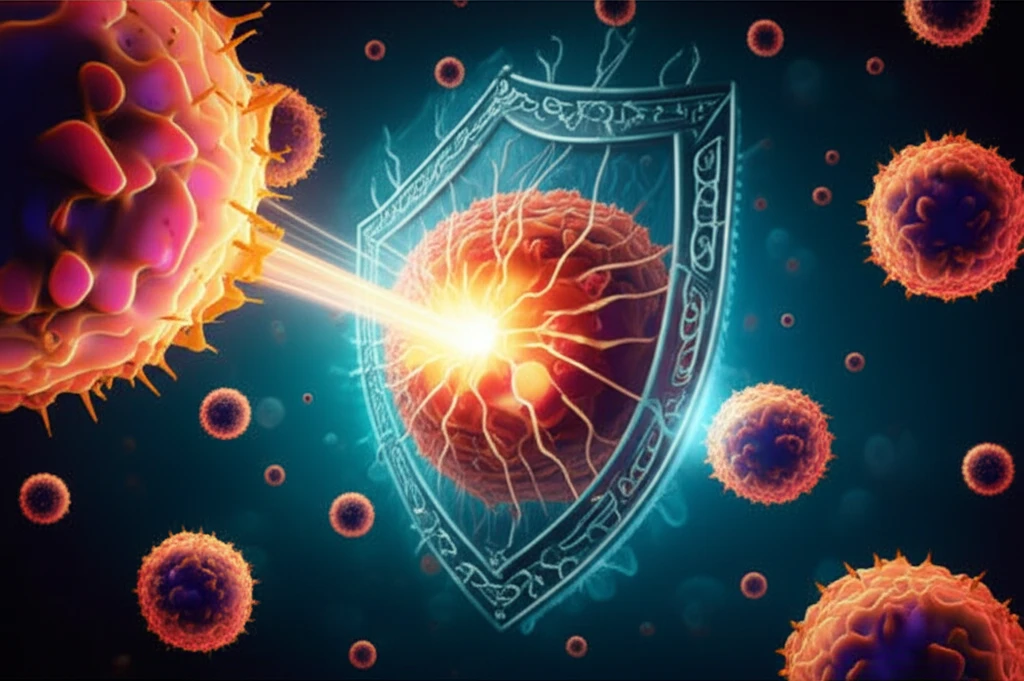
Cancer cells resisting treatment, with the Nrf2 pathway symbolized as a shield.

Can Nrf2 Inhibition Reverse Cancer's Resistance to Treatment?

"A new study reveals how blocking the Nrf2 pathway could make head and neck cancer cells vulnerable to ferroptosis, a promising cancer therapy."


Cancer's ability to resist treatment remains a significant hurdle in oncology. While therapies like chemotherapy can initially be effective, some cancer cells develop mechanisms to evade destruction, leading to treatment failure. Scientists are constantly exploring new ways to overcome this resistance and make cancer cells more vulnerable.

One promising approach involves targeting ferroptosis, a form of cell death distinct from apoptosis. Ferroptosis is triggered by iron accumulation and lipid peroxidation, and its induction can be a powerful weapon against therapy-resistant cancers. However, cancer cells are cunning, and some can develop ways to block even this pathway.

Recent research has focused on the Nrf2 pathway and its role in protecting cancer cells from ferroptosis. A study explored how inhibiting Nrf2 could reverse resistance to GPX4 inhibitors, a class of drugs designed to induce ferroptosis in head and neck cancer. This article will delve into the findings, offering insights into a potential new strategy for cancer treatment.

Unlocking Ferroptosis: The Role of Nrf2 Inhibition

Cancer cells resisting treatment, with the Nrf2 pathway symbolized as a shield.

The study, led by researchers at Asan Medical Center, investigated the molecular mechanisms behind ferroptosis resistance in head and neck cancer (HNC) cells. They focused on the Nrf2 pathway, known for its role in regulating antioxidant responses and protecting cells from oxidative stress. The team hypothesized that Nrf2 activation might be a key mechanism by which cancer cells evade ferroptosis.

The researchers used two GPX4 inhibitors, (1S, 3R)-RSL3 and ML-162, along with trigonelline, an Nrf2 inhibitor, to test their hypothesis in various HNC cell lines, including cisplatin-resistant (HN3R) and RSL3-resistant (HN3-rslR) cells. They then assessed cell viability, cell death, lipid ROS production, and protein expression.

  • Nrf2 Inhibition Sensitizes Resistant Cells: The team discovered that inhibiting Nrf2 made chemoresistant HNC cells more susceptible to RSL3-induced ferroptosis.
  • Trigonelline Enhances Ferroptosis: Trigonelline, an Nrf2 inhibitor, sensitized chemoresistant HNC cells to RSL3 treatment, even in a mouse model transplanted with HN3R cells.
  • Nrf2 Activation Confers Resistance: Overexpressing Nrf2 rendered chemosensitive HN3 cells resistant to RSL3.
These results suggest that activating the Nrf2-ARE pathway contributes to the resistance of HNC cells to GPX4 inhibition. By inhibiting this pathway, the resistance can be reversed, making cancer cells vulnerable to ferroptosis.

A New Avenue for Cancer Therapy

This study provides a compelling rationale for targeting the Nrf2 pathway in combination with GPX4 inhibitors to overcome resistance to ferroptosis in head and neck cancer. By inhibiting Nrf2, cancer cells lose their ability to protect themselves from lipid peroxidation, making them more susceptible to cell death.

The findings open up new avenues for developing more effective cancer therapies. Combining GPX4 inhibitors with Nrf2 inhibitors like trigonelline could be a promising strategy to improve treatment outcomes for patients with head and neck cancer, particularly those with chemoresistant tumors.

Further research is needed to fully understand the complexities of the Nrf2-ARE pathway and its role in ferroptosis resistance. However, this study provides a valuable step forward in the fight against cancer, offering hope for more effective and targeted treatments in the future.

About this Article -

This article was crafted using a human-AI hybrid and collaborative approach. AI assisted our team with initial drafting, research insights, identifying key questions, and image generation. Our human editors guided topic selection, defined the angle, structured the content, ensured factual accuracy and relevance, refined the tone, and conducted thorough editing to deliver helpful, high-quality information.See our About page for more information.

This article is based on research published under:

DOI-LINK: 10.1016/j.freeradbiomed.2018.10.426, Alternate LINK

Title: Nrf2 Inhibition Reverses Resistance To Gpx4 Inhibitor-Induced Ferroptosis In Head And Neck Cancer

Subject: Physiology (medical)

Journal: Free Radical Biology and Medicine

Publisher: Elsevier BV

Authors: Daiha Shin, Eun Hye Kim, Jaewang Lee, Jong-Lyel Roh

Published: 2018-12-01

Everything You Need To Know

1

What is the main problem in cancer treatment that this research is addressing?

Cancer cells are often resistant to treatments like chemotherapy. This resistance is a significant hurdle in oncology. The cells develop mechanisms to evade destruction, leading to treatment failure. This research explores how to overcome this by making cancer cells more vulnerable.

2

What is ferroptosis and why is it important in this context?

Ferroptosis is a type of cell death, distinct from apoptosis. It's triggered by iron accumulation and lipid peroxidation. The induction of ferroptosis can be a powerful weapon against therapy-resistant cancers. The research investigates how to make cancer cells susceptible to ferroptosis.

3

What is the role of the Nrf2 pathway, and how does it relate to ferroptosis?

The Nrf2 pathway is crucial for regulating antioxidant responses, protecting cells from oxidative stress. Some cancer cells use Nrf2 to protect themselves from ferroptosis. By inhibiting Nrf2, the cancer cells lose their ability to protect themselves, making them vulnerable. The research found that inhibiting Nrf2 sensitized chemoresistant HNC cells to RSL3-induced ferroptosis.

4

What specific methods did the researchers use in their study?

The study used GPX4 inhibitors (1S, 3R)-RSL3 and ML-162, along with trigonelline. They tested these in various HNC cell lines. The researchers assessed cell viability, cell death, lipid ROS production, and protein expression. These experiments helped to understand how inhibiting Nrf2 affects the cancer cells' response to ferroptosis.

5

What are the implications of this research for cancer treatment?

This study provides a strong case for combining Nrf2 pathway inhibitors with GPX4 inhibitors to tackle resistance to ferroptosis in head and neck cancer. Inhibiting Nrf2 makes cancer cells more susceptible to lipid peroxidation, ultimately leading to cell death. This approach offers a new strategy for cancer treatment, potentially improving outcomes for patients with head and neck cancer.

Newsletter Subscribe

Subscribe to get the latest articles and insights directly in your inbox.