
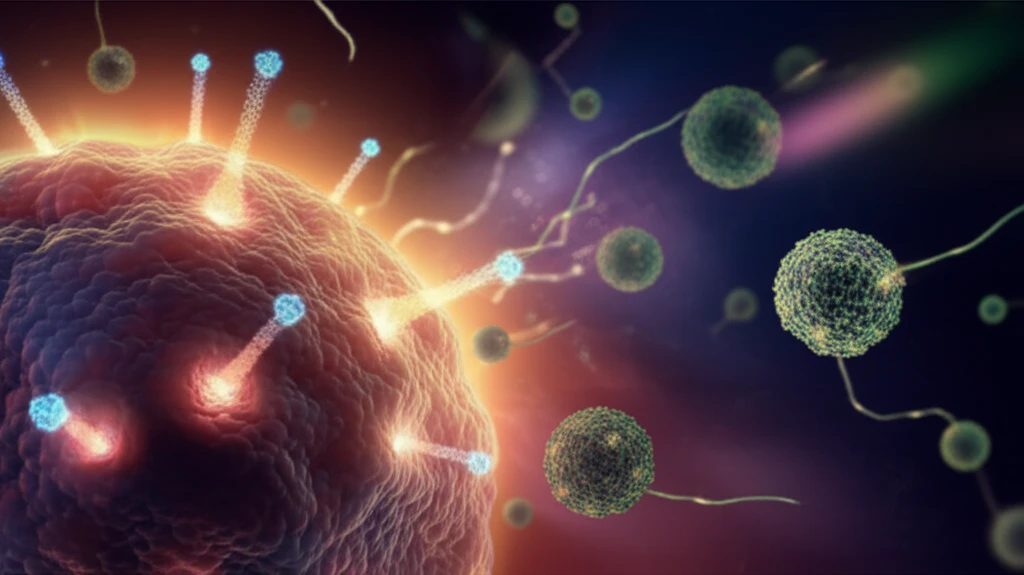
Nanoparticles attacking cancer cell.

Can Nanoparticles Be the Key to More Effective Colorectal Cancer Treatment?

"New research explores how copper cysteamine nanoparticles can boost the effectiveness of radiation therapy for colorectal cancer, offering hope for improved outcomes."


Cancer remains a significant global health challenge, with colorectal cancer (CRC) being the third most common type. While treatments like surgery, radiation, and chemotherapy exist, they often have limitations and side effects. Early diagnosis and effective treatment strategies are crucial for improving patient outcomes.

Radiotherapy, a common cancer treatment, faces the challenge of damaging both healthy and cancerous tissues. Increasing the radiation dose to effectively target the tumor is limited by the risk of harming surrounding healthy tissue. This has spurred the search for methods to enhance radiation efficacy while minimizing side effects.

One promising approach involves radiosensitizers – agents that make cancer cells more susceptible to radiation. Researchers have been exploring nanoparticle radiosensitizers, and new research investigates the potential of copper cysteamine (Cu-Cy) nanoparticles in improving X-ray radiotherapy for colorectal cancer.

How Cu-Cy Nanoparticles Enhance Cancer Cell Destruction

Nanoparticles attacking cancer cell.

The study published in Nature, investigated the effects of Cu-Cy nanoparticles on SW620 colorectal cancer cells. The results demonstrated that X-ray-activated Cu-Cy nanoparticles significantly inhibited cancer cell growth in a dose-dependent manner, suggesting their potential to improve X-ray radiotherapy.

Here’s how these nanoparticles work:

  • Increased Susceptibility: Cu-Cy nanoparticles make tumor cells more vulnerable to radiation, improving the killing effect while reducing harm to normal tissues.
  • Mitochondrial Damage: The nanoparticles disrupt the mitochondrial membrane potential in cancer cells, a crucial step in triggering apoptosis (programmed cell death).
  • Apoptosis and Autophagy: The activated nanoparticles induce both apoptosis and autophagy (a cellular self-degradation process) in cancer cells, leading to their destruction.
  • Reactive Oxygen Species (ROS) Production: Cu-Cy nanoparticles generate reactive oxygen species upon X-ray activation, further damaging cancer cells.
These combined effects suggest that Cu-Cy nanoparticles can enhance the effectiveness of radiation therapy, potentially allowing for lower radiation doses and reduced side effects. Furthermore, the optimized dose may result in the best outcome.

A Promising Future for Nanoparticle-Enhanced Cancer Therapy

This research offers a promising avenue for improving colorectal cancer treatment. By acting as radiosensitizers, Cu-Cy nanoparticles can enhance the effectiveness of radiation therapy, potentially leading to better outcomes for patients.

While further research is needed, these findings suggest that Cu-Cy nanoparticles could become a valuable tool in the fight against colorectal cancer.

The study's insights into the mechanisms of autophagy induced by X-ray irradiation also open new avenues for understanding and optimizing cancer treatment strategies.

About this Article -

This article was crafted using a human-AI hybrid and collaborative approach. AI assisted our team with initial drafting, research insights, identifying key questions, and image generation. Our human editors guided topic selection, defined the angle, structured the content, ensured factual accuracy and relevance, refined the tone, and conducted thorough editing to deliver helpful, high-quality information.See our About page for more information.

This article is based on research published under:

DOI-LINK: 10.1038/s41598-017-09375-y, Alternate LINK

Title: Investigation Of Copper Cysteamine Nanoparticles As A New Type Of Radiosensitiers For Colorectal Carcinoma Treatment

Subject: Multidisciplinary

Journal: Scientific Reports

Publisher: Springer Science and Business Media LLC

Authors: Zhipeng Liu, Li Xiong, Guoqing Ouyang, Lun Ma, Sunil Sahi, Kunpeng Wang, Liangwu Lin, He Huang, Xiongying Miao, Wei Chen, Yu Wen

Published: 2017-08-24

Everything You Need To Know

1

What is colorectal cancer and why is it a major health concern?

Colorectal cancer (CRC) is a significant global health challenge, ranking as the third most common type of cancer. Early diagnosis and effective treatment are crucial for improving patient outcomes due to the limitations and side effects associated with current treatments such as surgery, radiation, and chemotherapy. This research focuses on enhancing radiation therapy specifically.

2

What are radiosensitizers and what role do copper cysteamine (Cu-Cy) nanoparticles play in cancer treatment?

Radiosensitizers are agents designed to increase the sensitivity of cancer cells to radiation therapy. This study focuses on copper cysteamine (Cu-Cy) nanoparticles as radiosensitizers. These nanoparticles make cancer cells more vulnerable to radiation, potentially allowing for lower radiation doses while maintaining treatment effectiveness. The Cu-Cy nanoparticles enhance the effectiveness of X-ray radiotherapy for colorectal cancer.

3

How do Cu-Cy nanoparticles work to destroy cancer cells?

Cu-Cy nanoparticles enhance cancer cell destruction through several mechanisms. They increase the susceptibility of tumor cells to radiation, disrupt the mitochondrial membrane potential, induce apoptosis and autophagy (cellular self-degradation), and generate reactive oxygen species (ROS) upon X-ray activation. These combined effects lead to enhanced cancer cell destruction, potentially improving the effectiveness of radiation therapy.

4

Why is the use of Cu-Cy nanoparticles significant in colorectal cancer treatment?

The use of Cu-Cy nanoparticles in colorectal cancer treatment is significant because they act as radiosensitizers. This means they boost the effectiveness of radiation therapy, potentially allowing for lower radiation doses and minimizing side effects. The optimized dose may result in the best outcome for patients. This approach offers a promising avenue for improving colorectal cancer treatment outcomes.

5

What are the potential implications of this research on colorectal cancer treatment?

The implications of this research are far-reaching. By using Cu-Cy nanoparticles as radiosensitizers, the effectiveness of radiation therapy for colorectal cancer can be improved. This could lead to better patient outcomes, potentially with lower radiation doses and reduced side effects. This approach offers a promising advancement in cancer therapy, specifically for colorectal cancer.

Newsletter Subscribe

Subscribe to get the latest articles and insights directly in your inbox.