
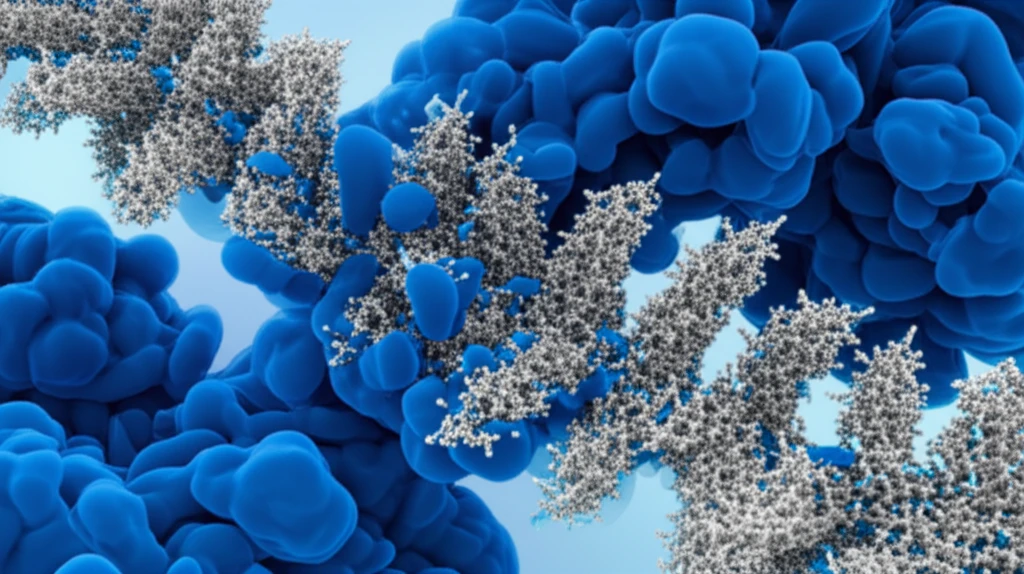
Microscopic LaFeO3/Bentonite nanocomposites degrading methylene blue dye in polluted water.

Can Nanomaterials Clean Up Our Water? A Breakthrough in Dye Degradation

"Scientists develop a novel nanocomposite that efficiently breaks down methylene blue, offering a promising solution for wastewater treatment."


Water pollution, especially from industrial dyes, poses a significant threat to ecosystems and human health. Traditional methods of wastewater treatment often fall short in removing these persistent pollutants, leading to environmental concerns and potential health risks. Methylene blue (MB), a common dye used in the textile industry, is one such pollutant that requires effective and sustainable removal strategies.

Now, researchers are exploring the use of nanomaterials to combat this issue. Nanomaterials, with their unique properties and high surface area, offer a promising avenue for efficient pollutant degradation. Among these, nanocomposites—combinations of different nanomaterials—are gaining traction for their enhanced performance and versatility.

A recent study published in "Materials Research Express" introduces a novel approach using a LaFeO3/Bentonite nanocomposite to degrade methylene blue with enhanced photocatalytic activity. This innovative material holds significant potential for revolutionizing wastewater treatment and addressing the pressing issue of dye pollution.

What is LaFeO3/Bentonite and How Does It Work?

Microscopic LaFeO3/Bentonite nanocomposites degrading methylene blue dye in polluted water.

The research team synthesized a nanocomposite using lanthanum ferrite (LaFeO3) and bentonite clay. LaFeO3 is a perovskite-type semiconductor known for its photocatalytic properties, meaning it can use light to drive chemical reactions. Bentonite, a natural clay mineral, acts as a support material, enhancing the nanocomposite's adsorption capabilities and overall stability.

The synthesis process involved a citric acid-assisted sol-gel method, which ensures uniform mixing of the materials at the nanoscale. This method allows for precise control over the nanocomposite's structure and properties, leading to optimized performance.

Here’s a breakdown of the key components and their roles:
  • LaFeO3 (Lanthanum Ferrite): Acts as the primary photocatalyst, absorbing light energy to initiate the degradation of methylene blue.
  • Bentonite Clay: Provides a high surface area for adsorption, supporting the LaFeO3 nanoparticles and enhancing the overall stability of the nanocomposite.
  • Citric Acid: Used in the sol-gel method to ensure uniform mixing and control the structure of the nanocomposite during synthesis.
The resulting LaFeO3/Bentonite nanocomposite exhibits enhanced photocatalytic activity due to the synergistic effect of its components. The bentonite clay not only supports the LaFeO3 nanoparticles but also contributes hydroxyl groups, which further aid in the degradation process. This combination creates a highly efficient system for breaking down methylene blue under visible light irradiation.

The Future of Water Purification

This innovative LaFeO3/Bentonite nanocomposite represents a significant step forward in sustainable wastewater treatment. Its ability to efficiently degrade methylene blue under visible light offers a cost-effective and environmentally friendly solution for addressing dye pollution. Further research and development in this area could pave the way for widespread adoption of nanocomposite-based technologies in water purification, ensuring cleaner and safer water resources for future generations.

About this Article -

This article was crafted using a human-AI hybrid and collaborative approach. AI assisted our team with initial drafting, research insights, identifying key questions, and image generation. Our human editors guided topic selection, defined the angle, structured the content, ensured factual accuracy and relevance, refined the tone, and conducted thorough editing to deliver helpful, high-quality information.See our About page for more information.

Everything You Need To Know

1

What is the primary function of the LaFeO3/Bentonite nanocomposite?

The primary function of the LaFeO3/Bentonite nanocomposite is to degrade methylene blue, a common pollutant found in wastewater, particularly from the textile industry. The nanocomposite achieves this through photocatalysis, where the LaFeO3, acting as a photocatalyst, absorbs light energy to initiate the breakdown of methylene blue molecules. Bentonite clay enhances this process by providing a support structure that increases the surface area for adsorption and overall stability of the nanocomposite, leading to a more efficient and effective degradation of the pollutant.

2

How does the LaFeO3 component contribute to the degradation process of methylene blue?

LaFeO3, or lanthanum ferrite, is a perovskite-type semiconductor that acts as the primary photocatalyst in the nanocomposite. Its key role is to absorb light energy, which then initiates a series of chemical reactions that break down the methylene blue molecules. This photocatalytic activity is essential for the degradation process, enabling the nanocomposite to effectively remove the dye from the water. The efficiency of LaFeO3 in this process is enhanced by its combination with bentonite clay, which supports the nanoparticles and further aids in the overall degradation.

3

What role does Bentonite clay play in the LaFeO3/Bentonite nanocomposite, and why is it important?

Bentonite clay serves as a support material in the LaFeO3/Bentonite nanocomposite, playing a crucial role in enhancing the nanocomposite's overall performance. It provides a high surface area, which increases the adsorption capabilities of the nanocomposite, allowing it to capture and hold more methylene blue molecules. Additionally, bentonite clay helps stabilize the LaFeO3 nanoparticles, preventing them from clumping together and ensuring that they remain effective in their photocatalytic function. Furthermore, bentonite contributes hydroxyl groups that actively participate in the degradation process, which is why it's a critical component.

4

How does the sol-gel method using citric acid improve the LaFeO3/Bentonite nanocomposite's performance?

The sol-gel method, assisted by citric acid, is used to synthesize the LaFeO3/Bentonite nanocomposite, and it plays a critical role in optimizing the material's performance. This method ensures uniform mixing of the LaFeO3 and bentonite components at the nanoscale, allowing for precise control over the nanocomposite's structure and properties. Citric acid in this process facilitates a homogenous mixture, preventing the formation of large particles and ensuring that the LaFeO3 nanoparticles are well-dispersed within the bentonite matrix. This precise control leads to enhanced photocatalytic activity, resulting in a more efficient and effective degradation of methylene blue.

5

What are the potential future implications of using the LaFeO3/Bentonite nanocomposite for wastewater treatment?

The LaFeO3/Bentonite nanocomposite holds significant promise for the future of wastewater treatment, particularly in addressing the issue of dye pollution from industries like textiles. Its ability to efficiently degrade methylene blue under visible light represents a cost-effective and environmentally friendly solution. Further research and development could lead to wider adoption of nanocomposite-based technologies in water purification, offering cleaner and safer water resources. This innovation could revolutionize how we treat wastewater, leading to reduced environmental impact and improved public health by minimizing the risks associated with persistent pollutants like methylene blue.

Newsletter Subscribe

Subscribe to get the latest articles and insights directly in your inbox.