
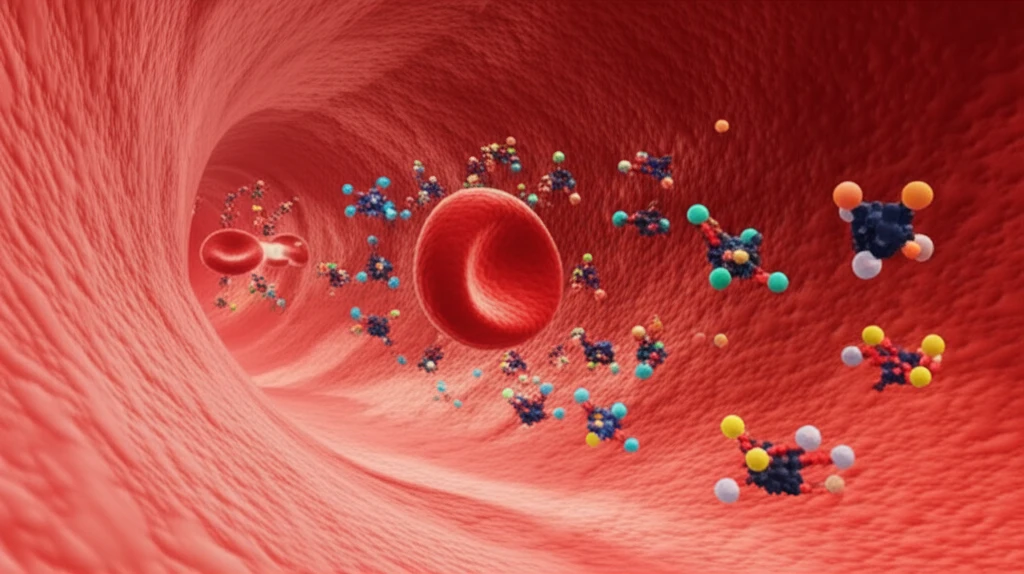
Can Modified Staphylokinase Revolutionize Clot Dissolution?

"Exploring Lipid Modification for Enhanced Thrombolytic Therapy"
Thrombotic disorders, which lead to the formation of dangerous blood clots, are a major cause of disability and death worldwide. These clots can block blood flow, leading to severe conditions such as stroke, heart attack, and deep vein thrombosis. Currently, medical interventions primarily involve intravenous administration of thrombolytic agents, drugs designed to dissolve these clots and restore normal blood flow.
Among the various thrombolytic agents, staphylokinase (SAK) has garnered significant attention due to its fibrin specificity and reduced inhibition by a2-antiplasmin. SAK is particularly effective in dissolving blood clots with minimal side effects. Staphylokinase has demonstrated promise, its relatively short circulatory half-life limits its effectiveness. Researchers have been exploring ways to enhance its stability and prolong its action within the body.
One promising approach involves lipid modification, where lipids are attached to the staphylokinase molecule to improve its stability and activity. This process enhances its ability to dissolve clots and extends its therapeutic effects. This article delves into the innovative technique of lipid modification of staphylokinase, exploring its potential to transform thrombolytic therapy.
Lipid Modification: A Cutting-Edge Approach to Enhancing Staphylokinase
Lipid modification involves attaching lipid molecules to staphylokinase, transforming it from a nonlipophilic to a lipophilic compound. Researchers incorporate a consensus sequence known as a lipobox, represented by the structure [LVI][ASTVI][GAS]C. This modification is strategic, occurring at specific positions within the molecule to optimize its functionality. In this sequence, the -3 position is leucine in 75% of cases, and the -2 position is either uncharged polar or nonpolar.
- Diacyl Glyceryl Transfer: The first step is the transfer of a diacyl glyceryl group from phosphatidyl-glycerol to the sulfhydryl group of N-terminal cysteine. This is facilitated by the enzyme prolipoprotein phosphatidyl-glycerol diacylglyceryl transferase (Lgt).
- Covalent Attachment: The covalent attachment of N-acyl S-diacylglyceryl to cysteine allows it to attach to the membrane, enhancing its stability.
- Signal Sequence Cleavage: The cleavage of the signal sequence between the amino acid at the -1 position and the diacylglyceryl modified cysteine residue, aided by enzyme lipoprotein-specific signal peptidase II (Lsp).
- Acylation: This involves acylation of the amino acid at the N-terminal by the enzyme N-acyl transferase (Lnt), increasing hydrophobicity and aiding the translocation of mature lipoprotein to the outer membrane.
The Future of Thrombolytic Therapy
Lipid modification of staphylokinase presents an effective strategy for improving its stability and activity. This method holds promise for developing enhanced thrombolytic agents, potentially revolutionizing the treatment of blood clots and related conditions. By improving circulatory half-life and fibrin specificity, lipid-modified staphylokinase could offer significant clinical benefits, reducing the risk of complications and enhancing therapeutic outcomes for patients with thrombotic disorders.