
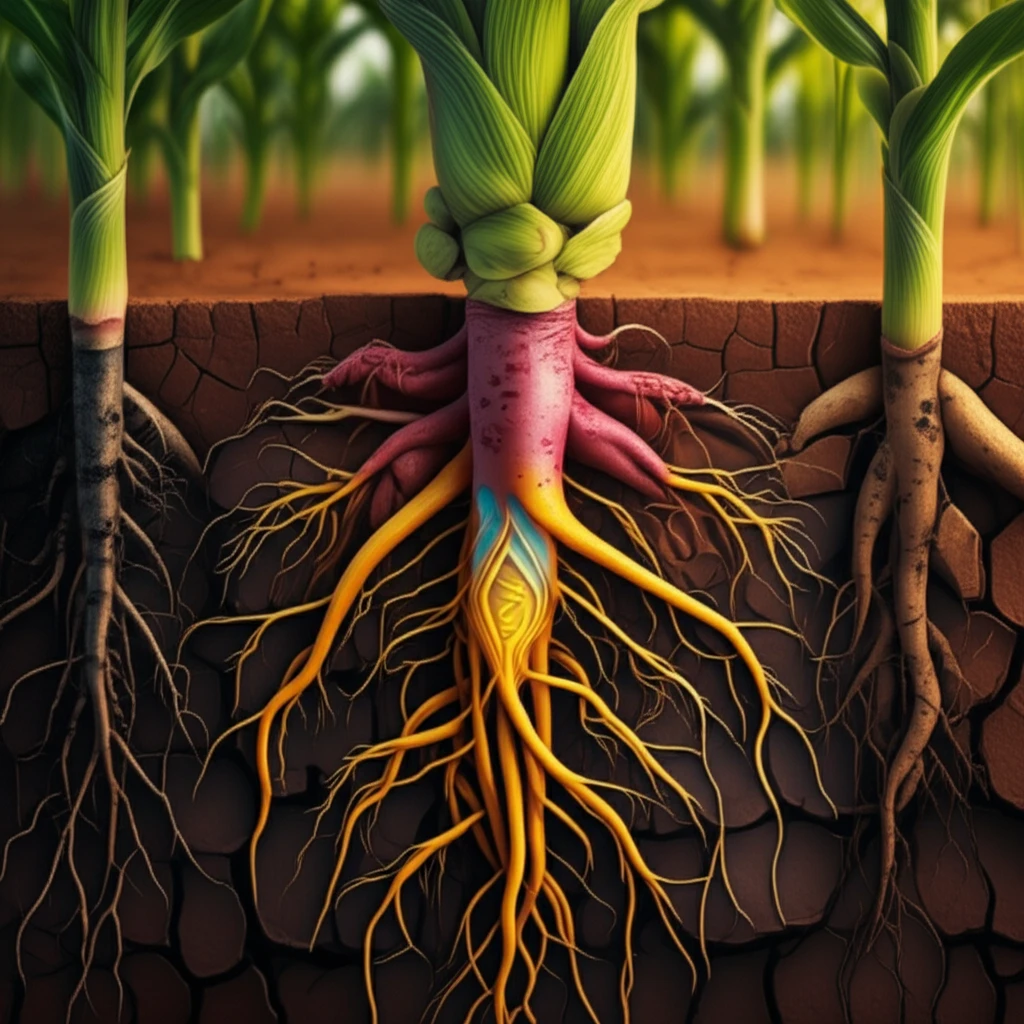
Illustration depicting resilient maize roots growing in aluminum-toxic soil.

Can Maize Adapt? Unlocking the Secrets of Aluminum Tolerance

"New research explores how maize plants adjust to toxic aluminum levels, offering hope for more resilient crops."


Aluminum toxicity in acidic soils poses a significant challenge to global crop production, limiting plant growth and productivity. Maize, a staple crop worldwide, is particularly vulnerable, making it crucial to understand how this plant responds to aluminum stress at a molecular level.

Nitrate reductase (NR) is a vital enzyme involved in nitrogen assimilation, a fundamental process for plant growth and development. When plants face aluminum toxicity, the activity of NR and the expression of genes encoding NR can be significantly affected. Understanding this relationship is critical for developing strategies to improve plant resilience.

Recent research has delved into the transcriptional modulation of genes encoding nitrate reductase in maize plants grown under aluminum toxicity. By identifying and characterizing the genes involved, scientists aim to unlock the genetic and physiological mechanisms that enable maize to tolerate aluminum stress. This article explores the key findings and implications of this research.

Decoding Maize's Response: Unlocking Genetic Mechanisms

Illustration depicting resilient maize roots growing in aluminum-toxic soil.

The study identified four genes in maize that encode nitrate reductase, named ZmNR1, ZmNR2, ZmNR3, and ZmNR4. To assess their roles under aluminum stress, researchers irrigated 30-day-old maize plants with an aluminum sulfate solution for 16 days and monitored the transcriptional levels of these genes in leaves.

The experiment revealed that ZmNR2, ZmNR3, and ZmNR4 exhibited similar transcriptional patterns and NR activity in leaves. After the second week of aluminum exposure, there was a noticeable decrease in both enzymatic activity and the accumulation of transcripts for these genes. This suggests that these genes play a crucial role in regulating NR activity in response to aluminum stress.

  • ZmNR2, ZmNR3, and ZmNR4 regulate NR activity under aluminum stress.
  • ZmNR1's expression increases, suggesting involvement in other metabolic pathways.
  • Understanding these genes can improve maize tolerance to aluminum toxicity.
Interestingly, ZmNR1 showed a different response. The levels of ZmNR1 mRNA increased under aluminum stress, indicating that this gene might be involved in other metabolic pathways beyond NR regulation. This finding opens new avenues for research into the complex metabolic adjustments maize plants make when facing aluminum toxicity.

Cultivating Resilient Maize: Future Directions

This research provides valuable insights into the genetic mechanisms underlying aluminum tolerance in maize. By identifying and characterizing the roles of ZmNR1, ZmNR2, ZmNR3, and ZmNR4, scientists have laid the foundation for developing maize varieties that are more resistant to aluminum toxicity.

The findings suggest that manipulating the expression of specific NR genes could enhance maize's ability to thrive in acidic soils. Future research could focus on identifying the specific metabolic pathways influenced by ZmNR1 and exploring strategies to optimize the activity of ZmNR2, ZmNR3, and ZmNR4 under aluminum stress.

Ultimately, this research contributes to the global effort to improve crop production in challenging environments. By understanding the genetic and physiological mechanisms of aluminum tolerance, we can develop more sustainable and resilient agricultural practices that ensure food security for a growing population.

About this Article -

This article was crafted using a human-AI hybrid and collaborative approach. AI assisted our team with initial drafting, research insights, identifying key questions, and image generation. Our human editors guided topic selection, defined the angle, structured the content, ensured factual accuracy and relevance, refined the tone, and conducted thorough editing to deliver helpful, high-quality information.See our About page for more information.

This article is based on research published under:

DOI-LINK: 10.5897/ajb2016.15585, Alternate LINK

Title: Transcriptional Modulation Of Genes Encoding Nitrate Reductase In Maize (Zea Mays) Grown Under Aluminum Toxicity

Subject: Agronomy and Crop Science

Journal: African Journal of Biotechnology

Publisher: Academic Journals

Authors: Cantú Talita, Emidio Vieira Crislaine, David Piffer Rafaélla, Carneiro Luiz Giovanna, Graciele Hülse De Souza Silvia

Published: 2016-10-26

Everything You Need To Know

1

What is the significance of aluminum toxicity in the context of maize cultivation?

Aluminum toxicity poses a major threat to crops, especially in acidic soils, where it limits growth and productivity. Understanding how maize, a staple crop, copes with this is crucial for global food security. The implications of aluminum toxicity are stunted growth, reduced yields, and potential crop failure. Research into aluminum tolerance is significant because it can lead to developing maize varieties that can thrive in these challenging soil conditions. This will help ensure food supplies.

2

What is the role of Nitrate Reductase (NR) and why is it important in this research?

Nitrate reductase (NR) is a vital enzyme involved in nitrogen assimilation. When maize plants are exposed to aluminum toxicity, the activity of NR and the expression of genes encoding NR are significantly affected. Specifically, in this context, the activity of NR and the expression of genes encoding NR are affected under aluminum stress. Understanding the relationship between aluminum toxicity, NR activity, and gene expression is critical for improving plant resilience. It has implications on the plant's ability to absorb nutrients and grow effectively.

3

What genes were identified in the research, and what did they do?

The study identified four genes: ZmNR1, ZmNR2, ZmNR3, and ZmNR4. These genes encode for nitrate reductase in maize. Experiments revealed that ZmNR2, ZmNR3, and ZmNR4 exhibited similar transcriptional patterns and NR activity in leaves, decreasing with aluminum exposure. ZmNR1 showed increased expression, suggesting a role in other metabolic pathways. Identifying and characterizing these genes is a step towards understanding how maize tolerates aluminum toxicity. Understanding the specific roles of these genes in maize is crucial for developing aluminum-resistant varieties, as the different responses of each gene point to the complexity of the plant's defense mechanisms.

4

What was the response of ZmNR2, ZmNR3, and ZmNR4 to aluminum exposure?

ZmNR2, ZmNR3, and ZmNR4 showed similar responses to aluminum exposure, with a decrease in expression and enzymatic activity. This suggests these genes play a crucial role in regulating NR activity in response to aluminum stress. The implications are that these genes are key players in how maize responds to aluminum. Understanding their function could lead to targeted strategies to enhance aluminum tolerance by manipulating these specific genes.

5

How did ZmNR1 respond to aluminum exposure, and what does this suggest?

ZmNR1 showed increased expression under aluminum stress, suggesting involvement in other metabolic pathways beyond NR regulation. While ZmNR2, ZmNR3, and ZmNR4 are associated with NR regulation. This opens new avenues for research into the complex metabolic adjustments maize plants make when facing aluminum toxicity. The implication is that ZmNR1's different behavior suggests it might be involved in different aspects of the plant's response. This points to a more complex response to aluminum, opening new areas for understanding the mechanisms behind maize's tolerance.

Newsletter Subscribe

Subscribe to get the latest articles and insights directly in your inbox.