
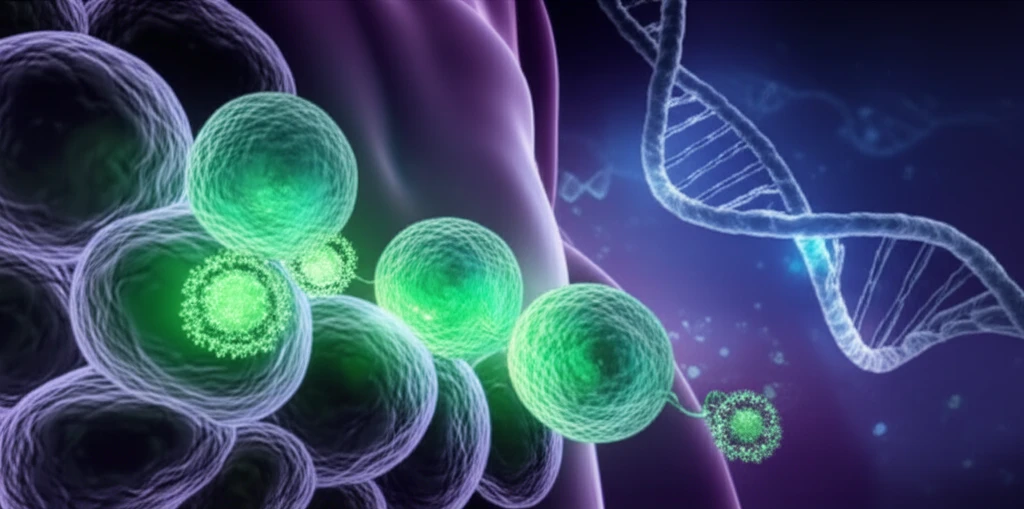
Immune cells attacking ovarian cancer cells, with DNA strands in background.

Can Gene Therapy and Immune Cells Team Up to Beat Ovarian Cancer?

"Combining the power of gene therapy with the precision of immune cells shows promise in targeting ovarian cancer."


Ovarian cancer remains a significant challenge in women's health, often diagnosed at advanced stages when treatment options are limited. Traditional cancer therapies, such as chemotherapy and radiation, can be effective but also come with harsh side effects and may not always prevent recurrence. This has driven researchers to explore more targeted and innovative approaches, including gene therapy.

Gene therapy holds immense potential for cancer treatment by modifying the genetic material of cells to fight the disease. One promising strategy involves using gene therapy to enhance the body's natural ability to fight cancer: the immune system. The Fas cell surface death receptor (Fas)/Fas ligand pathway is one of the primary pathways responsible for the regulation of cell apoptosis.

Recent research investigates a combined approach: using gene therapy to make ovarian cancer cells more susceptible to killing by immune cells. This involves delivering a specific gene, Fas, into cancer cells, which then increases their vulnerability to immune attack. By arming the immune system with the tools it needs to recognize and eliminate cancer cells, this approach holds the potential for more effective and less toxic cancer treatments.

How Does This Combined Therapy Work?

Immune cells attacking ovarian cancer cells, with DNA strands in background.

The study focuses on enhancing the expression of the Fas gene in ovarian cancer cells to make them more susceptible to immune cell-mediated killing. To achieve this, researchers used a combination of a tumor-specific promoter (hTERT) and a two-step transcriptional amplification system (TSTA) to ensure that the Fas gene was efficiently and selectively expressed in ovarian cancer cells. The hTERT promoter is only activated in ovarian cancer cells exhibiting high telomerase activity, and therefore is a good candidate TSP for gene therapy to treat ovarian cancer.

Here's a breakdown of the key components and steps involved:

  • Tumor-Specific Promoter (hTERT): This promoter ensures that the Fas gene is primarily activated in ovarian cancer cells, minimizing the risk of affecting healthy tissues.
  • Two-Step Transcriptional Amplification System (TSTA): This system boosts the expression of the Fas gene, ensuring that cancer cells produce enough of the Fas protein to become vulnerable.
  • Adenovirus Delivery: The Fas gene, along with the hTERT promoter and TSTA system, is delivered into ovarian cancer cells using an adenovirus vector.
  • Immune Cell Activation: Gamma delta (γδ) T cells, a type of immune cell known for their ability to recognize and kill cancer cells, are then introduced to target the ovarian cancer cells with high Fas expression.
Researchers found that the hTERT promoter effectively induced the specific expression of the FAS gene in SKOV3 cells, and the TSTA strategy increased FAS expression significantly. The killing effect of γδT cells increased with the expression level of Fas and the effector-target cell ratio. The regulators of hTERT promoter and TSTA assure the efficient and targeted expression of their downstream Fas gene in SKOV3 cells. The killing effect of γδT cells for ovarian cancer cells with relatively high Fas expression was improved.

What Does This Mean for Ovarian Cancer Treatment?

This research offers a promising step forward in the fight against ovarian cancer. By combining gene therapy with immunotherapy, researchers are developing more targeted and effective ways to eliminate cancer cells while minimizing harm to healthy tissues. The use of tumor-specific promoters and amplification systems ensures that the therapeutic gene is expressed primarily in cancer cells, reducing the risk of side effects.

While this research is still in its early stages, the results are encouraging. The ability to enhance the expression of the Fas gene in ovarian cancer cells and increase their susceptibility to immune cell-mediated killing opens up new avenues for treatment development.

Further studies are needed to fully evaluate the safety and efficacy of this combined therapy approach in clinical trials. However, the potential benefits for patients with ovarian cancer are significant, offering hope for more effective and less toxic treatment options in the future. This research highlights the importance of continued innovation in cancer therapy and the potential of combining different approaches to achieve better outcomes.

About this Article -

This article was crafted using a human-AI hybrid and collaborative approach. AI assisted our team with initial drafting, research insights, identifying key questions, and image generation. Our human editors guided topic selection, defined the angle, structured the content, ensured factual accuracy and relevance, refined the tone, and conducted thorough editing to deliver helpful, high-quality information.See our About page for more information.

This article is based on research published under:

DOI-LINK: 10.3892/mmr.2017.7107, Alternate LINK

Title: Gene Therapy For Human Ovarian Cancer Cells Using Efficient Expression Of Fas Gene Combined With Γδt Cells

Subject: Cancer Research

Journal: Molecular Medicine Reports

Publisher: Spandidos Publications

Authors: Jiajing Lin, Dingyuan Zeng, Hongying He, Guangping Tan, Ying Lan, Fuyan Jiang, Shuting Sheng

Published: 2017-07-27

Everything You Need To Know

1

How does combining gene therapy and immune cells work to target ovarian cancer?

The combined therapy uses gene therapy to enhance the expression of the Fas gene in ovarian cancer cells. This makes them more susceptible to being killed by immune cells. Researchers use a tumor-specific promoter called hTERT and a two-step transcriptional amplification system (TSTA) to selectively express the Fas gene in ovarian cancer cells. An adenovirus vector delivers the Fas gene, along with the hTERT promoter and TSTA system, into the ovarian cancer cells. Then, gamma delta (γδ) T cells, which are immune cells, target and kill the ovarian cancer cells with high Fas expression.

2

How does this research leverage the Fas cell surface death receptor pathway to combat ovarian cancer, and what are the implications?

This research enhances the Fas cell surface death receptor (Fas)/Fas ligand pathway to induce apoptosis. By using the hTERT promoter and the TSTA system, the Fas gene is selectively expressed in ovarian cancer cells, increasing their vulnerability to immune attack. This promotes more effective and less toxic cancer treatments by minimizing harm to healthy tissues and is achieved through the tumor-specific targeting and gene amplification strategies.

3

What roles do the hTERT promoter and the two-step transcriptional amplification system (TSTA) play in this combined therapy?

The hTERT promoter ensures that the Fas gene is primarily activated in ovarian cancer cells, minimizing the risk of affecting healthy tissues. It is activated in ovarian cancer cells exhibiting high telomerase activity. The two-step transcriptional amplification system (TSTA) boosts the expression of the Fas gene, ensuring that cancer cells produce enough of the Fas protein to become vulnerable to immune cell-mediated killing.

4

What are gamma delta (γδ) T cells, and how are they used in this ovarian cancer treatment approach?

Gamma delta (γδ) T cells are a type of immune cell known for their ability to recognize and kill cancer cells. In this research, they are introduced to target ovarian cancer cells with high Fas expression, which have been made more vulnerable through gene therapy. This leverages the immune system's natural ability to fight cancer, offering a targeted approach to eliminate cancer cells.

5

What is the significance of using adenovirus delivery in this gene therapy approach for ovarian cancer?

Adenovirus delivery is used to introduce the Fas gene, along with the hTERT promoter and TSTA system, into ovarian cancer cells. The adenovirus acts as a vector to transport the genetic material into the cancer cells, enabling the expression of the Fas gene and making the cells more susceptible to immune attack. This is a crucial step in ensuring that the gene therapy reaches its target effectively.

Newsletter Subscribe

Subscribe to get the latest articles and insights directly in your inbox.