
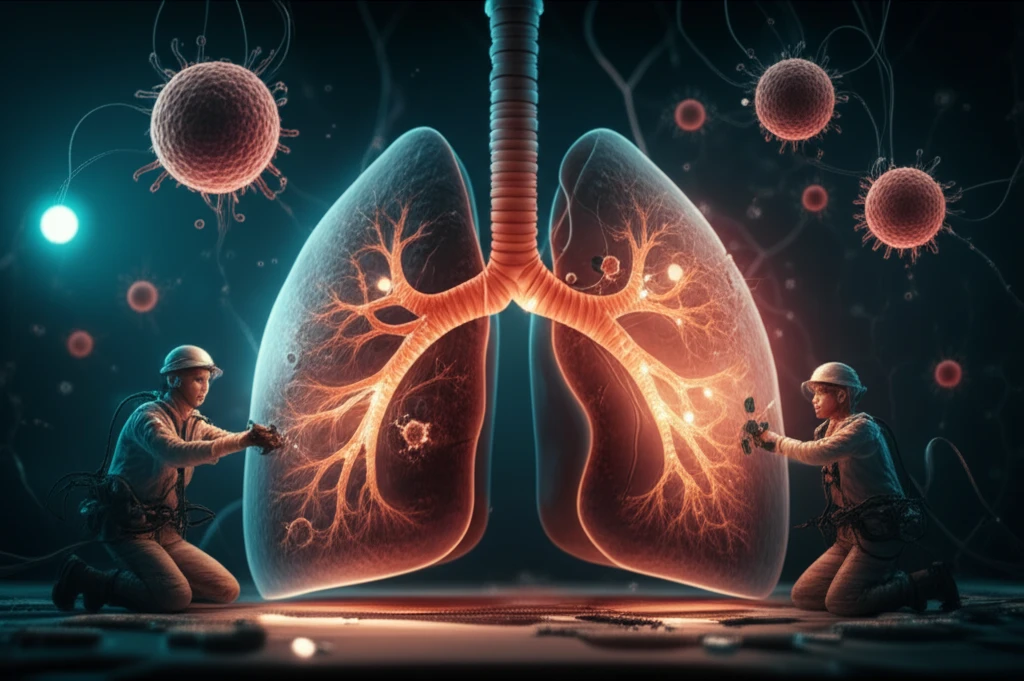
Can Endothelial Progenitor Cells Rescue Damaged Lungs?

"Exploring new frontiers in acute lung injury treatment."
Acute lung injury (ALI) remains a critical healthcare challenge, spurring the search for innovative treatments. Among these, endothelial progenitor cells (EPCs) have emerged as promising therapeutic agents. First identified in 1997, these cells offer potential in treating various diseases, including ALI, by aiding in tissue repair and reducing inflammation.
EPCs, derived from bone marrow, are characterized as CD34+/VEGFR2+/CD133+ cells. Their primary function involves repairing damaged vascular endothelium and promoting new blood vessel formation. This is achieved through direct differentiation into endothelial cells and the release of paracrine signals, such as vascular endothelial growth factor (VEGF) and stromal derived factor-1 (SDF-1).
Additionally, EPCs play a crucial role in modulating inflammatory responses by suppressing interleukin-1 beta (IL-1β), tumor necrosis factor-alpha (TNF-α), toll-like receptor 4, and IL-6. Recent studies have also highlighted the role of EPC-produced exosomes, containing microRNA (like miR-126), in alleviating lung injury. These findings suggest EPCs could offer a novel approach to managing lung inflammation and damage.
How EPCs Could Combat Respiratory Distress
Acute respiratory distress syndrome (ARDS) arises from widespread lung injury, leading to respiratory failure. Characterized by neutrophil influx and subsequent pro-inflammatory cascades, ARDS results in significant epithelial and endothelial damage. Despite medical advances, ARDS mortality remains high, underscoring the need for more effective treatments.
- EPCs in Focus: While MSCs show promise, EPCs also hold significant potential. They remain attractive as possible therapeutic agents for ARDS and sepsis, backed by supportive data from mouse models.
- Survival Link: Intriguingly, circulating EPC levels correlate with survival rates in ARDS patients, suggesting their therapeutic relevance.
- Journal Insights: A study by Mao et al. explores how EPCs protect against endotoxin-induced lung injury in mice, revealing their direct inhibitory effects on neutrophils.
The Future of EPCs in Lung Injury Treatment
While research indicates EPCs can attenuate lung injury by reducing inflammation and tissue damage, questions remain regarding their precise mechanisms of action. Specifically, whether these effects are mediated through paracrine signaling or direct cell-cell interaction needs further exploration.
The current research focuses on systemic endotoxin-induced lung injury without infection. Future studies should assess EPC effects in models that mimic clinical sepsis more closely, including bacterial infections and direct airway endotoxin administration. Understanding EPCs' effects on neutrophils and other inflammatory pathways is crucial for advancing their therapeutic application.
In summary, EPCs show promise for treating ARDS, potentially by leveraging their anti-inflammatory properties. Despite encouraging pre-clinical results, clinical trials are needed to confirm their efficacy in ARDS and sepsis. Further research elucidating how EPCs modulate neutrophil behavior in vitro and in vivo will pave the way for translating these findings into effective bedside treatments.